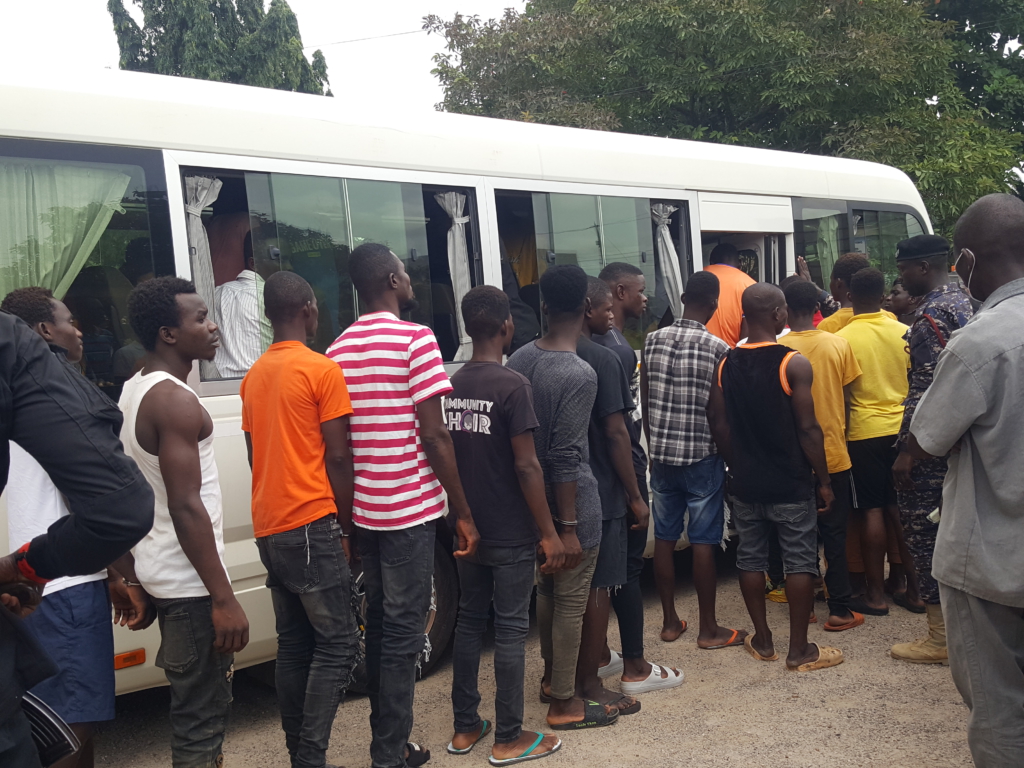
Fifty-one persons who allegedly attacked employees of Golden Star Wassa Limited (GSWL) and destroyed several properties belonging to the company have appeared before District Court B in Tarkwa.
The pleas of the accused persons who were arrested in batches have not been taken.
The prosecutor, Superintendent Juliana Essel-Dadzie, appealed to the court presided over by Justice Isaac Osei Asare to remand the accused persons for two weeks to enable them to complete their investigations that were underway.
She said considering the number of persons arrested so far, releasing anyone on bail would interfere with their investigation, adding that “we need more time to probe further into the case. This will help us deal solely with only those involved in the crime and free the innocent persons”.
The accused persons would be charged with conspiracy to commit crime and other offences, Superintendent Essel-Dadzie informed the court.
However, counsels for eight of the accused persons, Bright Baiden and Jacob Acquah-Sampson, prayed to the court to grant their clients bail.
“Our clients have been in police custody for a while and since they have intelligent and competent officers, they should have completed their investigation. Our clients provide the income that their respective families to live and life is becoming unbearable for them,” they pleaded to the court.
After hearing both parties, Justice Isaac Osei Asare said he would rule on the bail application on Friday, April 14, 2023.
The court also remanded all the accused persons into prison custody to re-appear on the same date.
Meanwhile, the Group Corporate Affairs Manager of GSWL, Mr Gerard Boakye who was present in court with some employees after the proceedings, told the Ghana News Agency (GNA) that, “we have not gotten into the case yet mainly because the police requested for more time to engage the suspects because the first set of suspects they arrested paved the way to apprehend more, so I think all is in line with making sure that people are not wrongful judged”.
“We have no problem with the proceedings because we are a law-abiding company, we also believe in human rights of people, we work and fight for that, so we are not disturbed that the law will take its course,” he added.
On Thursday, March 16, 2023, some illegal miners from Subriso in the Tarkwa-Nsuaem Municipality of the Western Region attacked employees of GSWL over illegal mining activities at one of the company’s concessions.
The illegal miners injured some employees, smashed the windscreens of 22 dumper trucks, set ablaze 12 vehicles which included excavators, ambulances, land cruisers, pick-ups and part of the administrative block of the company.
<img src="https://www.mtlblog.com/media-library/a-tim-hortons-maple-leaf-logo-in-huntsville-ontario.jpg?id=56227630&width=1200&height=600&coordinates=0%2C12%2C0%2C12"/><br/><br/><p> As a <a href="https://www.mtlblog.com/canada-trump-trudeau-tariffs" target="_blank">potential trade war between Canada and the United States</a> looms, many Canadians are flexing their buying power to <a href="https://www.mtlblog.com/made-in-canada-grocery-items" target="_blank">support homegrown businesses</a> while steering clear of American brands.
</p><p> Luckily, coffee is one thing most people don't have to think twice about. After all, Tim Hortons has thousands of locations across the country and proudly slaps maple leaves on all its branding.
</p><p> But despite it being embedded into our cultural identity, Tim Hortons might not be as Canadian as you think.
</p><p> The chain started as a small donut shop founded by an Ontario-born hockey player over 60 years ago, but its ownership evolution and current operations tell a more complicated story.</p><p>
<a href="https://www.forbes.com/companies/tim-hortons/" target="_blank">Forbes</a> describes Tim Hortons as a "North American restaurant chain" with more than 5,700 system-wide restaurants in Canada, the United States and worldwide. For context, there are 659 Tim Hortons restaurants in the United States, <a href="https://www.scrapehero.com/location-reports/Tim%20Hortons-USA/">according to data service provider ScrapeHero</a>, and over 4,000 in Canada.
</p><p> So yes, the brand's footprint is undeniably largest in Canada. But who's calling the shots — and where are the profits going?
</p><h2>Who really owns Tim Hortons?</h2><blockquote class="instagram-media" data-instgrm-permalink="https://www.instagram.com/p/CNGO-F3pRti/" data-instgrm-version="4" style="background:#FFF; border:0; border-radius:3px; box-shadow:0 0 1px 0 rgba(0,0,0,0.5),0 1px 10px 0 rgba(0,0,0,0.15); margin: 1px; max-width:658px; padding:0; width:99.375%; width:-webkit-calc(100% - 2px); width:calc(100% - 2px);">
<div style="padding:8px;">
<div style="background:#F8F8F8; line-height:0; margin-top:40px; padding:50% 0; text-align:center; width:100%;">
<div style="background:url(data:image/png;base64,iVBORw0KGgoAAAANSUhEUgAAACwAAAAsCAMAAAApWqozAAAAGFBMVEUiIiI9PT0eHh4gIB4hIBkcHBwcHBwcHBydr+JQAAAACHRSTlMABA4YHyQsM5jtaMwAAADfSURBVDjL7ZVBEgMhCAQBAf//42xcNbpAqakcM0ftUmFAAIBE81IqBJdS3lS6zs3bIpB9WED3YYXFPmHRfT8sgyrCP1x8uEUxLMzNWElFOYCV6mHWWwMzdPEKHlhLw7NWJqkHc4uIZphavDzA2JPzUDsBZziNae2S6owH8xPmX8G7zzgKEOPUoYHvGz1TBCxMkd3kwNVbU0gKHkx+iZILf77IofhrY1nYFnB/lQPb79drWOyJVa/DAvg9B/rLB4cC+Nqgdz/TvBbBnr6GBReqn/nRmDgaQEej7WhonozjF+Y2I/fZou/qAAAAAElFTkSuQmCC); display:block; height:44px; margin:0 auto -44px; position:relative; top:-22px; width:44px;">
</div>
</div>
<p style=" margin:8px 0 0 0; padding:0 4px;">
<a href="https://www.instagram.com/p/CNGO-F3pRti/" style=" color:#000; font-family:Arial,sans-serif; font-size:14px; font-style:normal; font-weight:normal; line-height:17px; text-decoration:none; word-wrap:break-word;" target="_top">See on Instagram</a>
</p>
</div>
</blockquote><script async="" defer="" src="//platform.instagram.com/en_US/embeds.js"></script><p> For most of the past six decades, Tim Hortons has been a Canadian company headquartered in Ontario and traded on the Toronto Stock Exchange.
</p><p> Over the years, the coffee franchise has changed hands. <a href="https://www.wendys.com/en-ca/wendys-story">Wendy's bought it in 1995</a> before divesting in 2006.</p><p> In 2014, Tim Hortons merged with Burger King to form a new parent company: <a href="https://www.rbi.com/English/brands/default.aspx" target="_blank">Restaurant Brands International (RBI)</a>. The deal was backed by 3G Capital, a Brazilian-American investment firm, which took a 51% majority stake, <a href="https://www.bbc.co.uk/news/business-28939538">according to BBC News</a>. Tim Hortons' existing shareholders kept 22%, while Burger King's got 27%.
</p><p> As part of the merger, Burger King's CEO, Daniel Schwartz, <a href="https://www.businesswire.com/news/home/20141212005684/en/Restaurant-Brands-International-Announces-Successful-Completion-of-Tim-Hortons-and-Burger-King-Transaction">took over as CEO of RBI,</a> while Tim Hortons' then-CEO Marc Caira moved into a vice-chairman role. The newly formed RBI was headquartered in Oakville, Ontario, and began trading on both the Toronto and New York stock exchanges.
</p><p> Fast forward to today, and RBI has become a global fast-food powerhouse, also controlling chains like Popeyes and Firehouse Subs. The company's headquarters are in Toronto, but 3G Capital remains the biggest player with <a href="https://www.theglobeandmail.com/business/article-3g-capital-selling-3-billion-shares-in-tim-hortons-owner/">a 32% stake</a>, meaning major decisions are influenced from beyond Canada's borders.</p><p> As for its staple product, Tim Hortons sources its coffee from small farmers in growing regions like Colombia and Guatemala, according to its <a href="https://www.timhortons.com/our-coffee-story" target="_blank">website</a>. But that's one thing "buy Canadian" advocates can't hold against them — after all, coffee is not generally grown in Canada.</p><h2>What Tim Hortons had to say</h2><blockquote class="instagram-media" data-instgrm-permalink="https://www.instagram.com/p/DFqd71Zp3Px/?img_index=1" data-instgrm-version="4" style="background:#FFF; border:0; border-radius:3px; box-shadow:0 0 1px 0 rgba(0,0,0,0.5),0 1px 10px 0 rgba(0,0,0,0.15); margin: 1px; max-width:658px; padding:0; width:99.375%; width:-webkit-calc(100% - 2px); width:calc(100% - 2px);">
<div style="padding:8px;">
<div style="background:#F8F8F8; line-height:0; margin-top:40px; padding:50% 0; text-align:center; width:100%;">
<div style="background:url(data:image/png;base64,iVBORw0KGgoAAAANSUhEUgAAACwAAAAsCAMAAAApWqozAAAAGFBMVEUiIiI9PT0eHh4gIB4hIBkcHBwcHBwcHBydr+JQAAAACHRSTlMABA4YHyQsM5jtaMwAAADfSURBVDjL7ZVBEgMhCAQBAf//42xcNbpAqakcM0ftUmFAAIBE81IqBJdS3lS6zs3bIpB9WED3YYXFPmHRfT8sgyrCP1x8uEUxLMzNWElFOYCV6mHWWwMzdPEKHlhLw7NWJqkHc4uIZphavDzA2JPzUDsBZziNae2S6owH8xPmX8G7zzgKEOPUoYHvGz1TBCxMkd3kwNVbU0gKHkx+iZILf77IofhrY1nYFnB/lQPb79drWOyJVa/DAvg9B/rLB4cC+Nqgdz/TvBbBnr6GBReqn/nRmDgaQEej7WhonozjF+Y2I/fZou/qAAAAAElFTkSuQmCC); display:block; height:44px; margin:0 auto -44px; position:relative; top:-22px; width:44px;">
</div>
</div>
<p style=" margin:8px 0 0 0; padding:0 4px;">
<a href="https://www.instagram.com/p/DFqd71Zp3Px/?img_index=1" style=" color:#000; font-family:Arial,sans-serif; font-size:14px; font-style:normal; font-weight:normal; line-height:17px; text-decoration:none; word-wrap:break-word;" target="_top">See on Instagram</a>
</p>
</div>
</blockquote><script async="" defer="" src="//platform.instagram.com/en_US/embeds.js"></script><p> MTL Blog reached out to Tim Hortons and RBI for clarification on the company's current ownership and operations. A Tim Hortons spokesperson responded, emphasizing the brand's Canadian identity.</p><p> "There's been some debate about what makes a company truly Canadian, so let's set the record straight — Tim Hortons is Canadian. Period. We wear the maple leaf proudly, and our roots, investments, and impact across this country are undeniable."
</p><p> They highlighted several key points to make their case:
</p><ul>
<li><strong>Corporate headquarters</strong> — Tim Hortons' main office is in downtown Toronto, employing over 400 Canadians.</li>
<li><span></span><strong>Canadian operations</strong> — The flagship coffee roastery is in Ancaster, Ontario, with over $150 million invested in five large distribution centres and three manufacturing plants across the country.</li>
<li><span></span><strong>Franchise ownership</strong> — Approximately 1,500 Canadian small business owners operate the over 4,000 Tim Hortons locations in Canada, employing over 100,000 people.</li>
<li><strong>Community investment</strong> — In 2024, the company raised $44.1 million for charitable causes in Canada, including Smile Cookie, Camp Day and the Special Olympics Donut campaign.</li>
</ul><p>"Yes, we're part of Restaurant Brands International (RBI), a global company, but RBI has a global office in Canada, by choice, and its foundation is built on the success and legacy of Tim Hortons," the representative told us.<br/></p><h2>Canadian enough?</h2><p> If a Canadian beer company brews its product here but packages it in the United States, is it still Canadian? Most people would argue that it is. But what about a coffee chain that was founded in Canada, still operates here, yet is largely controlled by a foreign investment firm?
</p><p>According to Karl Moore, an associate professor of strategy and organization at McGill University, the reality is simple. </p><p>"If you're owned by Americans, you're no longer Canadian in the way that you were before. There is a change, and it's a fact," Moore said in an interview with MTL Blog.</p><p>But ownership is just one piece of the puzzle. Moore, who also hosts a <a href="https://www.newstalk1010.com/shows/the-ceo-series.html" target="_blank">weekly radio show interviewing some of the world's top CEOs</a>, argues that what truly defines a company's nationality isn't just where its headquarters are — it's who's making the decisions.</p><p>"You might have foreign owners, so the profits may be going out of the country, but at one level, it doesn't really matter that much," he explained. "It's where the decision-making is made and who makes the decisions that is the central concern."</p><p>As a result, Tim Hortons' branding could shift as its ownership influences evolve.<br/></p><p>"The positioning is Canadian in Canada and other parts of the world, but that may not be as useful in the U.S. That may evolve over time as they open more stores," Moore notes. </p><p>At the moment, Tim Hortons still <em>feels</em> Canadian. Its history is wrapped in maple leaves and hockey sticks, many of its franchises are run by local owners, and its presence is woven into Canadian daily life. But behind the scenes, things are not so red and white. </p><p> Whether that makes it truly Canadian depends on what you think matters more — the Timbit in your hand or the boardroom pulling the strings.</p><em>This interview has been condensed and edited for clarity.</em>