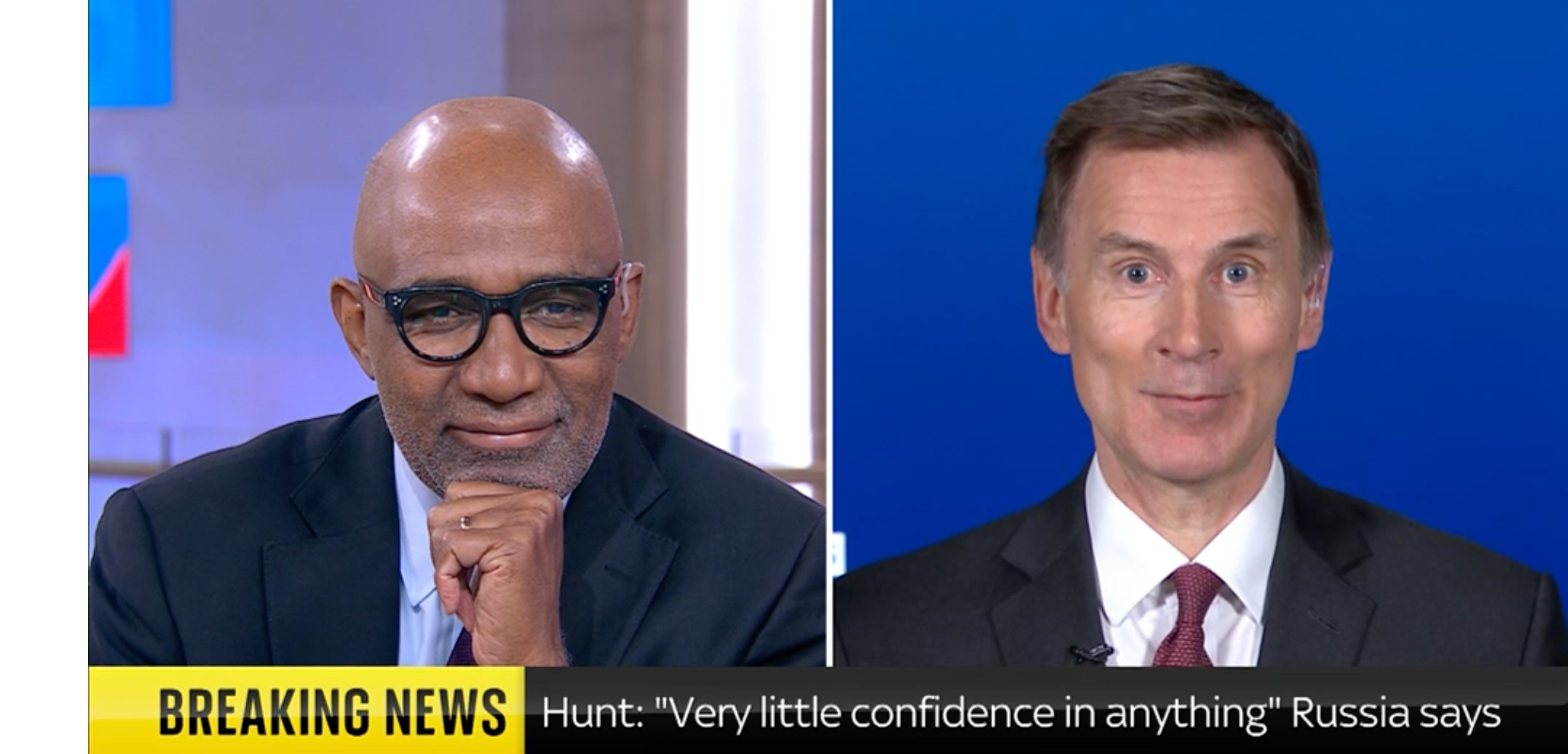
The presenter of Sunday with Laura Kuenssberg then pointed out that private rents are up 9% since 2023, council tax for band D up 5.1% since 2023 and petrol prices up 2.3p since January 2024.
After reminding Hunt of these incidents, she asked: “Isn’t there a danger that actually you sound like you’re in a parallel universe?”
Hunt said he was talking to one of his own constituents about paying for childcare in an area where the house prices are averaging around £670,000.
But, the BBC journalist noted: “In your own area, in Surrey, the average full time wage is not even half of that. It’s £42,000.
“So, don’t you think, to many people hearing that, it just sounds completely out of touch?”
Hunt said: “Well, I was talking to one of my own constituents who was saying that, but I do accept that even those people on those higher salaries do feel under pressure.”
He said for the national average salary – those on £35,000 – he reduced their National Insurance contributions, while those on National Living Wage have seen an increase.
Actually, due to fiscal drag – where tax thresholds do not change in line with inflation and rising wages – people will be paying more in tax.
The chancellor pointed out the Office for Budget Responsibility says we are going to recover to pre-pandemic living standards “two years earlier than previously thought”, saying the “plan was starting to bear fruit”.
Hunt admitted, “we’ve had a very very tough patch,” but blamed the invasion of Ukraine for driving up energy prices and the Covid pandemic.
He continued: “I think people will welcome the fact that inflation has fallen – but we’re not there yet.
“We need to stick to the course because we need inflation to get down to 2%.
“The thing that will make the biggest difference for families up and down the country is when interest rates falls, and the mortgage rate starts to fall.”
<img src="https://api.follow.it/track-rss-story-loaded/v1/IfVLmgUA43nDD4jzaWTdGXn9ye8UNv30" border=0 width="1" height="1" alt="The application of the "continuing violations” doctrine beyond "hostile workplace” claims" title="The application of the "continuing violations” doctrine beyond "hostile workplace” claims"> <p><em>The Relist Watch column examines cert petitions that the Supreme Court has “relisted” for its upcoming conference. A short explanation of relists is available </em><a href="https://www.scotusblog.com/faqs-announcements-of-orders-and-opinions/#relists_explained"><em>here</em></a><em>.</em></p> <p>The Supreme Court continues its recent streak of “promoting” relists to granted cases, as the court granted review in <a href="https://www.scotusblog.com/case-files/cases/the-hain-celestial-group-inc-v-palmquist/"><em>The Hain Celestial Group, Inc. v. Palmquist</em></a>, a lawsuit by parents seeking to hold a baby-food producer responsible for their child’s autism. The justices agreed to decide whether a federal district court’s final judgment in favor of the producer must be completely thrown out when the case is sent back to the state court because the district court should not have dismissed another defendant, the grocery chain Whole Foods, from the case. </p> <span id="more-505605"></span> <p>The court declined to take up a second question presented in that case: whether a plaintiff may defeat diversity jurisdiction after the case is transferred to federal court by amending the complaint to add new factual allegations when the complaint at the time of removal did not state such a claim.</p> <p>Turning to new business: There are 95 petitions and applications scheduled for this week’s conference. The justices will be discussing just one of them for a second time: <a href="https://www.scotusblog.com/cases/case-files/nicholson-v-w-l-york-inc-dba-cover-girls/"><em>Nicholson v. W.L. York, Inc. dba Cover Girls</em></a>, in which the justices have been asked to decide when the statute of limitations begins to run on a claim of a “pattern or practice” of racial discrimination.</p> <p>Chanel Nicholson, an African-American dancer, sued several Houston-area clubs under <a href="https://www.law.cornell.edu/uscode/text/42/1981">42 U.S.C. § 1981</a>, which prohibits racial discrimination in making and enforcing contracts. Nicholson alleged that the clubs maintained an explicit and continuing policy of limiting how many Black dancers could perform during any given shift. She says she was repeatedly denied work because of this quota, including in 2014, 2017, and most recently in 2021. </p> <p>In August 2021, Nicholson filed suit against the clubs, but the district court dismissed her case, concluding that <a href="https://www.law.cornell.edu/uscode/text/28/1658">the applicable four-year statute of limitations</a> began to run in 2014 and the claims were thus barred. The <a href="https://cases.justia.com/federal/appellate-courts/ca5/23-20440/23-20440-2024-03-04.pdf?ts=1709598617">U.S. Court of Appeals for the 5th Circuit affirmed</a> in a brief per curiam opinion. </p> <p>The 5th Circuit noted that in <em>National Railroad Passenger Corp. v. Morgan</em>, the Supreme Court recognized a “continuing violations doctrine” under which acts of discrimination were considered part of “one continuing violation,” such that an action would be timely if the last act were timely. But the 5th Circuit said that theory applied only to “hostile workplace” claims, which Nicholson had not pleaded. It concluded that “the act of discrimination that she alleges took place in 2021 … was merely a continuation of [the clubs’] original act of discrimination that she alleges took place in 2014, upon which the limitations period has already elapsed.”</p> <p>Nicholson filed <a href="https://www.supremecourt.gov/DocketPDF/23/23-7490/309933/20240516160644252_20240516-155948-00003433-00004809.pdf">her petition</a> pro se – by herself, as a layperson – but retained Supreme Court counsel in time to file her <a href="https://www.supremecourt.gov/DocketPDF/23/23-7490/355368/20250411133020649_23-7490--Nicholson%20-%20Cert%20Reply%2004-11%20rtf.pdf">reply brief</a>. She argues that the circuits are divided five to four on whether the continuing violations doctrine applies exclusively to hostile workplace claims, or whether it also applies to claims involving a pattern or practice of unlawful conduct. </p> <p>Opposing review, <a href="https://www.supremecourt.gov/DocketPDF/23/23-7490/337373/20250115144034230_2025.01.15%20-%20Respondent%20Brief%20in%20Opposition%20-%20Nicholson%20I.pdf">the clubs argue</a> that the 2021 incidents in which Nicholson alleges that she was denied entry or not hired were merely effects of the original alleged discriminatory acts, not new violations that reset the statute of limitations. And they argue that there is no genuine split among the courts of appeals justifying Supreme Court review. Rather, they say, the federal appeals courts uniformly apply the continuing violations doctrine only in hostile work environment cases, and not to revive time-barred discrete acts of discrimination.</p> <p>[Disclosure: I am among Nicholson’s counsel.] </p> <p>We should have a better idea soon whether the justices agree to hear Nicholson’s case in the fall. Until next time!</p> <h3 class="wp-block-heading" id="h-new-relists"><strong>New Relists</strong></h3> <p><a></a><a></a><a href="https://www.scotusblog.com/cases/case-files/nicholson-v-w-l-york-inc-dba-cover-girls/"><em>Nicholson v. W.L. York, Inc. dba Cover Girls</em></a>, <a href="https://www.supremecourt.gov/search.aspx?filename=/docket/docketfiles/html/public/23-7490.html">23-7490</a></p> <p><strong>Issue: </strong>Whether the continuing violations doctrine applies to claims premised on a pattern or practice of discrimination, or instead applies only in the context of hostile work environment claims.</p> <p>(Relisted after the April 25 conference.)</p> <h3 class="wp-block-heading"><strong>Returning Relists</strong></h3> <p><a href="https://www.scotusblog.com/case-files/cases/apache-stronghold-v-united-states/"><em>Apache Stronghold v. United States</em></a>, <a href="https://www.supremecourt.gov/search.aspx?filename=/docket/docketfiles/html/public/24-291.html">24-291</a></p> <p><strong>Issue</strong>: Whether the government “substantially burdens” religious exercise under the <a href="https://www.justice.gov/sites/default/files/jmd/legacy/2014/07/24/act-pl103-141.pdf">Religious Freedom Restoration Act</a>, or must satisfy heightened scrutiny under the free exercise clause of the First Amendment, when it singles out a sacred site for complete physical destruction, ending specific religious rituals forever.</p> <p>(Relisted after the Dec. 6, Dec. 13, Jan. 10, Jan. 17, Jan. 24, Feb. 21, Feb. 28, March 7, March 21, March 28, April 4, April 17 and April 25 conferences.)</p> <p><a href="https://www.scotusblog.com/case-files/cases/ocean-state-tactical-llc-v-rhode-island/"><em>Ocean State Tactical, LLC v. Rhode Island</em></a>, <a href="https://www.supremecourt.gov/search.aspx?filename=/docket/docketfiles/html/public/24-131.html">24-131</a></p> <p><strong>Issues: </strong>(1) Whether a retrospective and confiscatory ban on the possession of ammunition-feeding devices that are in common use violates the Second Amendment; and (2) whether a law dispossessing citizens without compensation of property that they lawfully acquired and long possessed without incident violates the takings clause of the Fifth Amendment.</p> <p>(Relisted after the Jan. 10, Jan. 17, Jan. 24, Feb. 21, Feb. 28, March 7, March 21, March 28, April 4, April 17 and April 25 conferences.)</p> <p><a href="https://www.scotusblog.com/case-files/cases/snope-v-brown/"><em>Snope v. Brown</em></a>, <a href="https://www.supremecourt.gov/search.aspx?filename=/docket/docketfiles/html/public/24-203.html">24-203</a></p> <p><strong>Issue:</strong> Whether the Constitution permits Maryland to ban semiautomatic rifles that are in common use for lawful purposes, including the most popular rifle in America.</p> <p>(Relisted after the Jan. 10, Jan. 17, Jan. 24, Feb. 21, Feb. 28, March 7, March 21, March 28, April 4, April 17 and April 25 conferences.)</p> <p><a href="https://www.scotusblog.com/case-files/cases/l-m-v-town-of-middleborough-massachusetts/"><em>L.M. v. Town of Middleborough, Massachusetts</em></a>, <a href="https://www.supremecourt.gov/search.aspx?filename=/docket/docketfiles/html/public/24-410.html">24-410</a></p> <p><strong>Issue</strong>: Whether school officials may presume substantial disruption or a violation of the rights of others from a student’s silent, passive, and untargeted ideological speech simply because that speech relates to matters of personal identity, even when the speech responds to the school’s opposing views, actions, or policies.</p> <p>(Relisted after the Feb. 21, Feb. 28, March 7, March 21, March 28, April 4, April 17 and April 25 conferences.)</p> <p><a href="https://www.scotusblog.com/case-files/cases/first-choice-womens-resource-centers-inc-v-platkin/"><em>First Choice Women’s Resource Centers, Inc. v. Platkin</em></a>, <a href="https://www.supremecourt.gov/search.aspx?filename=/docket/docketfiles/html/public/24-781.html">24-781</a></p> <p>Issue: Where the subject of a state investigatory demand has established a reasonably objective chill of its First Amendment rights, is a federal court in a first-filed action deprived of jurisdiction because those rights must be adjudicated in state court?</p> <p>(Relisted after the April 4, April 17 and April 25 conferences.)</p> <p><a href="https://www.scotusblog.com/case-files/cases/ghp-management-corporation-v-city-of-los-angeles-california/"><em>GHP Management Corp v. City of Los Angeles, California</em></a>, <a href="https://www.supremecourt.gov/search.aspx?filename=/docket/docketfiles/html/public/24-435.html">24-435</a></p> <p><strong>Issue</strong>: Whether an eviction moratorium depriving property owners of the fundamental right to exclude nonpaying tenants effects a physical taking.</p> <p>(Relisted after the April 17 and April 25 conferences.)</p>
<p>The post <a href="https://www.scotusblog.com/2025/05/the-application-of-the-continuing-violations-doctrine-beyond-hostile-workplace-claims/">The application of the “continuing violations” doctrine beyond “hostile workplace” claims</a> appeared first on <a href="https://www.scotusblog.com">SCOTUSblog</a>.</p>