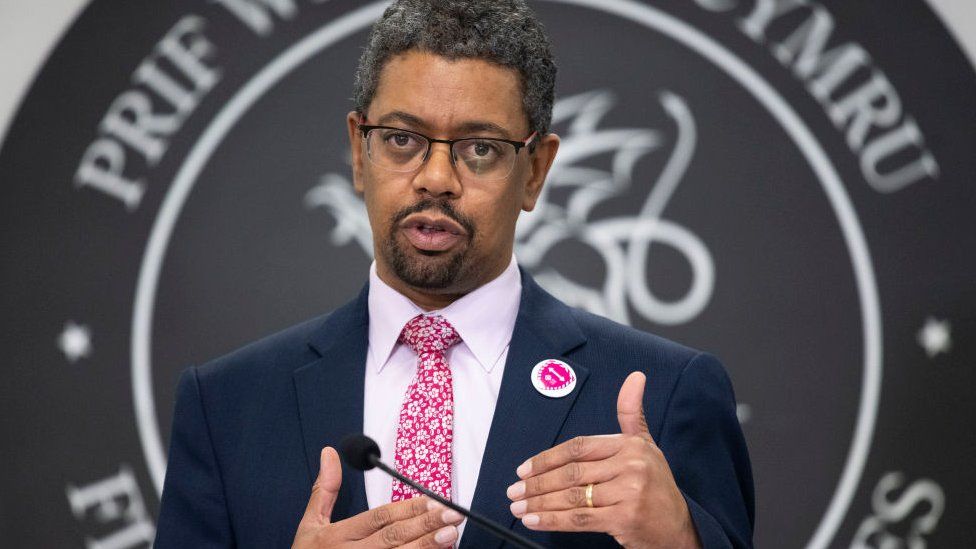

The Welsh Labour party elected Vaughan Gething as its new leader, making the 50-year-old politician the first Black head of government in Europe.
Gething will be confirmed as first minister next week, after a highly divisive leadership contest that pitted the former health and economy minister against Education Minister Jeremy Miles. The contest followed the surprise resignation of Mark Drakeford in December 2023.
Winning 51.7 percent of the vote on Saturday, the new leader promised to meet the deep challenges facing Wales, including a cost-of-living crisis, angry farmers and sluggish healthcare and education systems.
“Today, we turn a page in the book of our nation’s history. A history we write together. Not just because I have the honour of becoming the first Black leader in any European country — but because the generational dial has jumped too,” he told party members.
Born in the former British colony of Zambia, Gething is the son of a white veterinarian from south Wales and a Black chicken farmer from Lusaka. His parents moved the family to Wales when he was two and later settled in England after suffering racism in the Welsh countryside.
With Britain facing a general election this year, Gething will be an important player in the Labour Party’s bid to end 14 years of Conservative rule. “We look forward to campaigning with Vaughan in this new chapter for Wales, to deliver Labour governments across Britain,” wrote national party leader Keir Starmer on X.

<img src="https://api.follow.it/track-rss-story-loaded/v1/z2mWviCQXLJq5Bdi14Fb4Hn9ye8UNv30" border=0 width="1" height="1" alt="Split Supreme Court blocks first religious charter school in Oklahoma" title="Split Supreme Court blocks first religious charter school in Oklahoma"> <p>The Supreme Court on Thursday morning left in place a ruling by the Oklahoma Supreme Court rejecting an effort by a Catholic virtual charter school to become the country’s first religious charter school. In an unsigned one-sentence order, the justices indicated that, with Justice Amy Coney Barrett recused from the case, they had divided 4-4. The order did not indicate how any of the justices voted. That tie means the state supreme court’s opinion remains good law, although it is binding only in Oklahoma and does not have nationwide effect. </p> <span id="more-528745"></span> <p>Barrett did not state why she did not participate in the case. But the charter school was represented at the Supreme Court by the religious liberty clinic at Notre Dame’s law school, where Barrett taught for 15 years before becoming a federal judge and later a justice. And Nicole Stelle Garnett, who is a law professor at Notre Dame and a leading advocate for allowing the use of public funds at religious schools, is a close friend of Barrett’s. Barrett is godmother to one of Garnett’s children.</p> <p>The dispute began in 2023, when Oklahoma’s charter school board approved an application by the archdiocese of Oklahoma City and the diocese of Tulsa to create a virtual Catholic charter school, St. Isidore of Seville, named after the patron saint of the internet. The school was intended to be an explicitly religious one that would participate in “the evangelizing mission of the church.” The school’s contract with the charter school board specifically allowed the school to freely exercise its religious beliefs. </p> <p>Gentner Drummond, Oklahoma’s Republican attorney general, went to the state supreme court, asking it to invalidate the charter school board’s contract with St. Isidore. </p> <p>The state supreme court granted that request. Because St. Isidore is a public school, it concluded, state laws require it to be non-sectarian. That mandate, it added, is consistent with both the state and federal constitution, which bar the state from “using public money for the establishment of a religious institution.” </p> <p>The school and the charter school board came to the Supreme Court last fall, asking the justices to take up their case and reverse the state court’s ruling. </p> <p>Since 2017, the justices have sided with parents and religious institutions in three challenges to state policies that barred them from receiving education-related funds that were available for secular, but not religious, recipients. First, they ruled that <a href="https://www.scotusblog.com/2017/06/opinion-analysis-church-prevails-funding-dispute/">Missouri violated the Constitution</a> when it barred a church preschool from a state-run program to resurface its playground. In 2020, they ruled that <a href="https://www.scotusblog.com/cases/case-files/espinoza-v-montana-department-of-revenue/">Montana could not exclude religious schools</a> from a tax-credit program used to provide funding for children to attend private schools. And in 2022, <a href="https://www.scotusblog.com/2022/06/court-strikes-down-maines-ban-on-using-public-funds-at-religious-schools/">they invalidated a Maine policy</a> that allowed public funds to be used to pay tuition at non-sectarian schools but not at religious schools. </p> <p>At the April 30 oral argument, several of the justices – including, critically, Chief Justice John Roberts – suggested that the charter school case was different from the trio of cases in which the court had ruled against the state. Those cases, Roberts suggested, “involved fairly discrete state involvement,” while the state’s involvement in the operation of a Catholic virtual charter school would be “a much more comprehensive involvement.” </p> <p>The justices also seemed concerned about what the impact of a ruling either for or against the state might be. On the one hand, Justice Elena Kagan warned, a ruling for the charter school board might require a state to approve a religious school whose curriculum bears little resemblance to a traditional public school. </p> <p>On the other hand, Justice Brett Kavanaugh expressed concern that upholding the Oklahoma Supreme Court’s opinion could mean that other faith-based services, like Catholic Social Services or Catholic Charities, would also be deemed “government entities” that are unable to exercise their religion. </p> <p>After more than two hours of debate last month, the justices appeared divided. Thursday’s order confirmed that with Barrett not participating, they were unable to find five votes for either outcome. </p>
<p>The post <a href="https://www.scotusblog.com/2025/05/split-supreme-court-blocks-first-religious-charter-school-in-oklahoma/">Split Supreme Court blocks first religious charter school in Oklahoma</a> appeared first on <a href="https://www.scotusblog.com">SCOTUSblog</a>.</p>
Denmark’s Prime Minister Mette Frederiksen called Monday for Ukraine’s allies to greenlight the use of donated weapons for long-range strikes against Russia. “My suggestion is,…
Listen on Spotify Apple Music Google Play EN_Google_Podcasts_Badge Created with Sketch. Acast Amazon Music As war rages in the Middle East, host Jack Blanchard sits…