
Chennai, September 26: For the first time since 1978, in presidential elections in Sri Lanka, no candidate won more than 50% of the total votes in the first round of counting. Anura Kumara Dissanayake of the Janatha Vimukthi Peramuna (JVP), put up under the banner of the National People’s Power (NPP), obtained 42.31%. He was declared the winner after the second count, which tallied voters’ second and third choice candidates. This too was historic: no election in Sri Lanka has ever progressed to the second round of counting.
Table 1 shows overall % share of votes secured by major candidates in the 2019 and 2024 presidential elections
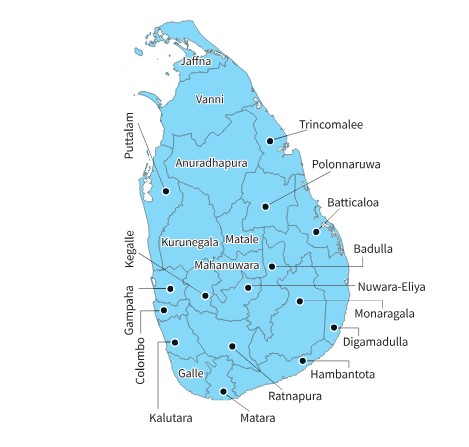
An analysis of the votes obtained in the first round of counting, excluding preferences, reveals that seven out of 22 electoral districts in the island nation — three each in the Western Province (Colombo, Gampaha, and Kalutara) and Southern Province (Galle, Matara, and Hambantota), and one in the North-Western Province (Kurunegala) — account for 57% of the vote share of Mr. Dissanayake.
Map shows the 22 electoral districts of Sri Lanka
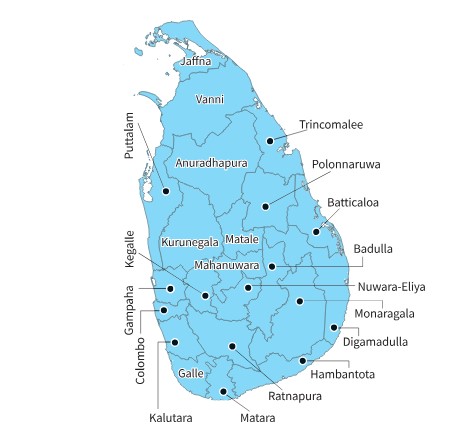
The 22 Electoral Districts
Coincidentally, in 2019, the collective share of the seven districts in the total votes of Mr. Dissanayake’s predecessor, Gotabaya Rajapaksa, was about 55%. The similarity does not stop there. As in the case of the former president five years ago, Mr. Dissanayake too got more than 50% of the votes in Gampaha and the three districts of the Southern Province. In these four districts, he exceeded the 50% mark, whereas Mr. Rajapaksa achieved this in 11 more districts. There is a difference of nearly 10 percentage points between the vote share that Mr. Dissanayake secured this time (42.31%) and what Mr. Rajapaksa secured in 2019 (52.25%). What is remarkable is that five years ago, Mr. Dissanayake got a vote share of merely 3.16%. He has clearly reaped the political dividends from the Janatha Aragalaya, which arose due to an economic crisis in 2022.
Table 2 shows the overall district-wise % share of votes secured by major candidates in the 2019 and 2024 presidential elections. Figures in %
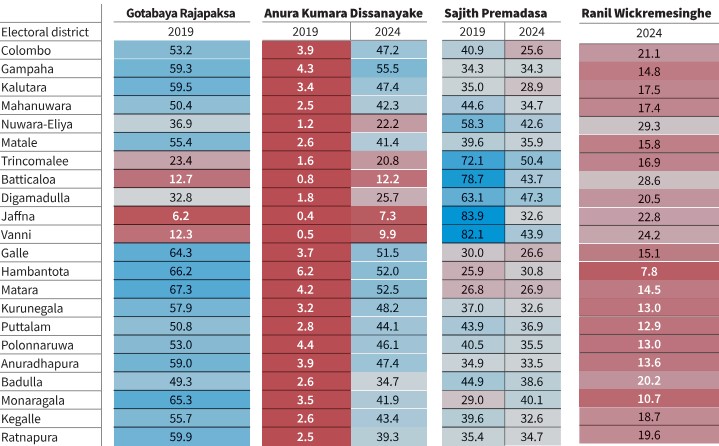
Comparative voting figures
Last election, of the about 4.18 lakh votes that Mr. Dissanayake received, the share of the seven districts was around 55%. The difference now is that the JVP-NPP has been able to spread its wings in every other district. In Matale in the Central Province, for instance, Mr. Dissanayake had received 2.6% of the votes in 2019; this rose to 41.37% in 2024. It was in Matale where several incidents of human rights violations were reported to have taken place in 1989 during the armed conflict between the Ranasinghe Premadasa-led United National Party (UNP) government and the JVP, which had organised an insurrections in 1971 and in 1987-89.
Even though Mr. Dissanayake lagged behind his immediate rival, Sajith Premadasa, of the Samagi Jana Balawegaya (SJB), in the districts with a substantial number of ethnic minorities, he improved his performance from 2019. In Digamadulla (Ampara) in the East, for instance, he did not get even 2% of the votes in 2019; this time, he secured more than 25%. Yet, the JVP chief could not secure an outright victory unlike his predecessors. The acceptability of his party remains an issue with a majority of voters of the country.
Mr. Sajith, who lost the presidential election for the second consecutive time, could have emerged the winner but for the presence of his one-time colleague in the UNP, former President Ranil Wickremesinghe, in the fray. Compared to 2019, Mr. Sajith’s vote share went down by about 10 points, to 32.8%, and Mr. Wickremesinghe, as an independent candidate, garnered around 17%. To make Mr. Sajith’s position more difficult, a ‘common Tamil candidate’, P. Ariyanethiran, who was supported by many parties and groups, secured about 2.26 lakh votes, two-thirds from Jaffna and Vanni districts in the North, and polled 1.7%. There was no such candidate last time.
May 27 (CNN) — Famed Portuguese footballer Cristiano Ronaldo, who has scored hundreds of goals in his career, invariably celebrates by running to the corner flag to perform his…
<img src="https://api.follow.it/track-rss-story-loaded/v1/2QEiaHJakWZinV0hmZTFmHn9ye8UNv30" border=0 width="1" height="1" alt="From police powers to pork: Supreme Court faces broad range of new relists" title="From police powers to pork: Supreme Court faces broad range of new relists"> <p><em>The Relist Watch column examines cert petitions that the Supreme Court has “relisted” for its upcoming conference. A short explanation of relists is available </em><a href="https://www.scotusblog.com/faqs-announcements-of-orders-and-opinions/#relists_explained"><em>here</em></a><em>.</em></p> <p>There are 102 petitions and applications on the Supreme Court’s docket for this week’s conference. After several months of relisting cases at a slow rate, the court has picked up the pace: There are six newly relisted cases this week covering a wide range of subjects.</p> <span id="more-528759"></span> <p><strong><em>Another commerce clause challenge to California’s Proposition 12</em></strong></p> <p>For the second time in as many years, the Supreme Court is once again considering a challenge to California’s Proposition 12, a voter-approved measure banning the in-state sale of pork from pigs confined in ways deemed cruel, such as cages denying them at least 24 square feet of space or the ability to turn around. </p> <p>In <a href="https://www.scotusblog.com/cases/case-files/iowa-pork-producers-association-v-bonta/"><em>Iowa Pork Producers Association v. Bonta</em></a>, pork producers argue that Proposition 12 violates the dormant commerce clause by discriminating against out-of-state pork producers, who they say had less “lead time” to comply than California farmers subject to an earlier law, Proposition 2. The U.S. Court of Appeals for the 9th Circuit dismissed the complaint, finding no plausible discrimination claim and ruling that the pork producers’ claim that the law imposed excessive burdens on interstate commerce under the balancing test of the 1970 case <a href="https://supreme.justia.com/cases/federal/us/397/137/"><em>Pike v. Bruce Church, Inc.</em></a> (which considers whether the effects on interstsate commerce are merely incidental) was foreclosed by the court’s fractured 2023 decision in <a href="https://www.scotusblog.com/cases/case-files/national-pork-producers-council-v-ross/"><em>National Pork Producers Council v. Ross</em></a>. That decision upheld Proposition 12 against a similar challenge to the current one, with a majority of the court rejecting an argument that the California law impermissibly had an extraterritorial effect on other states; five justices rejected a similar <em>Pike</em> claim, though in separate opinions and based on different rationales. </p> <p>That said, lower courts have had trouble determining what <em>Ross</em>’s governing rule is under <a href="https://supreme.justia.com/cases/federal/us/430/188/"><em>Marks v. United States</em></a>, the court’s leading precedent on how to interpret fractured holdings, which held that “[w]hen a fragmented Court decides a case and no single rationale explaining the result enjoys the assent of five Justices, the holding of the Court may be viewed as that position taken by those Members who concurred in the judgments on the narrowest grounds.”</p> <p>Iowa Pork Producers now seek review, arguing that their discrimination claim distinguishes this case from <em>Ross</em> and that the 9th Circuit misread <em>Ross</em>’s holding under <em>Marks</em>. The petition also raises due process, privileges and immunities, and preemption claims, though those are secondary to the dormant commerce clause challenge. California and several animal welfare groups that joined the case to defend the law counter that the discrimination claim is implausible, the <em>Pike</em> issue is settled by <em>Ross</em>, and the additional claims are not properly before the court. </p> <p>What’s got the court’s attention? The discrimination angle is the likely hook — Iowa Pork Producers insist that Proposition 12’s lead-time disparity gave California farmers a protectionist edge over those from other states. The 9th Circuit’s quick dismissal at the pleading stage might tempt the court to clarify whether such allegations deserve a fuller airing, especially given the dormant commerce clause’s core anti-discrimination principle between states. But the <em>Pike</em>claim, tied to <em>Ross</em>’s messy split, is a tougher sell; the court may hesitate to revisit that issue so soon, especially with no clear circuit split. The <em>Marks</em> issue — how to parse fractured rulings — adds some academic intrigue. People have wondered for years whether dissenting votes count towards the “holding” on an issue; here’s a <a href="https://volokh.com/2012/07/02/what-did-the-court-hold-about-the-commerce-clause-and-medicaid/">blog post</a> I wrote on the subject back in 2012. Given <em>Ross</em>’s relatively fresh vintage and the court’s reluctance to referee state morality-based legislation, this petition faces an uphill climb. For now, the pork industry — and SCOTUS watchers — will have to wait to see if <a href="https://m.media-amazon.com/images/I/51ksYVTbvGL._AC_UF894,1000_QL80_.jpg">this piggie goes to market or cries wee-wee-wee all the way home</a>.</p> <p><strong><em>Mootness and election law challenges</em></strong></p> <p>Voters supporting Buffalo Mayor <a href="https://en.wikipedia.org/wiki/Byron_Brown">Byron Brown</a>’s 2021 independent candidacy challenged New York’s <a href="https://www.nysenate.gov/legislation/laws/ELN/6-158">early filing deadline for independent candidate petitions</a>, which moved the deadline from August to May, preventing Brown’s name from appearing on the ballot after his Democratic primary loss. Incredibly, Brown won the mayoralty anyway as a write-in candidate, but later resigned to become CEO of a gambling firm. The U.S. Court of Appeals for the 2nd Circuit dismissed the challengers’ lawsuit as moot – that is, no longer a live controversy – after the election, concluding that the voters were required to make specific allegations that they would support a similar late-arising independent candidate in future elections. </p> <p>In <a href="https://www.scotusblog.com/cases/case-files/meadors-v-erie-county-board-of-elections/"><em>Meadors v. Erie County Board of Elections</em></a>, the challengers – represented by the University of Virginia’s Supreme Court Clinic – argue that the case comes within the exception for matters that are “capable of repetition yet evading review.” They contend the 2nd Circuit’s decision conflicts with the U.S. Court of Appeals for the 8th Circuit’s flexible approach, which presumes that recurrence is possible if the law still exists, and contravenes <a href="https://supreme.justia.com/cases/federal/us/460/780/">Supreme Court precedent</a>. The board of elections, while agreeing that the case isn’t moot (and characterizing the alleged split as “a slight difference of interpretation among the circuits”), now urges the court to deny review, citing the unpublished decision’s lack of precedential value, an alleged lack of voter injury, and it argues that the voters would likely lose if the court gets to the merits. </p> <p><strong><em>The breadth of the “compassionate release” statute</em></strong></p> <p>Two cases involve the scope of judicial discretion under the co-called “compassionate release statute,” <a href="https://www.law.cornell.edu/uscode/text/18/3582">18 U.S.C. § 3582(c)(1)(A)</a>, which permits a sentence reduction if the defendant requests it and the sentencing judge finds that “extraordinary and compelling reasons warrant such a reduction.” </p> <p>Joe Fernandez, serving a mandatory life sentence for the murder for hire of two Mexican drug cartel members, won a sentence reduction based on the district judge’s doubts about Fernandez’s guilt — stemming from the shakiness of a key witness’s testimony — and stark sentencing disparities with co-defendants who received sentences of two to 30 years. </p> <p>The 2nd Circuit reversed, holding that potential innocence claims must be made in petitions for habeas corpus under 28 U.S.C. § 2255, not through compassionate release claims, and that Fernandez’s disparity wasn’t “extraordinary and compelling” given his co-defendants’ plea deals.</p> <p>In <a href="https://www.scotusblog.com/cases/case-files/fernandez-v-united-states/"><em>Fernandez v. United States</em></a>, Fernandez argues the 2nd Circuit’s holding conflicts with the broader view of judicial discretion adopted by the U.S. Courts of Appeals for the 1st and 9th Circuits, as well as with Supreme Court precedents cautioning against placing extra-textual limits on factors judges can consider at sentencing. </p> <p>Similarly, Joel Elliott, serving a 444-month sentence for arson and a Section 924(c) firearm offense, sought a sentence reduction, arguing that his conviction wouldn’t qualify for a significant sentencing enhancement as a “crime of violence” under current law, and he also pointed to both the unusual severity of his sentence and to his rehabilitation. The U.S. Court of Appeals for the 10th Circuit denied him relief, concluding that circuit precedent foreclosed his claim. That court, like the 2nd Circuit in <em>Fernandez</em>, held that Elliott’s challenge to his Section 924(c) conviction was a “§ 2255-like” claim barred from consideration as an “extraordinary and compelling” reason for release. Elliott’s petition, in <a href="https://www.scotusblog.com/cases/case-files/elliott-v-united-states/"><em>Elliott v. United States</em></a>, alleges the same circuit split as in <em>Fernandez</em>.</p> <p>In both cases, the government insists any circuit split is overstated. Moreover, it notes that the U.S. Sentencing Commission has since amended the Sentencing Guidelines to expand the list of considerations that will support reductions, but even as amended does not permit reductions based on the factors cited by Fernandez and Elliott. It remains to be seen whether the justices will conclude that the Guidelines’ amendments moot this dispute, or whether the statute permits broader relief. Compassionate release watchers are holding their breath.</p> <p><strong><em>New “factual predicates” and habeas claims</em></strong></p> <p>Kayla Ayers was convicted of aggravated arson after a mattress caught fire in her father’s basement. At trial, Ohio’s fire inspector testified the blaze had two ignition points — suggesting intentional arson — and Ayers’s court-appointed lawyer never challenged his credentials or hired a competing expert. Years later, just before her release, Ayers obtained an expert report that declared the inspector’s methods “unscientific,” his logic “circular,” and his testimony “complete bunk.”</p> <p>Ayers then filed a federal habeas petition alleging ineffective assistance of counsel. Usually, a person in state custody has one year from the date on which the judgment became final to file a habeas petition, but the one-year clock restarts when a previously undiscoverable “factual predicate” “could have been discovered through the exercise of due diligence.” The question here: Did that expert report restart the Antiterrorism and Effective Death Penalty Act one-year limitations clock under Section 2244(d)(1)(D) as a newly discovered “factual predicate”?</p> <p>The U.S. Court of Appeals for the 6th Circuit said yes, reasoning that the expert’s report provided the “vital facts” necessary to satisfy the <a href="https://supreme.justia.com/cases/federal/us/466/668/#:~:text=Washington%2C%20466%20U.S.%20668%20(1984)&text=The%20appropriate%20standard%20for%20ineffective,led%20to%20a%20different%20outcome."><em>Strickland v. Washington</em></a> ineffectiveness standard and that Ayers couldn’t reasonably have discovered those facts earlier. </p> <p>In <a href="https://www.scotusblog.com/cases/case-files/chambers-smith-v-ayers/"><em>Chambers-Smith v. Ayers</em></a>, Ohio asks the justices to weigh in, arguing that eight circuits reject such expansive interpretations of Section 2244(d)(1)(D) and that allowing any “new support” of a known claim to restart the habeas clock effectively obliterates AEDPA’s time bar. </p> <p>Ayers denies that there’s a circuit split and says that this case just involves a fact-bound application of settled law. She also argues that the petition is jurisdictionally out of time, because the state did not file within 90 days after the 6th Circuit’s judgment — because that day fell on a weekend, it wound up filing on the 91st day. The state counters that due dates are automatically extended when the last day falls over a weekend. And it insists that the 6th Circuit’s approach diverges from cases from the U.S. Courts of Appeals for the 2nd, 3rd, and 5th Circuits that treat new expert opinions as supporting evidence, not a new predicate.</p> <p><strong><em>Warrantless entry to prevent a suicide</em></strong></p> <p>Trevor Case’s ex-girlfriend called police saying he had threatened suicide and might have a gun. Police officers entered his home without a warrant nearly 40 minutes later, even though they suspected Case might be attempting “suicide by cop.” Officers shot Case during the resulting chaos, and Case was charged and convicted of assaulting an officer. </p> <p>Case argued that the officer’s warrantless entry into his house violated the Fourth Amendment, so that the gun and other evidence should be suppressed. The Montana Supreme Court affirmed the denial of his motion to suppress in a 4–3 decision, adopting a standard that requires police have an “objectively reasonable belief” that there is an emergency before providing assistance — something substantially less than a showing of probable cause.</p> <p>In <a href="https://www.scotusblog.com/cases/case-files/case-v-montana/"><em>Case v. Montana</em></a>, Case argues that this “reasonable belief” standard improperly dilutes <a href="https://supreme.justia.com/cases/federal/us/547/398/"><em>Brigham City v. Stuart</em></a>, in which the court held that police may enter a home without a warrant when they have an “objectively reasonable” basis for believing that an occupant is seriously injured or imminently threatened with such injury. And he argues that the holding below conflicts with holdings from the U.S. Courts of Appeals for the 2nd, 11th, and District of Columbia Circuits, which require probable cause for warrantless home entry even under emergency-aid rationales. </p> <p>In a supporting brief, the Project for Privacy and Surveillance Accountability urge the Supreme Court to step in, warning that loosening the evidentiary standard here could greenlight broader incursions into digital and home privacy alike. </p> <p>Montana argues that the “objectively reasonable basis” test amounts to probable cause in practice, and that the split is more semantic than substantive. </p> <p>The court has not considered the circumstances when police may enter a home since 2021’s <a href="https://www.supremecourt.gov/opinions/20pdf/20-157_8mjp.pdf"><em>Caniglia v. Strom</em></a>, when Justice Brett Kavanaugh wrote separately to explain his belief that “police officers may enter a home without a warrant in circumstances where they are reasonably trying to prevent a potential suicide.” </p> <p>So the court has a lot to chew on at this week’s conference. Tune in Monday to find out whether they’ll be adding to the fall argument calendar. </p> <p><strong>New Relists</strong></p> <p><em><a href="https://www.scotusblog.com/cases/case-files/fernandez-v-united-states/">Fernandez v. United States</a></em>, <a href="https://www.supremecourt.gov/search.aspx?filename=/docket/docketfiles/html/public/24-556.html">24-556</a></p> <p><strong>Issue: </strong>Whether the U.S. Court of Appeals for the 2nd Circuit erred in recognizing extra-textual limitations on what information a court may consider when determining whether there exist extraordinary and compelling reasons warranting a sentence reduction under <a href="https://www.law.cornell.edu/uscode/text/18/3582">18 U.S.C. § 3582(c)(1)(A)</a>.</p> <p>(relisted after the May 15 conference.)</p> <p><a href="https://www.scotusblog.com/cases/case-files/chambers-smith-v-ayers/"><em>Chambers-Smith v. Ayers</em></a>, <a href="https://www.supremecourt.gov/search.aspx?filename=/docket/docketfiles/html/public/24-584.html">24-584</a></p> <p><strong>Issue: </strong>Whether, when a person in state custody obtains new support for a previously available claim, that means she has a new “factual predicate” that restarts her clock to file a habeas petition under <a href="https://www.law.cornell.edu/uscode/text/28/2244">28 U.S.C. §2244(d)(1)(D)</a>.</p> <p>(relisted after the May 15 conference.)</p> <p><a href="https://www.scotusblog.com/cases/case-files/case-v-montana/"><em>Case v. Montana</em></a>, <a href="https://www.supremecourt.gov/search.aspx?filename=/docket/docketfiles/html/public/24-624.html">24-624</a></p> <p><strong>Issue: </strong>Whether law enforcement may enter a home without a search warrant based on less than probable cause that an emergency is occurring, or whether the emergency-aid exception requires probable cause.</p> <p>(relisted after the May 15 conference.)</p> <p><a href="https://www.scotusblog.com/cases/case-files/meadors-v-erie-county-board-of-elections/"><em>Meadors v. Erie County Board of Elections</em></a>, <a href="https://www.supremecourt.gov/search.aspx?filename=/docket/docketfiles/html/public/24-684.html">24-684</a></p> <p><strong>Issue</strong>: Whether the “capable of repetition, yet evading review” doctrine requires plaintiffs in election law cases to predict and articulate specific plans for their own future electoral participation, or instead it is sufficient to show that the challenged law will continue to affect voters and candidates in future elections. </p> <p>(relisted after the May 15 conference.)</p> <p><a href="https://www.scotusblog.com/cases/case-files/iowa-pork-producers-association-v-bonta/"><em>Iowa Pork Producers Association v. Bonta</em></a>, <a href="https://www.supremecourt.gov/search.aspx?filename=/docket/docketfiles/html/public/24-728.html">24-728</a></p> <p><strong>Issues: </strong>(1) Whether a party alleging that California’s Proposition 12, “which enacts a pork sales ban to regulate the manner in which pigs are housed in states across the country,” discriminates against interstate commerce, both directly and under <a href="https://supreme.justia.com/cases/federal/us/397/137/"><em>Pike v. Bruce Church</em></a>, states a claim; and (2) whether lower federal courts evaluating fractured opinions from this court consider all justices’ opinions to determine the majority position on a legal issue, or instead are limited to consider only opinions concurring in the result.</p> <p>(relisted after the May 15 conference.)</p> <p><a href="https://www.scotusblog.com/cases/case-files/elliott-v-united-states/"><em>Elliott v. United States</em></a>, <a href="https://www.supremecourt.gov/search.aspx?filename=/docket/docketfiles/html/public/24-6126.html">24-6126</a></p> <p><strong>Issue: </strong>Whether a combination of “extraordinary and compelling reasons” that may warrant a discretionary sentence reduction under <a href="https://www.law.cornell.edu/uscode/text/18/3582">18 U.S.C. § 3582(c)(1)(A)</a> can include reasons that may also be alleged as grounds for vacatur of a sentence under <a href="https://www.law.cornell.edu/uscode/text/28/2255">28 U.S.C. § 2255</a>. </p> <p>(relisted after the May 15 conference.)</p> <p><strong>Returning Relists</strong></p> <p><a href="https://www.scotusblog.com/case-files/cases/apache-stronghold-v-united-states/"><em>Apache Stronghold v. United States</em></a>, <a href="https://www.supremecourt.gov/search.aspx?filename=/docket/docketfiles/html/public/24-291.html">24-291</a></p> <p><strong>Issue</strong>: Whether the government “substantially burdens” religious exercise under the <a href="https://www.justice.gov/sites/default/files/jmd/legacy/2014/07/24/act-pl103-141.pdf">Religious Freedom Restoration Act</a>, or must satisfy heightened scrutiny under the free exercise clause of the First Amendment, when it singles out a sacred site for complete physical destruction, ending specific religious rituals forever.</p> <p>(Relisted after the Dec. 6, Dec. 13, Jan. 10, Jan. 17, Jan. 24, Feb. 21, Feb. 28, March 7, March 21, March 28, April 4, April 17, April 25, May 2 and May 15 conferences.)</p> <p><a href="https://www.scotusblog.com/case-files/cases/ocean-state-tactical-llc-v-rhode-island/"><em>Ocean State Tactical, LLC v. Rhode Island</em></a>, <a href="https://www.supremecourt.gov/search.aspx?filename=/docket/docketfiles/html/public/24-131.html">24-131</a></p> <p><strong>Issues: </strong>(1) Whether a retrospective and confiscatory ban on the possession of ammunition-feeding devices that are in common use violates the Second Amendment; and (2) whether a law dispossessing citizens without compensation of property that they lawfully acquired and long possessed without incident violates the takings clause of the Fifth Amendment.</p> <p>(Relisted after the Jan. 10, Jan. 17, Jan. 24, Feb. 21, Feb. 28, March 7, March 21, March 28, April 4, April 17, April 25, May 2 and May 15 conferences.)</p> <p><a href="https://www.scotusblog.com/case-files/cases/snope-v-brown/"><em>Snope v. Brown</em></a>, <a href="https://www.supremecourt.gov/search.aspx?filename=/docket/docketfiles/html/public/24-203.html">24-203</a></p> <p><strong>Issue:</strong> Whether the Constitution permits Maryland to ban semiautomatic rifles that are in common use for lawful purposes, including the most popular rifle in America.</p> <p>(Relisted after the Jan. 10, Jan. 17, Jan. 24, Feb. 21, Feb. 28, March 7, March 21, March 28, April 4, April 17, April 25, May 2 and May 15 conferences.)</p> <p><a href="https://www.scotusblog.com/case-files/cases/l-m-v-town-of-middleborough-massachusetts/"><em>L.M. v. Town of Middleborough, Massachusetts</em></a>, <a href="https://www.supremecourt.gov/search.aspx?filename=/docket/docketfiles/html/public/24-410.html">24-410</a></p> <p><strong>Issue</strong>: Whether school officials may presume substantial disruption or a violation of the rights of others from a student’s silent, passive, and untargeted ideological speech simply because that speech relates to matters of personal identity, even when the speech responds to the school’s opposing views, actions, or policies.</p> <p>(Relisted after the Feb. 21, Feb. 28, March 7, March 21, March 28, April 4, April 17, April 25, May 2 and May 15 conferences.)</p> <p><a href="https://www.scotusblog.com/case-files/cases/first-choice-womens-resource-centers-inc-v-platkin/"><em>First Choice Women’s Resource Centers, Inc. v. Platkin</em></a>, <a href="https://www.supremecourt.gov/search.aspx?filename=/docket/docketfiles/html/public/24-781.html">24-781</a></p> <p>Issue: Where the subject of a state investigatory demand has established a reasonably objective chill of its First Amendment rights, is a federal court in a first-filed action deprived of jurisdiction because those rights must be adjudicated in state court?</p> <p>(Relisted after the April 4, April 17, April 25, May 2 and May 15 conferences.)</p> <p><a href="https://www.scotusblog.com/cases/case-files/ghp-management-corp-v-city-of-los-angeles-california/"><em>GHP Management Corp v. City of Los Angeles, California</em></a>, <a href="https://www.supremecourt.gov/search.aspx?filename=/docket/docketfiles/html/public/24-435.html">24-435</a></p> <p><strong>Issue</strong>: Whether an eviction moratorium depriving property owners of the fundamental right to exclude nonpaying tenants effects a physical taking.</p> <p>(Relisted after the April 17, April 25, May 2 and May 15 conferences.)</p> <p><a></a><a></a><a href="https://www.scotusblog.com/cases/case-files/nicholson-v-w-l-york-inc-dba-cover-girls/"><em>Nicholson v. W.L. York, Inc. dba Cover Girls</em></a>, <a href="https://www.supremecourt.gov/search.aspx?filename=/docket/docketfiles/html/public/23-7490.html">23-7490</a></p> <p><strong>Issue: </strong>Whether the continuing violations doctrine applies to claims premised on a pattern or practice of discrimination, or instead applies only in the context of hostile work environment claims.</p> <p>(Relisted after the April 25, May 2 and May 15 conferences.)</p>
<p>The post <a href="https://www.scotusblog.com/2025/05/from-police-powers-to-pork-supreme-court-faces-broad-range-of-new-relists/">From police powers to pork: Supreme Court faces broad range of new relists</a> appeared first on <a href="https://www.scotusblog.com">SCOTUSblog</a>.</p>
The U.K. economy grew by 0.5 percent in May, data from the national statistics office showed Wednesday, surprising analysts who had largely expected the economy…
