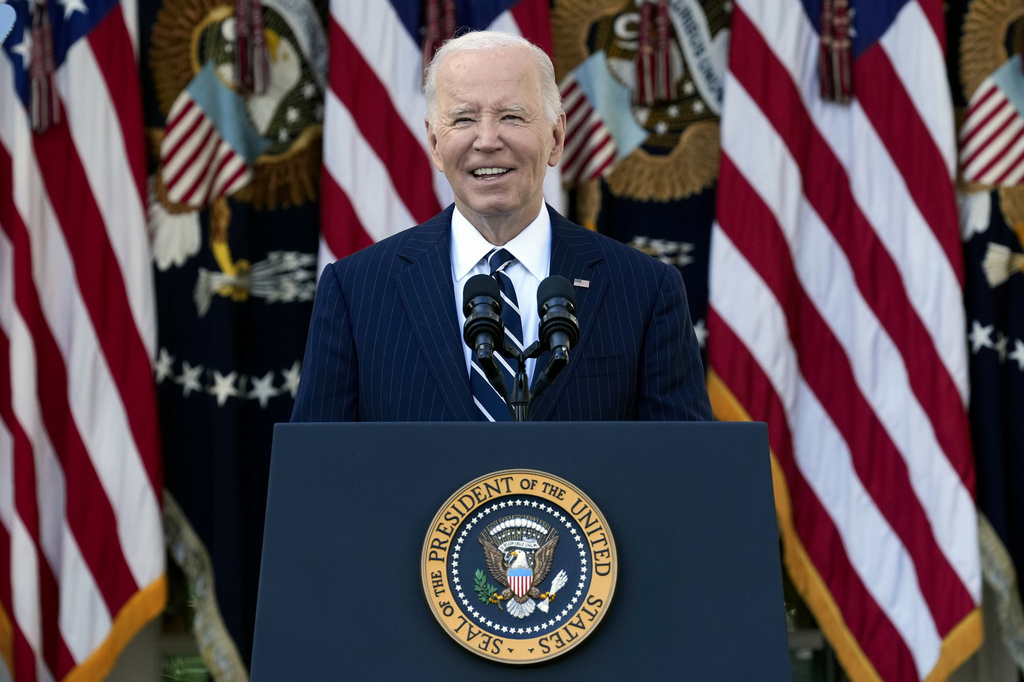
The Biden administration will allow U.S. military contractors to deploy to Ukraine — a policy reversal aimed at helping Kyiv maintain complex Western-provided weapons systems, a defense official told POLITICO.
The decision was made before Tuesday’s election as a way to provide Ukraine with specific technical expertise needed for weapons like F-16 fighter jets and Patriot air defense systems, said the official, who was granted anonymity to speak about a sensitive military issue.
It will give the Defense Department the ability to ask for a small group of American weapon contractors to bid on sending their maintainers to the war-torn country.
“Having small numbers of contractors in Ukraine conducting maintenance away from the front lines will help ensure U.S.-provided equipment can be rapidly repaired when damaged and be provided maintenance as needed,” the defense official said.
CNN previously reported the policy change.
President Joe Biden has long promised that the U.S. would not put military boots on the ground in Ukraine — other than service members detailed to the American Embassy in Kyiv — despite the administration providing more than $64 billion in aid since Russia’s full-scale invasion of Ukraine more than two years ago. The official said the American contractors would be working “far from the front lines” and would not be fighting Russian forces.
“They will help Ukrainian Armed Forces rapidly repair and maintain U.S.-provided equipment as needed so it can be quickly returned to the front lines,” the official said of the contractors. Each contractor or organization that successfully bids on the maintenance contracts will be responsible for their own safety, the official added.
The move comes months after the U.S. State Department decided to beef up the presence of American diplomats by adding several dozen people at the embassy in Kyiv and allowing them to travel freely throughout areas surrounding the Ukrainian capital. Shortly after Russia’s invasion, diplomats were restricted to travel within Kyiv’s city limits.
<img src="https://api.follow.it/track-rss-story-loaded/v1/IfVLmgUA43nDD4jzaWTdGXn9ye8UNv30" border=0 width="1" height="1" alt="The application of the "continuing violations” doctrine beyond "hostile workplace” claims" title="The application of the "continuing violations” doctrine beyond "hostile workplace” claims"> <p><em>The Relist Watch column examines cert petitions that the Supreme Court has “relisted” for its upcoming conference. A short explanation of relists is available </em><a href="https://www.scotusblog.com/faqs-announcements-of-orders-and-opinions/#relists_explained"><em>here</em></a><em>.</em></p> <p>The Supreme Court continues its recent streak of “promoting” relists to granted cases, as the court granted review in <a href="https://www.scotusblog.com/case-files/cases/the-hain-celestial-group-inc-v-palmquist/"><em>The Hain Celestial Group, Inc. v. Palmquist</em></a>, a lawsuit by parents seeking to hold a baby-food producer responsible for their child’s autism. The justices agreed to decide whether a federal district court’s final judgment in favor of the producer must be completely thrown out when the case is sent back to the state court because the district court should not have dismissed another defendant, the grocery chain Whole Foods, from the case. </p> <span id="more-505605"></span> <p>The court declined to take up a second question presented in that case: whether a plaintiff may defeat diversity jurisdiction after the case is transferred to federal court by amending the complaint to add new factual allegations when the complaint at the time of removal did not state such a claim.</p> <p>Turning to new business: There are 95 petitions and applications scheduled for this week’s conference. The justices will be discussing just one of them for a second time: <a href="https://www.scotusblog.com/cases/case-files/nicholson-v-w-l-york-inc-dba-cover-girls/"><em>Nicholson v. W.L. York, Inc. dba Cover Girls</em></a>, in which the justices have been asked to decide when the statute of limitations begins to run on a claim of a “pattern or practice” of racial discrimination.</p> <p>Chanel Nicholson, an African-American dancer, sued several Houston-area clubs under <a href="https://www.law.cornell.edu/uscode/text/42/1981">42 U.S.C. § 1981</a>, which prohibits racial discrimination in making and enforcing contracts. Nicholson alleged that the clubs maintained an explicit and continuing policy of limiting how many Black dancers could perform during any given shift. She says she was repeatedly denied work because of this quota, including in 2014, 2017, and most recently in 2021. </p> <p>In August 2021, Nicholson filed suit against the clubs, but the district court dismissed her case, concluding that <a href="https://www.law.cornell.edu/uscode/text/28/1658">the applicable four-year statute of limitations</a> began to run in 2014 and the claims were thus barred. The <a href="https://cases.justia.com/federal/appellate-courts/ca5/23-20440/23-20440-2024-03-04.pdf?ts=1709598617">U.S. Court of Appeals for the 5th Circuit affirmed</a> in a brief per curiam opinion. </p> <p>The 5th Circuit noted that in <em>National Railroad Passenger Corp. v. Morgan</em>, the Supreme Court recognized a “continuing violations doctrine” under which acts of discrimination were considered part of “one continuing violation,” such that an action would be timely if the last act were timely. But the 5th Circuit said that theory applied only to “hostile workplace” claims, which Nicholson had not pleaded. It concluded that “the act of discrimination that she alleges took place in 2021 … was merely a continuation of [the clubs’] original act of discrimination that she alleges took place in 2014, upon which the limitations period has already elapsed.”</p> <p>Nicholson filed <a href="https://www.supremecourt.gov/DocketPDF/23/23-7490/309933/20240516160644252_20240516-155948-00003433-00004809.pdf">her petition</a> pro se – by herself, as a layperson – but retained Supreme Court counsel in time to file her <a href="https://www.supremecourt.gov/DocketPDF/23/23-7490/355368/20250411133020649_23-7490--Nicholson%20-%20Cert%20Reply%2004-11%20rtf.pdf">reply brief</a>. She argues that the circuits are divided five to four on whether the continuing violations doctrine applies exclusively to hostile workplace claims, or whether it also applies to claims involving a pattern or practice of unlawful conduct. </p> <p>Opposing review, <a href="https://www.supremecourt.gov/DocketPDF/23/23-7490/337373/20250115144034230_2025.01.15%20-%20Respondent%20Brief%20in%20Opposition%20-%20Nicholson%20I.pdf">the clubs argue</a> that the 2021 incidents in which Nicholson alleges that she was denied entry or not hired were merely effects of the original alleged discriminatory acts, not new violations that reset the statute of limitations. And they argue that there is no genuine split among the courts of appeals justifying Supreme Court review. Rather, they say, the federal appeals courts uniformly apply the continuing violations doctrine only in hostile work environment cases, and not to revive time-barred discrete acts of discrimination.</p> <p>[Disclosure: I am among Nicholson’s counsel.] </p> <p>We should have a better idea soon whether the justices agree to hear Nicholson’s case in the fall. Until next time!</p> <h3 class="wp-block-heading" id="h-new-relists"><strong>New Relists</strong></h3> <p><a></a><a></a><a href="https://www.scotusblog.com/cases/case-files/nicholson-v-w-l-york-inc-dba-cover-girls/"><em>Nicholson v. W.L. York, Inc. dba Cover Girls</em></a>, <a href="https://www.supremecourt.gov/search.aspx?filename=/docket/docketfiles/html/public/23-7490.html">23-7490</a></p> <p><strong>Issue: </strong>Whether the continuing violations doctrine applies to claims premised on a pattern or practice of discrimination, or instead applies only in the context of hostile work environment claims.</p> <p>(Relisted after the April 25 conference.)</p> <h3 class="wp-block-heading"><strong>Returning Relists</strong></h3> <p><a href="https://www.scotusblog.com/case-files/cases/apache-stronghold-v-united-states/"><em>Apache Stronghold v. United States</em></a>, <a href="https://www.supremecourt.gov/search.aspx?filename=/docket/docketfiles/html/public/24-291.html">24-291</a></p> <p><strong>Issue</strong>: Whether the government “substantially burdens” religious exercise under the <a href="https://www.justice.gov/sites/default/files/jmd/legacy/2014/07/24/act-pl103-141.pdf">Religious Freedom Restoration Act</a>, or must satisfy heightened scrutiny under the free exercise clause of the First Amendment, when it singles out a sacred site for complete physical destruction, ending specific religious rituals forever.</p> <p>(Relisted after the Dec. 6, Dec. 13, Jan. 10, Jan. 17, Jan. 24, Feb. 21, Feb. 28, March 7, March 21, March 28, April 4, April 17 and April 25 conferences.)</p> <p><a href="https://www.scotusblog.com/case-files/cases/ocean-state-tactical-llc-v-rhode-island/"><em>Ocean State Tactical, LLC v. Rhode Island</em></a>, <a href="https://www.supremecourt.gov/search.aspx?filename=/docket/docketfiles/html/public/24-131.html">24-131</a></p> <p><strong>Issues: </strong>(1) Whether a retrospective and confiscatory ban on the possession of ammunition-feeding devices that are in common use violates the Second Amendment; and (2) whether a law dispossessing citizens without compensation of property that they lawfully acquired and long possessed without incident violates the takings clause of the Fifth Amendment.</p> <p>(Relisted after the Jan. 10, Jan. 17, Jan. 24, Feb. 21, Feb. 28, March 7, March 21, March 28, April 4, April 17 and April 25 conferences.)</p> <p><a href="https://www.scotusblog.com/case-files/cases/snope-v-brown/"><em>Snope v. Brown</em></a>, <a href="https://www.supremecourt.gov/search.aspx?filename=/docket/docketfiles/html/public/24-203.html">24-203</a></p> <p><strong>Issue:</strong> Whether the Constitution permits Maryland to ban semiautomatic rifles that are in common use for lawful purposes, including the most popular rifle in America.</p> <p>(Relisted after the Jan. 10, Jan. 17, Jan. 24, Feb. 21, Feb. 28, March 7, March 21, March 28, April 4, April 17 and April 25 conferences.)</p> <p><a href="https://www.scotusblog.com/case-files/cases/l-m-v-town-of-middleborough-massachusetts/"><em>L.M. v. Town of Middleborough, Massachusetts</em></a>, <a href="https://www.supremecourt.gov/search.aspx?filename=/docket/docketfiles/html/public/24-410.html">24-410</a></p> <p><strong>Issue</strong>: Whether school officials may presume substantial disruption or a violation of the rights of others from a student’s silent, passive, and untargeted ideological speech simply because that speech relates to matters of personal identity, even when the speech responds to the school’s opposing views, actions, or policies.</p> <p>(Relisted after the Feb. 21, Feb. 28, March 7, March 21, March 28, April 4, April 17 and April 25 conferences.)</p> <p><a href="https://www.scotusblog.com/case-files/cases/first-choice-womens-resource-centers-inc-v-platkin/"><em>First Choice Women’s Resource Centers, Inc. v. Platkin</em></a>, <a href="https://www.supremecourt.gov/search.aspx?filename=/docket/docketfiles/html/public/24-781.html">24-781</a></p> <p>Issue: Where the subject of a state investigatory demand has established a reasonably objective chill of its First Amendment rights, is a federal court in a first-filed action deprived of jurisdiction because those rights must be adjudicated in state court?</p> <p>(Relisted after the April 4, April 17 and April 25 conferences.)</p> <p><a href="https://www.scotusblog.com/case-files/cases/ghp-management-corporation-v-city-of-los-angeles-california/"><em>GHP Management Corp v. City of Los Angeles, California</em></a>, <a href="https://www.supremecourt.gov/search.aspx?filename=/docket/docketfiles/html/public/24-435.html">24-435</a></p> <p><strong>Issue</strong>: Whether an eviction moratorium depriving property owners of the fundamental right to exclude nonpaying tenants effects a physical taking.</p> <p>(Relisted after the April 17 and April 25 conferences.)</p>
<p>The post <a href="https://www.scotusblog.com/2025/05/the-application-of-the-continuing-violations-doctrine-beyond-hostile-workplace-claims/">The application of the “continuing violations” doctrine beyond “hostile workplace” claims</a> appeared first on <a href="https://www.scotusblog.com">SCOTUSblog</a>.</p>
<p><img width="150" height="150" src="https://www.scotusblog.com/wp-content/uploads/2025/03/supremecourt-4-150x150.jpg" class="attachment-thumbnail size-thumbnail wp-post-image" alt="Alito and Gorsuch call for court to reconsider confrontation clause precedent" title="Alito and Gorsuch call for court to reconsider confrontation clause precedent" style="float:right;" decoding="async" srcset="https://www.scotusblog.com/wp-content/uploads/2025/03/supremecourt-4-150x150.jpg 150w, https://www.scotusblog.com/wp-content/uploads/2025/03/supremecourt-4-570x570.jpg 570w, https://www.scotusblog.com/wp-content/uploads/2025/03/supremecourt-4-500x500.jpg 500w, https://www.scotusblog.com/wp-content/uploads/2025/03/supremecourt-4-1000x1000.jpg 1000w" sizes="(max-width: 150px) 100vw, 150px" />The Sixth Amendment’s confrontation clause gives defendants in criminal cases the right to “be confronted with the witnesses against” them. The Supreme Court on Monday morning declined to decide when a statement that is made out of court to an agency responsible for making bail...</p>
<p>The post <a href="https://www.scotusblog.com/2025/03/alito-and-gorsuch-call-for-court-to-reconsider-confrontation-clause-precedent/">Alito and Gorsuch call for court to reconsider confrontation clause precedent</a> appeared first on <a href="https://www.scotusblog.com">SCOTUSblog</a>.</p>