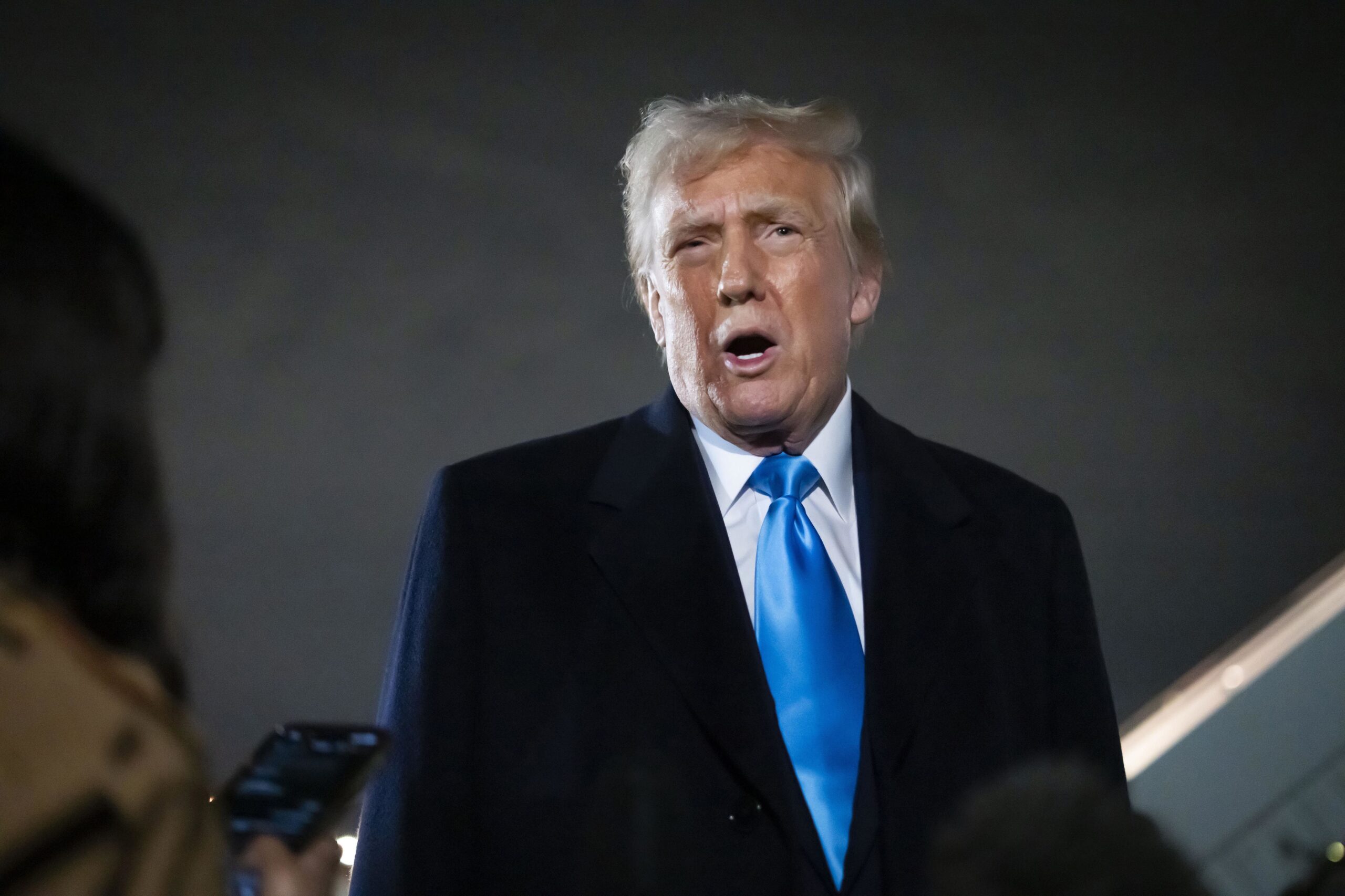
President Donald Trump continued to attack Ukrainian President Volodymyr Zelenskyy on Wednesday, asserting in a social media post that the U.S. was duped into spending billions to help Ukraine defend itself following Russia’s 2022 invasion.
“Think of it, a modestly successful comedian, Volodymyr Zelenskyy, talked the United States of America into spending $350 Billion Dollars, to go into a War that couldn’t be won, that never had to start, but a War that he, without the U.S. and ‘TRUMP,’ will never be able to settle,” the president wrote in a post on Truth Social. “A Dictator without Elections, Zelenskyy better move fast or he is not going to have a Country left.”
Trump’s remarkable attack on the wartime president — which inflates the amount of money the U.S. has provided in aid and asserts without evidence that half of it was “MISSING” — came after Zelenskyy said earlier on Wednesday that Trump was “surrounded by misinformation” in response to the president’s comments on Tuesday in which he blamed Ukraine for starting the war.
It comes on the heels of Trump administration negotiators meeting with Russian officials earlier this week — without Ukraine at the table — to start negotiations to potentially end the war Russia started.

Polish Prime Minister Donald Tusk said he reached a “historic breakthrough” with Recep Tayyip Erdoğan on Wednesday, as he tried to convince the Turkish president…
<img src="https://api.follow.it/track-rss-story-loaded/v1/MswWHjvMw6PokLduI7CFHHn9ye8UNv30" border=0 width="1" height="1" alt="Justices add procedural issue to next term’s docket" title="Justices add procedural issue to next term’s docket"> <p>The Supreme Court on Monday added one new case, involving procedural issues that arose in a lawsuit claiming that an organic baby food caused a child’s case of autism spectrum disorder, to its docket for the 2025-26 term. The justices also called for the federal government’s views in a case involving the commercial-activity exception to the Foreign Sovereign Immunities Act, which generally shields foreign governments from lawsuits in U.S. courts. The announcements came on <a href="https://www.supremecourt.gov/orders/courtorders/042825zor_bq7c.pdf">a list of orders</a> from the justices’ private conference on Friday, April 25. </p> <p>The justices granted <a href="https://www.scotusblog.com/cases/case-files/the-hain-celestial-group-inc-v-palmquist/">a petition for review filed by Hain Celestial Group</a>, the makers of Earth’s Best organic baby food, which is sold at (among other stores) Whole Foods. In 2021, Sarah and Grant Palmquist sued both Hain and Whole Foods in a Texas state court, alleging that heavy metals in Earth’s Best baby food had caused their son’s autism spectrum disorder. </p> <span id="more-505454"></span> <p>As a general rule, businesses often prefer to litigate disputes in federal courts because they believe that federal courts are more predictable and efficient, and less influenced by local politics, than state courts. Because the Palmquists are residents of Texas and Hain was based in Delaware and New York, Hain moved the case to federal court, relying on diversity jurisdiction – a doctrine that allows federal courts to hear cases involving adverse parties from two different states. Hain contended that federal courts could still take up the case because Whole Foods, which is based in Texas, was protected under state law as an “innocent seller” of the product and therefore had been improperly added to the case. </p> <p>The Palmquists amended their complaint to add new claims against Whole Foods and sought to send the case back to the state court, but the federal court denied that request and dismissed Whole Foods from the case. Nearly two years later, the case went to trial, and the district court eventually entered a ruling in Hain’s favor. </p> <p>The Palmquists went to the U.S. Court of Appeals for the 5th Circuit, which sent the case back to state court with instructions to start fresh. It concluded that because the federal trial court was wrong when it dismissed Whole Foods from the case, it effectively lacked the power to enter the judgment against the Palmquists. </p> <p>Hain and Whole Foods came to the Supreme Court, asking the justices to weigh in, which they agreed to do on Monday. </p> <p>And the justices asked the Trump administration to file a brief in <em><a href="https://www.supremecourt.gov/search.aspx?filename=/docket/docketfiles/html/public/24-759.html">Wye Oak Technology v. Republic of Iraq</a></em>, in which a U.S.-based defense contractor seeks payment for services it provided to the Iraqi government beginning more than two decades ago. Wye Oak raises two questions related to the FSIA’s commercial-activity exception. There is no deadline for the U.S. solicitor general to file the government’s brief. </p> <p>The justices once again did not act on several high-profile petitions for review that have been pending for several weeks, including challenges to <a href="https://www.scotusblog.com/cases/case-files/ocean-state-tactical-llc-v-rhode-island/">Rhode Island’s ban on large-capacity magazines</a> and <a href="https://www.scotusblog.com/cases/case-files/snope-v-brown/">Maryland’s ban on military-style assault rifles</a>, as well as a challenge to <a href="https://www.scotusblog.com/cases/case-files/apache-stronghold-v-united-states/">the transfer to a mining company of federal land</a> in Arizona that the San Carlos Apache Tribe regards as a sacred site. </p> <p>The justices will meet for another private conference on Friday, May 2. Orders from that conference are expected on Monday, May 5, at 9:30 a.m. </p>
<p>The post <a href="https://www.scotusblog.com/2025/04/justices-add-procedural-issue-to-next-terms-docket/">Justices add procedural issue to next term’s docket</a> appeared first on <a href="https://www.scotusblog.com">SCOTUSblog</a>.</p>