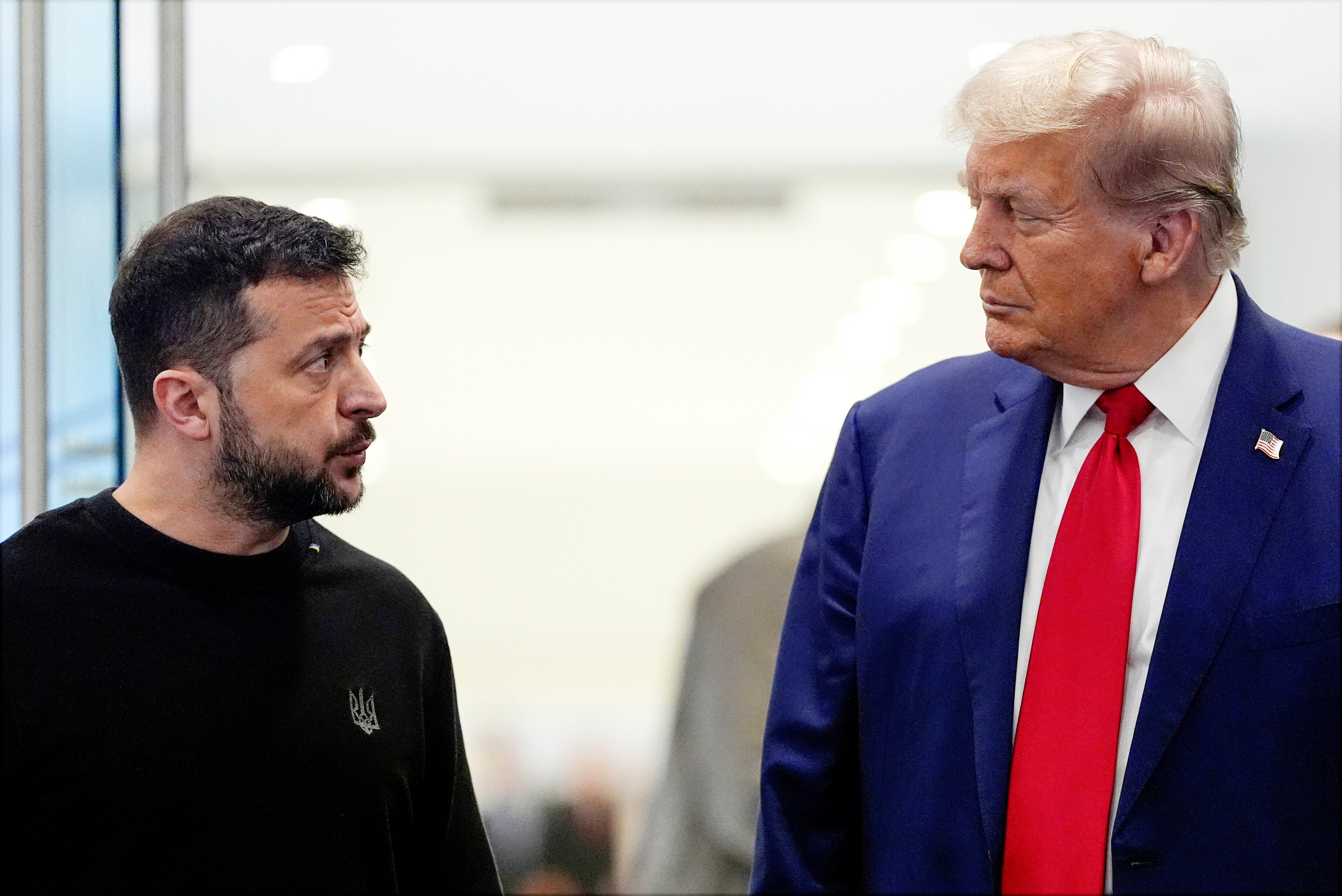
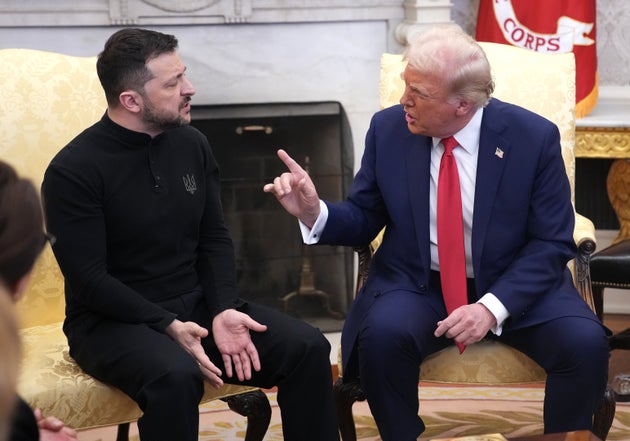
President Donald Trump and Ukrainian President Volodymyr Zelenskyy meet in the Oval Office at the White House on Feb. 28, 2025.
WASHINGTON – President Donald Trump and his vice president, JD Vance, effectively took the side of Russian dictator Vladimir Putin in his brutal invasion of Ukraine, calling visiting Ukrainian President Volodymyr Zelenskyy “disrespectful” and telling him he has “no cards” with which to negotiate.
“You’re either going to make a deal or we’re out, and if we’re out, you’ll fight it out. I don’t think it’s going to be pretty,” Trump said, berating Zelenskyy in the Oval Office in front of gathered reporters.
Vance added: “I think it’s disrespectful for you to come to the Oval Office to try to litigate this in front of the American media… You should be thanking the president for trying to bring you into this conference.”
Trump has been trying to coerce Zelenskyy into handing over Ukraine’s mineral rights in exchange for US support, and the purpose of Zelenskyy’s visit was ostensibly to reach an agreement. Trump then told Zelenskyy that he was currently in no position to complain about the state of affairs, even though it was Putin, not Zelenskyy, who began the bloody three-year war.
“You don’t have the cards, but once we sign that deal, you’re in a much better position, but you’re not acting at all thankful. And that’s not a nice thing, I’ll be honest, that’s not a nice thing,” he said.
WATCH: Full Heated Exchange between President Trump, Vice President Vance and Ukrainian President Zelenskyy in the Oval Office. pic.twitter.com/oMJUGPqbSU
Trump and Vance’s insults of Zelenskyy came at the tail end of a nearly hour-long photo opportunity in which Trump invited questions. Trump grew visibly angry and ended media availability with: “I think we’ve seen enough.”
A planned joint news conference was cancelled and Zelenskyy left the White House about an hour later.
By that point, Trump had already attacked Zelenskyy in a social media post: “We had a very meaningful meeting in the White House today. Much was learned that could never be understood without conversation under such fire and pressure.
“It’s amazing what comes out through emotion, and I have determined that President Zelenskyy is not ready for Peace if America is involved, because he feels our involvement gives him a big advantage in negotiations.
“I don’t want advantage, I want PEACE. He disrespected the United States of America in its cherished Oval office. He can come back when he is ready for Peace.”
At one point, Trump went off on a long tangent about the investigations into Putin helping Trump win the presidency in the first place in 2016. Although the details of Russian involvement were confirmed by both special counsel Robert Mueller’s probe and a separate inquiry by the Senate Intelligence Committee, Trump again lied that it was a “hoax.”
He told reporters that Putin was similarly wronged by the investigations. “Let me tell you, Putin went through a hell of a lot with me. He went through a phony witch hunt where they used him in ’Russia, Russia,
“Let me tell you, Putin went through a hell of a lot with me. He went through a phony witch hunt where they used him in ‘Russia, Russia, Russia, Russia.’ You ever hear that deal that was a phony, that was a phony Hunter Biden, Joe Biden scam, Hillary Clinton, shifty, Adam Schiff, it was a Democrat scam, and he had to go through that. And he did go through it.”
Trump continued, “We didn’t end up in a war. And he went through it. He was accused of all that stuff. He had nothing to do with it. Came out of Hunter Biden’s bathroom. It came out of Hunter Biden’s bedroom. It was disgusting. And then they said, oh, oh, the laptop from hell was made by Russia, the 51 agents. The whole thing was a scam, and he had to put up with that. He was being accused of all that stuff.”
<img src="https://api.follow.it/track-rss-story-loaded/v1/QmuZ7Zb8Vvxq5Bdi14Fb4Hn9ye8UNv30" border=0 width="1" height="1" alt="Court takes up New York man’s bid for compassionate release" title="Court takes up New York man’s bid for compassionate release"> <p>The Supreme Court on Tuesday agreed to weigh in on the bid for compassionate release by a New York man convicted of murder for hire a quarter-century ago. The justices’ decision to grant review in <em><a href="https://www.scotusblog.com/cases/case-files/fernandez-v-united-states/">Fernandez v. United States</a></em> was announced on a scheduled <a href="https://www.supremecourt.gov/orders/courtorders/052725zor_p8k0.pdf">list of orders</a> released after the holiday weekend from their private conference on Thursday, May 22. </p> <span id="more-528794"></span> <p>The justices also denied review in two cases that they had repeatedly considered at their conferences over the past few months – one involving the challenge by Native Americans to the transfer to a mining company of federal land that they regard as sacred, the other involving a middle-schooler who was barred from wearing a t-shirt proclaiming that “There Are Only Two Genders.” Both denials spurred dissents from the denial of review by some of the court’s conservative justices.</p> <p>The Supreme Court took up the case of Joe Fernandez, who was sentenced to life in prison for his role in a 2000 murder for hire in retaliation for the victim’s failure to pay a drug debt. In 2021, Fernandez filed a motion for compassionate release. He pointed to the possibility that he was innocent, because the key witness against him was also the alleged main shooter in the conspiracy and had admitted that he had lied as a cooperating witness in another case. Moreover, Fernandez contended, other participants in the conspiracy, who had pleaded guilty while he went to trial, received much lower sentences. </p> <p>A federal district judge in New York granted Fernandez’s motion, reduced his sentence to the time that he had served, and ordered his release. </p> <p>The government appealed to the U.S. Court of Appeals for the 2nd Circuit, which reversed the district court’s decision. The court of appeals interpreted Fernandez’s argument that he is potentially innocent as a challenge to the validity of his conviction. And such a challenge, the court of appeals concluded, cannot qualify as the kind of “extraordinary and compelling reasons” justifying a reduction in sentence, but must instead be brought through a motion for post-conviction relief. </p> <p>Fernandez came to the Supreme Court last fall, asking the justices to weigh in. He contends that although Congress has specifically prohibited district courts from considering a defendant’s rehabilitation when deciding whether to reduce a sentence, federal law otherwise gives district courts broad discretion to reduce sentences when they find “extraordinary and compelling reasons” to do so. In holding that the district court could not consider Fernandez’s potential-innocence claim, he argues, the court of appeals imposed limits that are not found in the statute. </p> <p>The federal government urged the justices to deny review. It insists that Fernandez’s potential innocence and the lighter sentences given to the other participants in the conspiracy are neither “extraordinary” nor “compelling” reasons to reduce his sentence. </p> <p>On Tuesday the court granted review. It reframed the question presented in the case, agreeing to decide whether the kind of “extraordinary and compelling reasons” that may justify a lower sentence can include reasons that can also be cited as reasons to vacate a sentence in a motion for post-conviction relief. </p> <p>Fernandez’s case will likely be argued in the fall, with a decision to follow sometime next year. </p> <p>The justices also asked the federal government to file a brief expressing its views in <em><a href="https://www.supremecourt.gov/search.aspx?filename=/docket/docketfiles/html/public/24-856.html">Cisco v. Doe</a></em>, a case brought by a group of Chinese nationals and a U.S. citizen who are members of the religious group Falun Gong against the company and its executives, alleging that the company helped the Chinese government to set up surveillance technology that it then used to repress the group. </p> <p>Cisco came to the Supreme Court in January, asking the justices to weigh in on the applicability of the Alien Tort Statute, an 18th-century law that allows foreigners to bring lawsuits in U.S. courts alleging serious violations of international human-rights laws, as well as the Torture Victim Protection Act, a 1991 law that allows lawsuits in U.S. courts against foreign officials for torture and murder. </p> <p>There is no deadline for the U.S. solicitor general, D. John Sauer, to file the government’s brief. </p> <p>Over a 17-page dissent by Justice Neil Gorsuch, joined by Justice Clarence Thomas, the court declined to decide <a href="https://www.scotusblog.com/cases/case-files/apache-stronghold-v-united-states/">whether the transfer of federal land in Arizona to a mining company</a> violates the rights of some Native Americans, who regard an area within that land as a sacred site that is essential to their religious practices. A divided federal appeals court rejected a request to block the transfer. Although it acknowledged that the copper mining project planned for the land would at the very least “interfere significantly” with the challengers’ ability to practice their religion, it concluded that the transfer did not force the challengers to violate their religious beliefs. </p> <p>The land at the center of the case, known as Oak Flat, is located on federally owned land in the Tonto National Forest, northeast of Phoenix. Members of the Western Apache people believe that Oak Flat is central to their religious worship because it provides them with a “direct corridor” to speak with their creator. </p> <p>Roughly a mile below Oak Flat is an ore deposit that, if mined, could yield as much as 40 billion pounds of copper. In 2014, Congress enacted a law that authorized the federal government to transfer 2,422 acres, including Oak Flat, to Resolution Copper in exchange for a separate parcel of land, more than twice as large, owned by the company. When the land is eventually transferred and mining begins, it will ultimately create a large crater – approximately 1.8 miles in diameter and somewhere between 800 and 1,115 feet deep – on the land’s surface. </p> <p>Apache Stronghold, an advocacy group created by members of the San Carlos Apache Tribe, went to federal court in Arizona, seeking to block the transfer. The district court rejected that request and a deeply divided U.S. Court of Appeals for the 9th Circuit upheld that ruling. </p> <p>After considering the case at 16 consecutive conferences, the court on Tuesday denied the group’s petition for review. Gorsuch called that decision “a grave mistake.” He suggested that the lower court’s ruling “is highly doubtful as a matter of law,” conflicts with the decisions of other federal courts of appeals, and “is vitally important.” “Before allowing the government to destroy the Apaches’ sacred site,” he concluded, “this Court should have at least troubled itself to hear their case.”</p> <p>Thomas also joined a dissent from the denial of review (along with his own brief dissent) filed by Justice Samuel Alito in <a href="https://www.scotusblog.com/case-files/cases/l-m-v-town-of-middleborough-massachusetts/">the case of a middle schooler</a> who was barred from wearing a t-shirt reading “There Are Only Two Genders.” </p> <p>The student at the center of the case, known here only as L.M. because he is under 18, came to school in 2023 wearing the shirt. When an assistant principal told him that he would need to remove the shirt to remain at school, L.M.’s father picked him up and took him home. The school superintendent later explained in an email to L.M.’s father that the school had been enforcing its dress code, which (among other things) prohibits clothing with “hate speech or imagery” targeting groups based on their sexual identity and gender orientation. </p> <p>The school district’s defense of the dress code and the decision to bar L.M. from wearing the shirt sparked media coverage, protesters and counter-protesters near the school property, and a variety of “hateful” and “threatening” messages to the school or its staff. </p> <p>About six weeks after he originally wore the shirt to school, L.M. came to school again wearing the shirt – this time with the words “Only Two” covered in a piece of tape with the word “Censored” on it. When the school told him that he was not allowed to wear the shirt, L.M. opted to remove it and return to class. </p> <p>L.M. then went to federal court, alleging that by prohibiting him from wearing the t-shirt (both with and without the tape on it) the school district violated his First Amendment right to free speech. </p> <p>A federal appeals court in Boston ruled that the school did not violate L.M.’s First Amendment rights. In 1969, it explained, the Supreme Court upheld the right of public-school students to wear black armbands to protest the Vietnam War. But at the same time, the court made clear that it was sensitive to the “special characteristics of the school environment,” and it indicated that school officials can restrict student speech that “materially and substantially” interferes with discipline in the school. </p> <p>In L.M.’s case, the U.S. Court of Appeals for the 1st Circuit concluded that the school district acted reasonably in concluding that his t-shirt would be interpreted as demeaning to transgender and non-binary students at the middle school, and that it would therefore have a “materially disruptive” effect on the learning environment at the school. </p> <p>Alito indicated that he would have granted L.M.’s petition for review. First, he wrote, the justices “should affirm the bedrock principle that a school may not engage in viewpoint discrimination when it regulates student speech.” He accused the court of appeals of “cherry-picking which First Amendment principles it thought worthy of allowing through the schoolhouse gates.” </p> <p>Second, Alito continued, the justices should have taken up L.M.’s case to “determine whether the First Circuit properly understood” the court’s longstanding rule “regarding the suppression of student speech on the ground that it presents a risk of material disruption.” Although the standard is supposed to be “demanding,” Alito stressed, “the First Circuit fashioned a rule that is anything but.” </p> <p>The justices will meet again for another private conference on Thursday, May 29. Orders from that conference are expected on Monday, June 2, at 9:30 am. </p>
<p>The post <a href="https://www.scotusblog.com/2025/05/court-takes-up-new-york-mans-bid-for-compassionate-release/">Court takes up New York man’s bid for compassionate release</a> appeared first on <a href="https://www.scotusblog.com">SCOTUSblog</a>.</p>
Monkey Business Images / Shutterstock Most people think democracy is something that adults do and regard the prospect of children voting as too silly to…