Top Cold Wallets for Storing Cryptocurrencies
This article was updated in December 2025 by Vera Lim.
Cryptocurrency wallets are a key part of the crypto space, as you need them to manage your assets. These can be custodial or non-custodial, and the latter can be split into software (hot) or hardware (cold) wallets. Hot wallets like MetaMask and Trust Wallet have grown popular over the years, scoring high in terms of convenience. Meanwhile, cold wallets are focused on security, and are the recommended way for users to store long-term holdings.
What Are Cold Wallets?
Cold wallets are also called hardware wallets. Cold wallets are hardware devices resembling USB storage devices with connectivity features like USB, WIFI and Bluetooth. Cold wallets secure crypto assets held in a blockchain account by storing the wallet’s private keys offline, unlike hot wallets which are always connected to the internet.
This makes cold wallets more inconvenient to use, as signing transaction requests involves more steps. However, their reduced convenience is a key part of its rigid security structure. Some popular cold wallets include Trezor, Ledger, SafePal, and Tangem Wallet. The security level of cold wallets is usually rated according to the EAL metrics.
What Is the EAL rating?
EAL (Evaluation Assurance Level) rating is the security ranking standard for IT products like cryptocurrency cold wallets. It ranks tech products’ assurance levels from 1 to 7, where higher levels imply more rigorous security measures. The EAL rating system considers the product design, functional analysis, and performance in penetration testing, and accords an EAL score based on the average performance.
Most cold wallets have an EAL rating of 5 and above, where the qualification promises users a high level of independently assured security with a rigorous development approach.
Do note that the EAL level does not measure the security of the system itself, and it only states at what level (EAL1-7) the system was tested.
Now, let’s look at some of the notable cold wallets and their key features. The wallets are listed in order of their estimated website traffic based on Similarweb data.
OneKey: Open-Source Security with Smart Transaction Defense and Wireless Connectivity
This section is brought to you by OneKey.
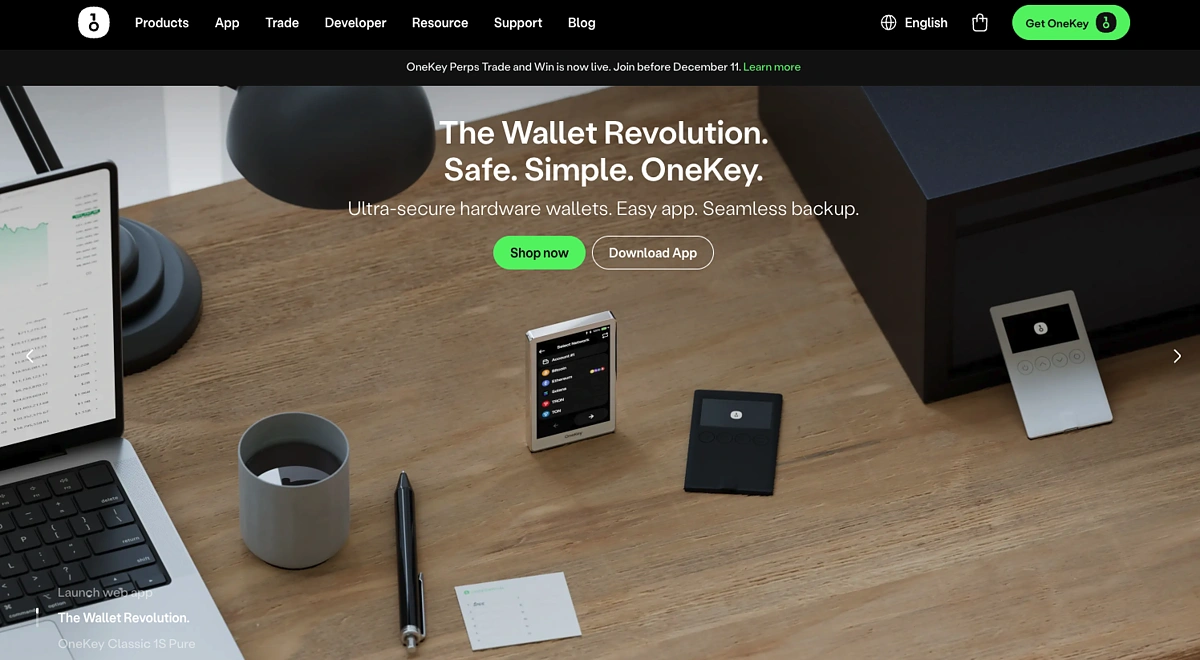
OneKey stands out in the hardware wallet space by combining top-tier security elements with a commitment to full transparency through open-source code. Founded in 2020, OneKey has quickly established itself, backed by industry leaders like Coinbase Ventures and Dragonfly.
As a fully open-source hardware wallet, both the firmware and the companion software are publicly auditable. OneKey devices are secured by EAL 6+ certified chips, offering the same level of banking-grade security found in government IDs and bank cards.
The OneKey ecosystem is managed via the native OneKey App (available on mobile, PC, Mac, and as a browser extension). This app allows users to track, send, receive, and swap assets across networks. OneKey supports over 100 blockchains and 30,000+ coins and tokens, including Bitcoin, Ethereum, Solana, and various NFTs.
A key security feature is SignGuard, which works across the devices and the app to block risky signatures and flag malicious contracts, phishing sites, or drainers in real-time before a transaction is confirmed. The hardware is also designed with a Quantum-Ready Architecture to address future cryptographic threats.
Here are some OneKey hardware wallet options:
OneKey Pro
The OneKey Pro is the flagship device, designed for advanced users prioritizing a full-feature experience and maximum physical isolation. It retails for $278.
-
Key Features: It is equipped with four separate EAL 6+ Secure Elements and offers multiple connectivity options, including Air-gapped signing (via a built-in camera for QR codes), Bluetooth, and USB-C.
-
Display & Interaction: It features a large 3.5-inch HD color touchscreen (480×800) and supports fast authentication via fingerprint recognition.
-
Power: It supports Qi wireless charging, making it the first air-gapped cold wallet with this capability.
OneKey Classic 1S
The Classic 1S provides a balance of high security and portability at an affordable price of $99.
-
Key Features: It uses a single EAL 6+ Secure Element and maintains a compact, thin form factor (5.2 mm).
-
Display & Interaction: The device uses a 1.54-inch monochrome OLED display and four physical navigation buttons for transaction confirmation.
-
Connectivity: It connects via USB-C and Bluetooth for full platform support (Windows, macOS, Linux, Android, and iOS).
OneKey Classic 1S Pure
Priced at $79, this model is tailored for long-term HODLers who prefer a battery-free device.
-
Key Features: Identical to the Classic 1S in terms of security and display, it uses a single EAL 6+ Secure Element and the same compact design.
-
Power: The “Pure” version is battery-free and requires a constant USB-C connection to operate, minimizing the risks associated with internal batteries and maximizing longevity.
Ledger: The Popular Hardware Wallet Classic
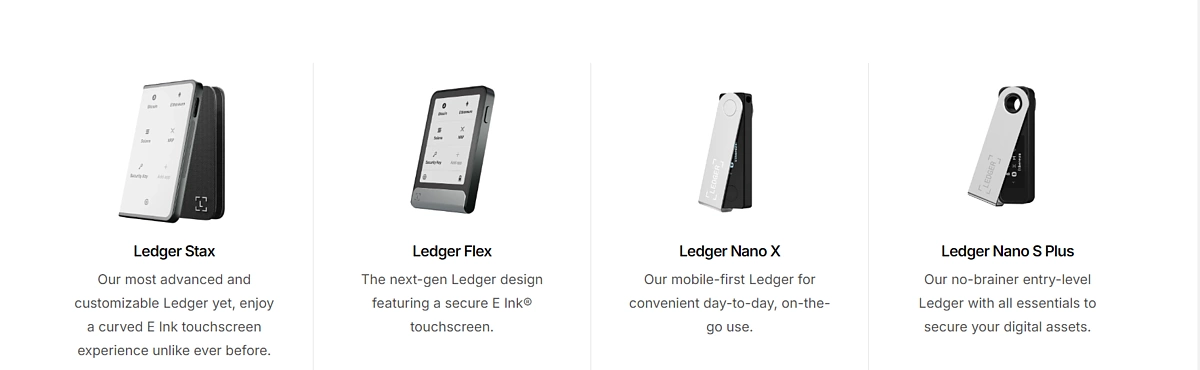
Ledger launched the Ledger Nano S, its first hardware wallet in 2016 as a safe storage medium for Bitcoin. Since then, it has released about five cold wallets including the Ledger Nano X, Ledger Flex, and Ledger Nano S Plus, and has grown its support for crypto assets, including NFTs. Ledger wallets store your private keys offline and connect to smart devices for advanced operations like staking and purchasing assets through Ledger Live – the software interface for the Ledger wallet.
You can manage your assets either through the native Ledger Live app, which supports 500 coins and Ethereum and Polygon NFTs, or through 50 supported third-party wallets like MetaMask, which supports over 5,000 coins and multi-blockchain NFTs.
Ledger Wallet also supports connection through third-party wallets like MetaMask. Through Ledger Live and third-party wallet connections, users can access DeFi platforms and dApps deployed on the supported networks.
For all Ledger devices, you can recover access to your assets through a 24-word secret recovery phrase, or you may opt for the controversial Ledger Recover, which allows users to retrieve lost private keys.
Here are some Ledger wallet options:
Ledger Nano S Plus
The Ledger Nano S Plus sells for as low as $79. It comes in a plastic body with a stainless steel swivel, a 1.09-inch screen display, and a USB-C connection. It has a security rating of EAL6+ and an ANSSI CSPN certification. The Ledger Nano S Plus is supported on the Ledger Live application and can connect to decentralized applications through third-party wallets. However, the Ledger Nano S Plus only works on desktop and Android.
Ledger Nano X
The Ledger Nano X tops the Nano S Plus device with a wider body but retains the 1.09 inch screen size. It has a battery with up to five hours of normal use, and offers additional iOS compatibility.The Ledger Nano S has a security rating of EAL5+ and an ANSSI CSPN certification, with USB-C connection and Bluetooth connectivity. At time of writing, the Ledger Nano X retails for $149.
Ledger Stax
The Ledger Stax is Ledger’s most advanced cryptocurrency cold wallet with an EAL6+ rating, and prices start at $399 at the time of writing. The Ledger Stax is equipped with a 3.7 inch curved screen, and a battery time of up to 10 hours or 150 transactions. In addition to the usual USB-C connection, the Ledger Stax also features Bluetooth and specialized NFC (Near Field Communication).
Trezor: Open Source Hardware Wallets
Trezor launched one of the earliest forms of contemporary cold wallets – the Trezor Model One on July 19, 2014, and followed up with the Model T about four years later. Trezor is an open source cold wallet for storing cryptocurrencies, and it combines the seed phrase with a non-stored passphrase that makes hacks of the physical device unlikely.
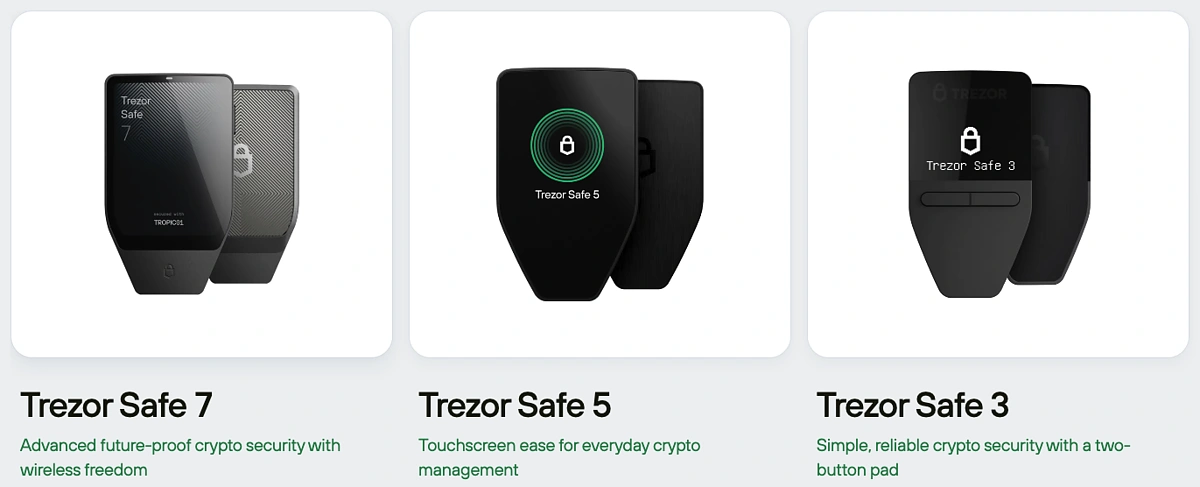
Trezor currently has three cold wallet options under its wing. Each wallet supports over 1,000 crypto assets and up to 80 blockchain networks. Trezor wallet mobile application, Trezor Suite, allows users to connect their devices to a smart device and perform advanced operations including trading assets and paying for daily essentials, where every transaction requires confirmation on the accompanying Trezor hardware wallet. Like other cold wallets, Trezor also supports DeFi transactions through third-party wallet connections.
However, note that Trezor only offers USB-C/USB-A connections, and is only compatible with MacOS, Windows, Linux, and Android, where iOS capabilities are limited to view-only.
Here are some Trezor wallets:
Trezor Safe 7
The soon to be released Trezor Safe 7 includes a transparent, auditable Secure Element (TROPIC01), open to anyone to audit and verify how it protects your crypto. The TROPIC01 chip is combined with an additional EAL6+ secure element. It also uses post-quantum cryptography to secure firmware updates, device authentication, and the boot process, protecting wallets against future quantum computing threats. It will also offer wireless charging and bluetooth connectivity. The Trezor Safe 7 will retail at $249, and preorders are open.
Trezor Safe 5
The Trezor Safe 5 was released on 14 June 2024; it is the latest Trezor wallet device and the most advanced yet. The Trezor Safe 5 retails at $169 and comes with a 1.54 Inch Gorilla Glass 3 color touchscreen. It has an EAL6+ security rating and is open-source like other Trezor wallets. Connectivity-wise, the Trezor Safe 5 utilizes a USB-C cable.
Trezor Safe 3
The Trezor Safe 3 was released on 12 October 2023, and is priced at $79 at the time of writing. It is equipped with a 0.96 inch monochromatic display and two control buttons. Like the Trezor Safe 5, the Trezor Safe 3 utilizes USB-C for connectivity.
Trezor Model One
The Trezor Model One is the earliest Trezor wallet device, and was released on 29 July 2014. It is priced at $49, and comes with a 0.96 inch monochromatic display and two control buttons. Unlike the other two Trezor models, it enables USB connectivity via a micro USB connection port.
SafePal: Extensive Support for Tokens and Chains
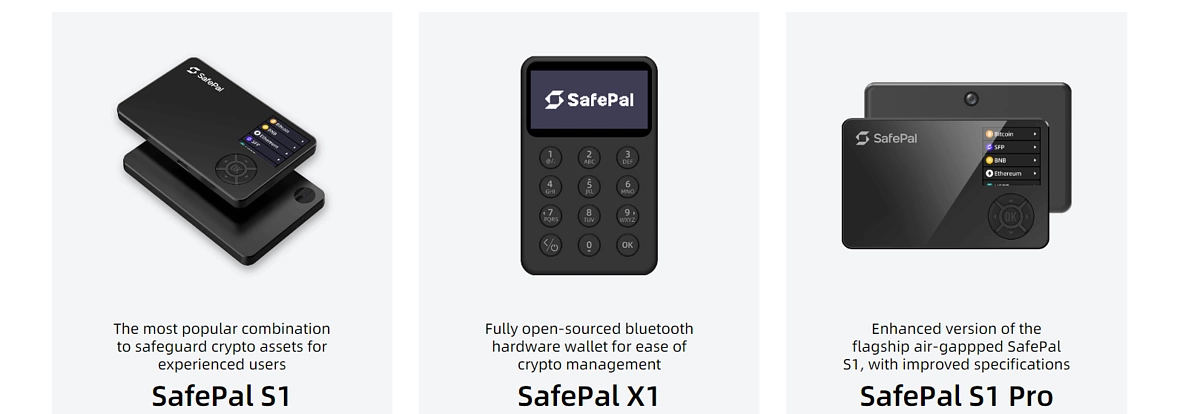
SafePal S1 – the first SafePal hardware wallet – was launched in May 2019. Since then, the firm has added two more hardware wallet devices to its product list. Safepal wallets support over 100 blockchain networks and millions of NFTs and tokens – to check if your token is supported and on what device, you can check out SafePal’s Supported Assets page.
SafePal’s hardware wallets are compatible with the SafePal hot wallet, allowing hardware wallet owners to perform advanced operations like interacting with decentralized applications with their wallets. The SafePal hot wallet is available as a native application for Android and iOS devices and as a browser extension for desktop devices.
SafePal’s hardware wallets also feature a self-destruct mechanism that triggers if the secure element is tampered with, during which the secure element will erase all wallet data.
SafePal S1/S1 pro
The S1 series features fully air-gapped and 100% offline hardware wallets – the SafePal S1 and the newer S1 Pro. The S1 Pro offers an improvement in battery life (S1 – 400mAh, S1 Pro – 500mAh) and uses more premium housing materials for the cold wallet. The S1 retails at $49.99, while the S1 Pro is priced at $89.99.
However, both wallets share many similarities. The S1 and S1 Pro have the same screen size and security features. Both wallets use a 100% air-gapped signing mechanism, with its secure chip having an EAL rating of 5+. These wallets also use QR codes for connection, although there is also a USB-C option.
SafePal X1
The SafePal X1 retails for $69.99, and comes with a 1.8 inch monochrome display screen, a 12-button control pad, and a 200mAh battery. It uses a high-speed Bluetooth 5.0 signing mechanism for improved efficiency, with its secure chip rated EAL5+. The SafePal X1 is also open source, with its code available on github for maximum trust and efficiency.
Tangem Wallet: Leveraging NFC Technology for One-Tap Convenience
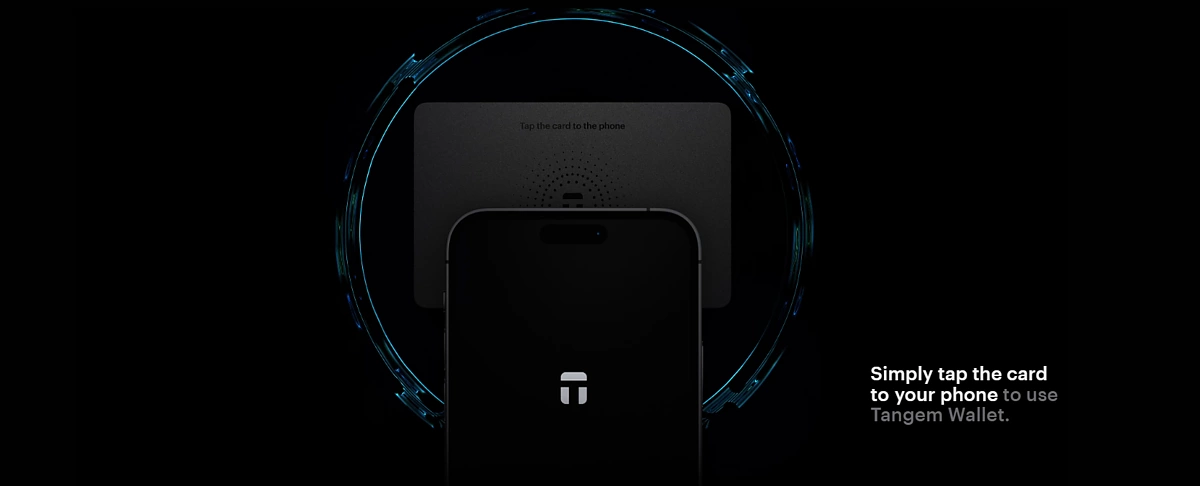
Tangem Wallet uses chip technology and NFC (Near Field Communication) technology to develop a cold wallet for crypto assets. Tangem Wallets are cards with chips attached, and are equipped with NFC technology for connectivity. The communication technology is supported by mobile devices (Android 6.0 or higher and iOS 15.0 or higher).
The chip in the card generates a random private key that is never exposed, ensuring the wallet cannot be compromised, and each Tangem Wallet can contain up to three Tangem cards, all of which are tied to the same wallet. Each card holds a copy of the wallet keys, which are generated during the activation process and copied to each of the available cards. The Tangem 1.0 does not generate passphrases, but this can be done on the Tangem 2.0.
To transact using the Tangem Wallet, the user only needs to tap the card on their device to activate it. Tangem Wallets work with the Tangem App, which is available as a native app for Android and iOS devices. Through the app, users can manage their assets and perform DeFi transactions like swapping and staking.
Tangem also offers the Ring wallet. The Ring wallet works the same way as the card wallets, however, the chip is embedded in a ring for more portability, and will replace at least one card in a three-card Tangem wallet.
Tangem wallet supports over 61 blockchain networks and thousands of crypto assets including NFTs on these networks. The Tangem card wallet sells for $54.90 at the time of writing, while the Tangem Ring is $160.
Ellipal: The First 100% Air-Gapped Wallet
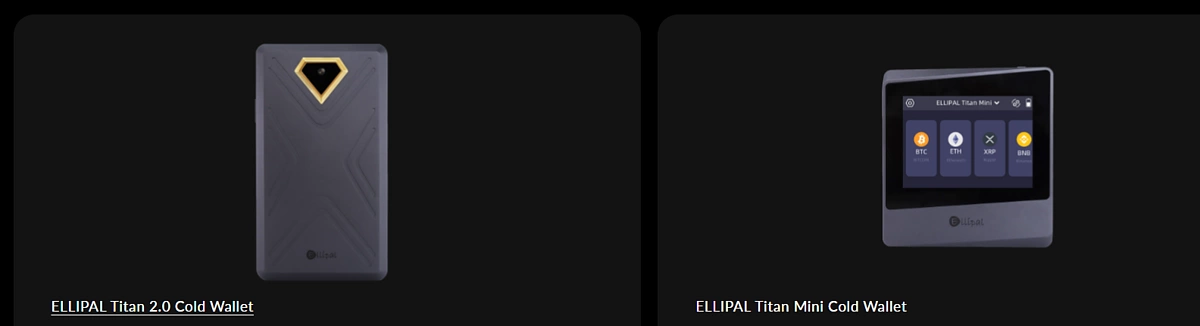
Ellipal claims to be the first cold wallet developer to produce a 100% air-gapped wallet. The Hong Kong-based wallet development firm was launched in 2018 and released their first cold wallet – Ellipal – the same year. This was followed by the Ellipal Titan about a year later. Ellipal wallets are EAL5+ rated and support over 10,000 crypto assets including tokens from over 80 blockchain networks and NFTs for Ethereum and other supported networks.
According to the team, the Ellipal wallet is completely disconnected from the internet and is equipped with an efficient QR Code scanner for connecting to third-party applications and running transactions. Ellipal wallet users can connect their wallet to the Ellipal App, a native mobile application that can be installed on Android and iOS devices to manage their assets and run advanced transactions like staking and swapping. Ellipal wallets are also compatible with hot wallets like the MetaMask Wallet. Through third-party connections, users can access decentralized applications.
Ellipal has two flagship wallets; the Ellipal Titan Mini and Ellipal 2.0. Both wallets are tamper-proof and feature a self-destruct anti-hacking mechanism, and users can create up to 10 accounts and store NFTs on Ethereum and Polygon. The Titan Mini sells for $99 and features a 2.7 inch HD screen with a 600mAh battery. Ellipal 2.0 is Ellipal’s most advanced cold wallet yet, and retails at a significantly higher price of $169. It has a larger 4.0 inch screen and a 1400mAh battery. Like the Titan Mini, Ellipal 2.0 is compatible with the Ellipal App and third-party wallet. The Ellipal 2.0 also comes with a pattern PIN – a feature that is not available on the Titan Mini.
Cypherock X1: Eliminating a Single Point of Failure

The Cypherock X1 was launched in 2022, and has a security rating of EAL 6+. According to the developers, the Cypherock X1 does not require seed phrase backup. Cypherock X1 is priced at about $129 at the time of writing and comes with four cards and the X1 vault. It uses NFC technology for connectivity and a USB-C cord to connect the vault to smart devices. The X1 cards have chips attached and thanks to the automatic detection technology, can be recognized by the X1 vault. The X1 vault comes with a 0.96 inch display screen and a joystick for control.
Users’ keys are split between the four cards and the X1 Vault using Shamir’s Secret Sharing. Each card can be used to transact funds using the X1 Vault, as users only need two parts of the five-part wallet to run a transaction. This eliminates a single point of failure, as Cypherock claims that users can easily recover any missing part of their 5-part wallet using any two other parts.
Cyperock X1 is compatible with Cysync, a native application for Windows, MacOS, and Linux devices that allows for flexibility for tailored crypto asset management. It supports over 9,000 crypto assets including NFTs and tokens.
GridPlus Lattice1 and SafeCards: Unlimited Hardware-Backed Crypto Wallets
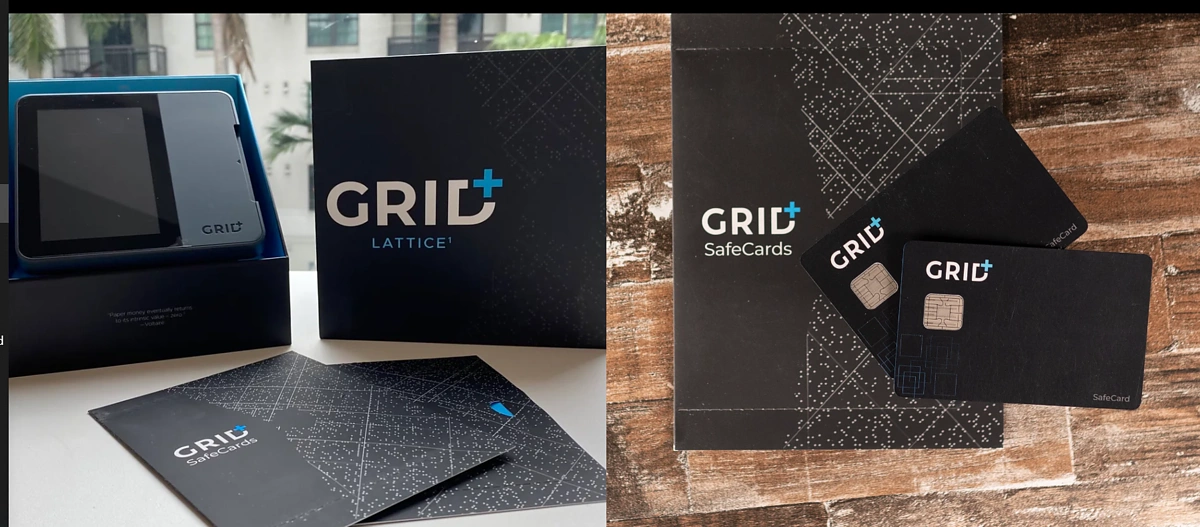
The GridPlus wallet comprises the GridPlus Lattice1 and the SafeCard(s), where each SafeCard can hold one unique wallet with all its addresses. To access the wallet tied to a SafeCard, users need to slot their SafeCard into the Lattice1. Through SafeCards, users can manage unlimited hardware-backed crypto wallets with one Lattice1 device, making it easy for users to split their crypto holdings into multiple wallets with different seed phrases, further enhancing wallet security. The GridPlus is a standalone wallet that does not require connection to any applications or devices, although you’ll still need another device to access the protocols you want to connect to.
Your private keys are never accessible from the internet as GridPlus uses two separate compute environments, while PIN-protected SafeCards let you backup your wallets, as even if someone finds the SafeCard, they won’t be able to use it without the PIN. The SafeCard supports the Bitcoin network and over 30 EVM blockchain networks and tokens on supported smart contract networks.
The GridPlus Lattice1 sells for $397 at the time of writing and comes packed with three SafeCards. Additional SafeCards can be purchased at $40 for a pack of two.
Comparison Table of Listed Cold Wallets
|
|
EAL rating |
Assets Supported |
Devices supported |
Price ($) |
|
OneKey Pro |
EAL6+ | Over 100 blockchains and 30,000+ coins and tokens | Windows, macOS, Linux, Android, and iOS | $278 |
|
OneKey Classic 1S |
EAL6+ | Over 100 blockchains and 30,000+ coins and tokens | Windows, macOS, Linux, Android, and iOS | $99 |
| OneKey Classic 1S Pure | EAL6+ | Over 100 blockchains and 30,000+ coins and tokens | Windows, macOS, Linux, Android, and iOS | $79 |
|
Ledger Nano S Plus |
EAL6+ |
Over 5,000 assets including NFTs from multiple blockchain networks |
Windows, macOS, Linux, and Android devices |
$79 |
|
Ledger Nano X |
EAL5+ |
Over 5,000 assets including NFTs from multiple blockchain networks |
Windows, macOS, Linux, Android and iOS devices |
$149 |
|
Ledger Stax |
EAL6+ |
Over 5,000 assets including NFTs from multiple blockchain networks |
Windows, macOS, Linux, Android and iOS devices |
$399 |
| Trezor Safe 7 | EAL6+ | Over 1,000 cryptocurrencies including Bitcoin, Dogecoin, and Litecoin. | Windows, macOS, Linux, Android and iOS devices | $249 |
|
Trezor Safe 5 |
EAL6+ |
Over 1,000 cryptocurrencies including Bitcoin, Dogecoin, and Litecoin. |
Windows, macOS, Linux, and Android devices |
$169 |
|
Trezor Safe 3 |
EAL6+ |
Over 1,000 cryptocurrencies including Bitcoin, Dogecoin, and Litecoin. |
Windows, macOS, Linux, and Android devices |
$79 |
|
Trezor Model One |
NA |
Over 1,000 cryptocurrencies including Bitcoin, Dogecoin, and Litecoin. |
Windows, macOS, Linux, and Android devices |
$59 |
|
SafePal X1 |
EAL5+ |
Over 100 blockchains, unlimited tokens, and NFTs |
Extension on Chrome, FireFox, and Edge. Android and iOS devices |
$69.99 |
|
SafePal S1/S1 Pro |
EAL5+ |
Over 100 blockchains, unlimited tokens, and NFTs |
Extension on Chrome, FireFox, and Edge. Android and iOS devices |
$49.99/$89.99 |
|
Tangem Wallet |
EAL6+ |
Over 60 blockchain networks and thousands of crypto assets on supported networks |
Android and iOS devices |
From $54.90 |
|
Ellipal Titan Mini/2.0 |
EAL5+ |
Over 10,009 cryptocurrencies and over 80 blockchain networks. |
Android and iOS devices |
$99/$169 |
|
Cypherock X1 |
EAL6+ |
Over 9,000 cryptocurrencies from about 85 blockchain networks |
Windows, macOS, and Linux devices |
$199 |
|
GridPlus Lattice and SafeCards |
NA |
Over 30 EVM networks and Bitcoin |
Standalone device |
$397 |
|
KeepKey |
NA |
Over 7,000 cryptocurrencies from over 200 blockchain networks |
Windows, macOS, and Linux devices |
$78 |
Final Thoughts
Storing your assets in cold wallets is the recommended safety practice. Despite the convenience of software (hot) crypto wallets, they have been implicated in several cases of crypto hacks as they are constantly connected to the internet. Cold wallets tackle this risk by disconnecting your blockchain wallet from the internet. However, this is not to discount the convenience of hot wallets, as it’s recommended for users to use a hot wallet for regular transactions, while using cold wallets for long-term storage and holding of crypto assets.
If you are looking to improve the security of your crypto investments using cold wallets, this article reviews some of the best cold wallets. It is important to consider the features of a cold wallet as they apply to you and choose one that serves your needs. Also, note that this article reviews cold wallets for educational purposes only and should not be taken as financial advice. Featured projects are not endorsed.