

Outstanding Token Value (OTV) Overview

Understanding Outstanding Token Value
When evaluating cryptocurrency projects, investors often struggle with the gap between current Market Cap and Fully Diluted Valuation (FDV). While Market Cap only considers tokens currently in circulation and FDV assumes all tokens will eventually be released, neither metric accurately represents the economic reality of many projects.
This is where Outstanding Token Value comes in. Introduced by CoinGecko, OTV offers a middle ground that reflects the actual planned value of a cryptocurrency project by considering only tokens that have been allocated for specific purposes.
The Stock Market Parallel
OTV is analogous to Outstanding Shares in traditional equity markets. Just as companies have authorized shares that may never be issued, cryptocurrency projects often have total token supplies that may never fully enter circulation.
In stock markets, investors focus on outstanding shares rather than authorized shares when valuing companies. Similarly, OTV suggests investors should focus on tokens with clear purposes rather than the maximum theoretical supply.
How Is OTV Calculated?
The calculation for Outstanding Token Value is straightforward:
OTV = Token Price x Outstanding Supply
The accuracy of OTV depends on the definition of Outstanding Supply:
Outstanding Supply = Total Supply – (Unplanned, Unallocated, and Unissued Tokens)
Note on Data Integrity: On CoinGecko, Total Supply already excludes burned tokens. Therefore, the OTV calculation focuses on subtracting unallocated reserves from this net total to prevent double-counting.
Tokens Excluded from Outstanding Supply
CoinGecko’s methodology excludes tokens that are idle or lack a specific designated purpose. These typically include:
-
Foundation / Treasury Holdings: Tokens held without specific allocation for long-term development, grants, or operations.
-
Buyback & R&D Reserves: Tokens set aside for future buyback programs or Research and Development funds that lack a clear execution strategy.
-
Community & Marketing Funds: Large reserves or unlocked tokens marked for “future growth” but lacking concrete allocation schedules or timelines.
-
Unallocated Supply: Any portion of the supply not assigned a specific purpose in the project’s official tokenomics.
Example Calculation
Let’s say Project A has the following token distribution:
-
Total Supply: 1,000,000 tokens
-
Token Price: $2.50
-
Treasury Holdings: 100,000 tokens
-
Ecosystem Grants: 100,000 tokens
-
Community Reserves: 200,000 tokens
In this case:
-
Outstanding Supply = 1,000,000 – 100,000 – 100,000 – 200,000 = 600,000 tokens
-
OTV = $2.50 × 600,000 = $1,500,000
Meanwhile, the FDV would be:
-
FDV = $2.50 × 1,000,000 = $2,500,000
The difference of $1,000,000 represents tokens held in various reserves without specific allocation plans, which may never enter active circulation.
OTV vs. Market Cap vs. FDV
Understanding how these three metrics relate helps paint a complete picture of a project’s valuation:
|
Metric |
Formula |
What It Represents |
Best Used For |
|
Market Cap |
Token Price × Circulating Supply |
Current value of actively trading tokens |
Understanding present market valuation |
|
Outstanding Token Value (OTV) |
Token Price × Outstanding Supply |
Value of all tokens with planned purposes |
Realistic medium-term valuation assessment |
|
Fully Diluted Valuation (FDV) |
Token Price × Total Supply |
Maximum theoretical value if all tokens existed |
Understanding potential future dilution |
OTV bridges the gap between these two extremes, offering a more practical valuation that accounts for tokens with clear purposes while excluding supply that may remain permanently idle.
Why OTV Matters for Investors
FDV has come under criticism for creating inflated valuations, especially for newly launched projects. A project might show a multi-billion dollar FDV while having only a small fraction of tokens in circulation, leading to misleading comparisons with established projects.
OTV addresses this issue by providing a more realistic valuation framework. When comparing projects within the same sector, OTV offers several advantages:
More Accurate Comparisons
By excluding unallocated tokens, OTV enables fairer comparisons between projects at different stages of token distribution. Two projects with similar use cases can be compared more meaningfully using OTV than FDV.
Better Risk Assessment
A large gap between Market Cap and OTV suggests significant planned token releases ahead, indicating potential selling pressure. Conversely, when Market Cap and OTV are close, it indicates most allocated tokens are already circulating.
Realistic Growth Projections
Investors can use the Market Cap / OTV ratio to understand how much of the planned token allocation is already in circulation, helping estimate potential dilution from scheduled releases.
Limitations of OTV
While OTV provides valuable insights, it’s not without limitations:
Subjective Classifications
Determining if a fund is “unallocated” versus “strategic” involves judgment. If a project reclassifies a treasury holding for a new initiative, the OTV will change dynamically.
Information Dependency
Accuracy relies on projects providing transparent, up-to-date data. CoinGecko verifies this by cross-referencing provided wallet addresses with on-chain data and tools like Tokenomist.
Not a Standalone Metric
Like all valuation metrics, OTV should be used alongside other factors including product utility, market conditions, team execution, and competitive positioning. A strong OTV doesn’t guarantee investment success.
Dynamic Nature
Outstanding Supply can change as projects allocate previously unallocated tokens for new initiatives. Regular monitoring is necessary for accurate assessment.
How to Use OTV in Your Analysis
When evaluating cryptocurrency projects, consider using OTV as part of a comprehensive analysis:
-
Compare all three metrics: Look at Market Cap, OTV, and FDV together to understand the complete valuation picture.
-
Calculate the Market Cap / OTV ratio: This shows how much of the planned allocation is already circulating. A ratio close to 1 suggests minimal future dilution from allocated tokens.
-
Compare within sectors: Use OTV to compare similar projects (e.g., all Layer 1 blockchains or all DeFi protocols) for more meaningful valuations.
-
Monitor changes over time: Track how OTV evolves as projects allocate previously unassigned tokens or burn supply.
-
Cross-reference with tokenomics: Review the project’s whitepaper and tokenomics documentation to understand release schedules and allocation purposes.
Viewing OTV on CoinGecko
CoinGecko displays OTV alongside Market Cap and FDV on token pages for projects that have provided sufficient supply information. Users can toggle between these metrics to gain different perspectives on project valuation.
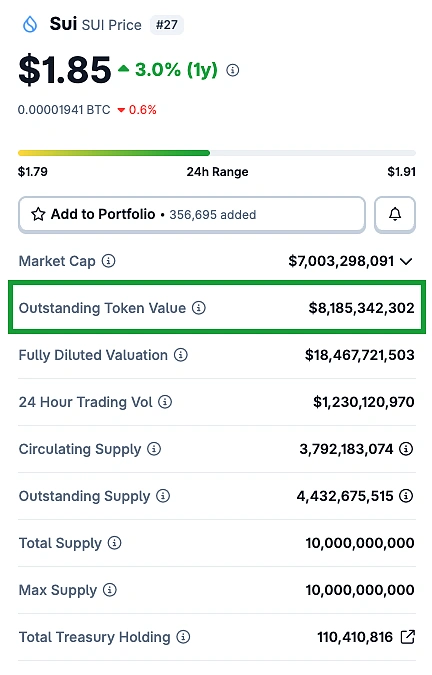
To ensure accurate OTV data, CoinGecko requires projects to submit detailed information about their token supply, including wallet addresses for locked, vested, and treasury holdings. This verification process helps maintain data integrity.
Bottom Line
Outstanding Token Value represents an evolution in cryptocurrency valuation metrics. By focusing on tokens with clear purposes and excluding idle supply, OTV provides investors with a more realistic assessment of a project’s economic value than FDV alone.
While FDV considers all possible tokens and Market Cap only counts circulating tokens, OTV strikes a balance by considering planned allocations. This makes it particularly useful for comparing projects with different token distribution strategies and understanding the true economic scale of cryptocurrency projects.
As with any metric, OTV should be used as part of a broader analysis rather than as a sole decision-making factor. Combined with fundamental analysis, market conditions, and other on-chain metrics, OTV helps investors make more informed decisions in the cryptocurrency market.
This article is only for informational purposes and should not be taken as financial or investment advice. Always do your own research and evaluation around any project, protocol, or cryptocurrency.
