Top Hot Wallets for Storing Cryptocurrencies

What Is a Hot Wallet?
A hot wallet is any crypto wallet that remains connected to the internet. This connectivity is what separates hot wallets from cold (hardware) wallets, which store private keys entirely offline. Hot wallets are typically delivered as mobile apps, desktop applications, or browser extensions, and they allow users to send, receive, and manage crypto assets with minimal friction.
Whether you are a first-time crypto holder or a seasoned DeFi participant, the wallet you choose shapes your entire blockchain experience. It determines which chains you can access, what features are available to you, and how you interact with the wider ecosystem.
However, because hot wallets are always online, they are inherently more exposed to potential threats than hardware alternatives. Even then, non-custodial hot wallets — where the user alone holds the private keys — offer a meaningful security upgrade over custodial exchange accounts, where your crypto is held by the exchange and subjected to custodial risks.
In this article, we review the top seven hot wallets of 2026, evaluating each on chain coverage, staking support, NFT and dApp capabilities, security model, and overall user experience to help you find the right fit.
Comparing the Top 8 Hot Wallets
|
Wallet |
Chains Supported |
Staking |
NFT Support |
dApp Browser |
Best For |
|---|---|---|---|---|---|
| Tangem Mobile | 87+ chains | Yes (SOL, ATOM, TRX, BNB + Aave yield) | Yes | Via WalletConnect | Hardware-backed mobile security |
|
Trust Wallet |
110+ chains |
Yes (ETH, SOL, BNB, MATIC) |
Yes |
Yes (mobile) |
Native Multi-Chain & High-Leverage Trading |
|
MetaMask |
EVM + Solana + BTC |
Via dApps |
Yes (EVM focus) |
Yes (extension) |
Advanced EVM & Modular Extensibility |
|
Coinbase Wallet |
EVM + BTC + SOL + more |
Yes (ETH, SOL) |
Yes |
Yes |
Account Abstraction & Layer 2 Integration |
|
Phantom |
Solana + ETH + Polygon + BTC |
Yes (SOL native + Jito) |
Yes (Solana focus) |
Yes |
Native Solana Performance & Digital Identity |
|
Exodus |
50+ blockchains |
Yes (ADA, SOL, ATOM, ALGO) |
Yes |
Via WalletConnect |
Cross-Platform Sync & Cold-Storage Bridging |
|
Blockchain.com |
BTC, ETH, XLM, BCH + more |
Yes (DOT, ALGO, ENA) |
Limited |
No |
Regulated Custody & MiCA-Compliant Rewards |
|
Atomic Wallet |
300+ coins / multiple chains |
Yes (multiple PoS assets) |
Yes (ETH, SOL, BSC) |
Via extension |
Trustless Peer-to-Peer (HTLC) Swaps |
Table data is as of March 2026. Chain counts reflect supported networks, not individual tokens.
Tangem Mobile: Best for Hardware-Backed Mobile Security
This section is brought to you by Tangem.

Tangem AG, based in Zug, Switzerland, has operated since 2017 and is known for its NFC-based hardware wallet cards and rings. In early 2026, the company introduced Tangem Mobile — a standalone app-only wallet that brings Tangem’s self-custody model to users without requiring physical hardware.
Keys are stored on the phone’s dedicated security chip, and users can upgrade to full hardware-backed signing by pairing a Tangem NFC card or a Tangem Ring at any time. The Tangem Mobile app was independently audited by Cure53, a Berlin-based cybersecurity firm, in Q4 2025, with no critical or high-severity vulnerabilities found.
Chain Coverage
The Tangem app supports 87+ blockchain networks and over 16,000 cryptocurrencies and tokens. Major supported chains include Bitcoin, Ethereum, Solana, BNB Chain, Polygon, Avalanche, Tron, Arbitrum, Optimism, Base, Cardano, XRP Ledger, TON, Cosmos, and Sui. Monad support was added in early 2026. In-app swaps work across all supported tokens without needing to pin them to the portfolio view first.
Key Features
-
No seed phrase by default: Tangem eliminates traditional recovery phrases, reducing a common attack vector. Mobile users are prompted to complete a backup phrase, while hardware users rely on linked NFC cards or rings.
-
Hardware upgrade path: A smooth transition from the Tangem mobile app to the hardware wallet. Start mobile-only, then pair NFC cards or a Tangem Ring later for tap-to-sign security, with no wallet migration required.
-
Staking: Native staking for SOL, ATOM, TRX, and BNB, plus external staking via WalletConnect and Tangem Yield (Aave integration).
-
Smart Gas: Pay gas fees in USDT or USDC on supported networks instead of the native token.
-
Multi-Accounts: Segment funds within one wallet for different purposes (DeFi, holding, spending).
-
dApp connectivity: WalletConnect support for DeFi protocols like Uniswap, Aave, PancakeSwap, and OpenSea.
-
Tangem Pay: Visa-powered crypto spending, currently rolling out with a UK/EU launch planned under MiCA compliance.
-
No wallet service fee: Users pay only blockchain network fees.
Considerations
-
Tangem Mobile is mobile-only with no desktop client or browser extension, which limits multi-window DeFi workflows.
-
Some assets may require pairing with Tangem hardware cards and are not available in mobile-only mode.
2. Trust Wallet: Best for Native Multi-Chain & High-Leverage Trading
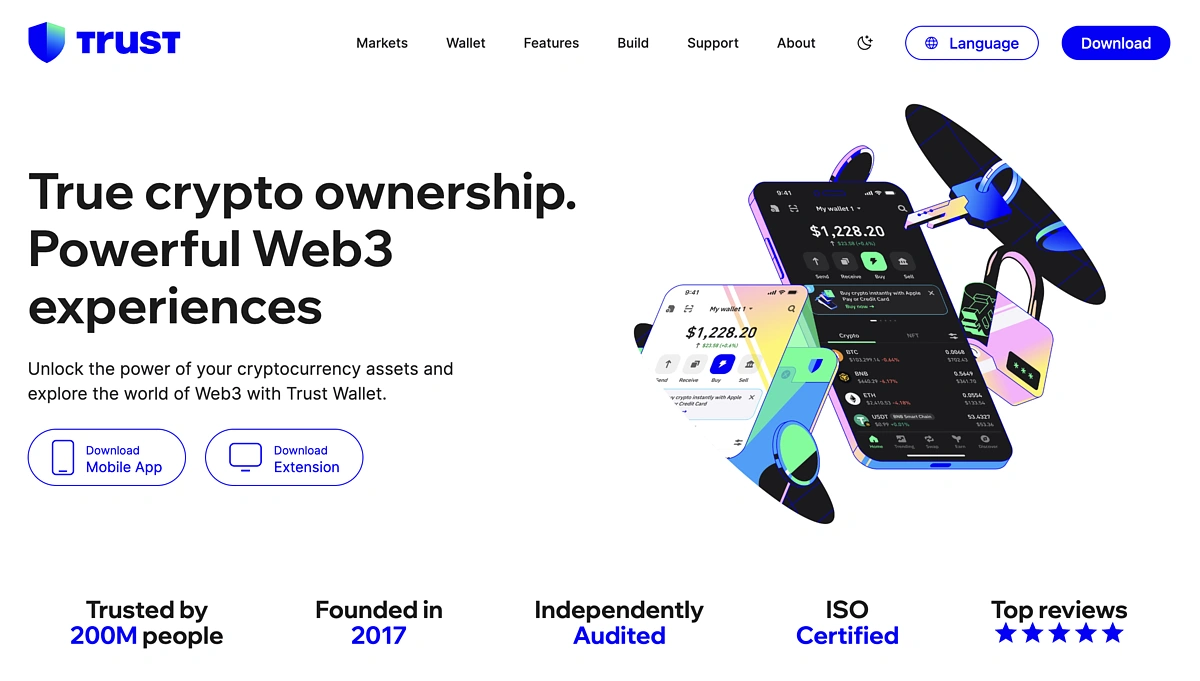
Originally launched in 2017 and acquired by Binance in 2018, Trust Wallet has since grown into one of the world’s most widely used non-custodial wallets, surpassing 220 million total downloads by the end of 2025 and reaching approximately 17 million monthly active users. It now operates as an independent entity and remains a cornerstone of the self-custody movement.
Chain Coverage
Trust Wallet’s headline strength is breadth. The wallet supports over 110 native blockchains — including Bitcoin, Ethereum, BNB Chain, Solana, Polygon, Avalanche, Tron, TON, Sui, Sonic, and Monad — alongside 1,000+ custom EVM chains and a catalogue of more than 32 million individual assets. Swaps between chains, including BTC-to-ETH cross-chain routes, are available directly within the app.
Key Features
-
Staking: Native staking for Ethereum (via Kiln), BNB, Polygon, Solana, NEAR, and other Proof of Stake networks, with minimum ETH staking as low as 0.025 ETH.
-
Trust Card & Trust Pay: The wallet is moving beyond storage to compete with traditional fintech by launching “Trust Pay” for gas-free transactions and a “Trust Card” for direct crypto spending.
-
No additional wallet service fee: Users only pay the DEX fee and gas.
-
Built-in dApp browser (mobile only): Direct access to DeFi protocols, NFT marketplaces, and Web3 games.
-
NFT gallery: View, store, and manage NFTs across Ethereum, BNB Chain, Solana, and Polygon.
-
Trust Wallet Premium: Tiered loyalty programme offering up to 50% gas fee discounts and swap fee reductions for active users who lock TWT tokens.
-
FlexGas: Pay gas fees using Trust Wallet token (TWT), reducing friction for frequent traders.
-
Advanced Trading: Introduction of perpetuals with up to 100x leverage for eligible users, and AI-powered investment insights.
-
Security scanner: A real-time tool that blocked more than $162 million in potentially harmful transactions in 2025.
-
Fiat on-ramp: Buy crypto via Apple Pay, Google Pay, and P2P options in eligible regions.
Considerations
-
The dApp browser is mobile-only, and desktop users will find the experience more limited than MetaMask’s browser extension.
-
For Ledger hardware wallet users, connectivity is available through the browser extension but not the mobile app.
3. MetaMask: Best for Advanced EVM & Modular Extensibility
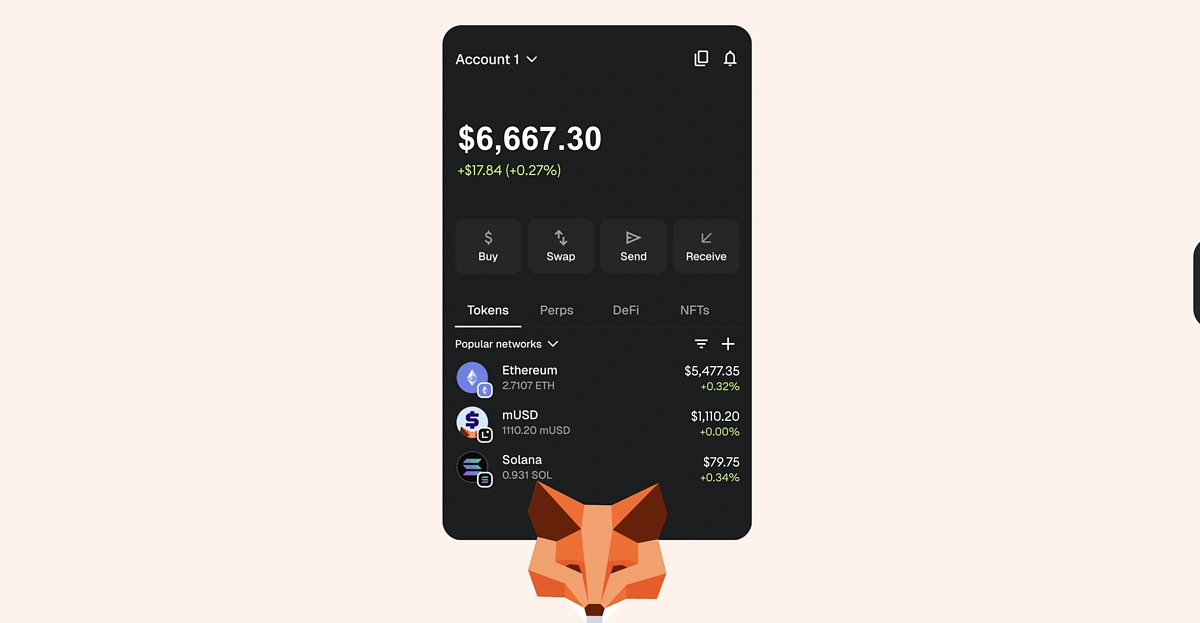
Developed by ConsenSys and launched in 2016, MetaMask is one of the most widely used hot wallets in the world, with an estimated 143 million total accounts created and approximately 30 million monthly active users as of mid-2025. It began as a browser extension purpose-built for Ethereum and has steadily evolved into a broader multi-chain platform while retaining its reputation as the default gateway to EVM-based dApps.
Chain Coverage
MetaMask supports all EVM-compatible networks out of the box, including Ethereum mainnet, BNB Chain, Polygon, Avalanche, Arbitrum, Optimism, and Base. In 2025, native Solana support was introduced alongside Multichain Accounts — a unified interface for managing EVM, Solana, and Bitcoin assets within a single wallet. Bitcoin and Tron support were added in late 2025 and early 2026 respectively.
Key Features
-
Swaps: Aggregates liquidity from 18+ providers for competitive rates; cumulative swap revenue has exceeded $325 million.
-
MetaMask Mastercard: Officially expanded across 49 US states (excluding Vermont) in early 2026. It features a physical “Metal Card” tier for power users with up to 3% cashback in stablecoins.
-
Tokenized Stocks: A new integration with Ondo Finance allows eligible non-US users to trade over 200 tokenized US stocks and ETFs directly within the wallet.
-
MetaMask Snaps: A modular extension system allowing third-party developers to add new chains, security tools, and features without altering the core wallet.
-
Transaction Shield: A premium subscription providing up to $10,000/month in transaction protection against misclassified malicious transactions.
-
Prediction Markets: In-app integration with Polymarket for trading on real-world event outcomes.
-
MetaMask Perps: Perpetual futures powered by Hyperliquid, available on mobile.
-
Smart Transactions: Reduces failed transactions by simulating outcomes before broadcasting.
-
Hardware wallet support: Full compatibility with Ledger and Trezor.
Considerations
-
MetaMask is an EVM-first wallet; non-EVM chain support may be less seamless than dedicated multi-chain wallets.
-
Native staking is limited; users must connect to external dApps like Lido or Rocket Pool.
-
MetaMask has also historically been a phishing target given its prominence, making vigilance around link verification important when clicking to connect your wallet.
-
MetaMask charges a wallet service fee of 0.875% for swaps on the wallet.
4. Coinbase Wallet: Best for Account Abstraction & Base Layer 2 Integration
Coinbase Wallet is the self-custodial companion to Coinbase’s centralized exchange, though it operates entirely independently — users do not need a Coinbase account to use it. Available as a mobile app and browser extension, it supports over 5,000 cryptocurrencies and has built a strong reputation for its security architecture and beginner-friendly interface. As of 2025, Coinbase Wallet has surpassed 15 million total installs globally, with approximately 3.2 million monthly active users — a distinct and smaller figure than the 120 million monthly users of the broader Coinbase exchange platform.
Chain Coverage
Coinbase Wallet supports all major EVM-compatible chains (Ethereum, Polygon, Arbitrum, Optimism, Base, BNB Chain, Avalanche) as well as Bitcoin, Solana, Dogecoin, Litecoin, Ripple, and Stellar. Coinbase’s own Layer 2 network, Base, is deeply integrated in the Coinbase Wallet and is actively promoted within the app. The wallet offers a curated experience compared to Trust Wallet’s maximal coverage, prioritising the most widely used networks.
Key Features
-
Security: 2FA, AES-256 encryption, biometric authentication, and token-approval alerts as standard.
-
Exchange integration: Frictionless asset transfers between Coinbase.com and Coinbase Wallet with no additional fees.
-
Staking: Native staking for ETH and SOL available directly within the wallet interface.
-
dApp connectivity: Supports Uniswap, Aave, Compound, PancakeSwap, and thousands of other dApps.
-
Smart Wallet: Coinbase’s account abstraction implementation simplifies onboarding by removing the need for gas tokens in some interactions.
-
NFT support: Full NFT viewing, management, and interaction with marketplaces.
-
dApp blocklists: Proactive security feature that flags and blocks known malicious applications.
Considerations
-
Coinbase Wallet’s curated approach means it covers fewer lesser-known chains than Trust Wallet or Atomic Wallet.
-
Coinbase wallet also has a fee of around ~1%, although this varies by asset/network and includes a spread.
5. Phantom: Best for High-Performance Solana & Web3 Social
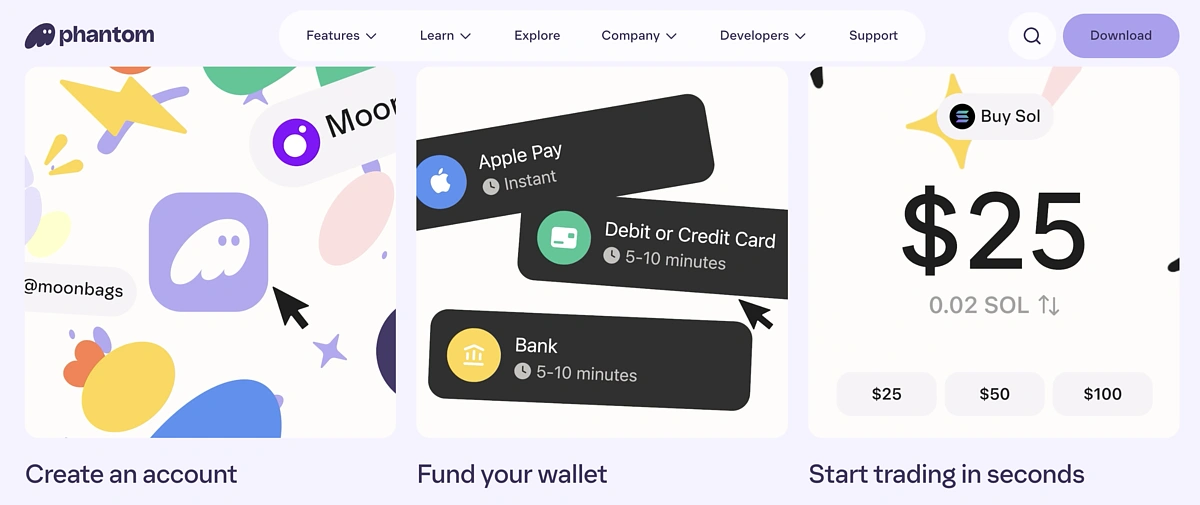
Phantom launched in 2021 as a purpose-built Solana wallet and quickly became the dominant interface for Solana-based DeFi and NFTs. In the years since, it has expanded into a genuine multi-chain wallet. By mid-2025, Phantom had grown to approximately 15–17 million monthly active users — up from 10 million in 2024 — with over $25 billion in self-custodied assets. A $150 million Series C funding round in early 2025 valued the company at $3 billion, underscoring institutional confidence in its trajectory.
Chain Coverage
Phantom natively supports Solana, Ethereum, Polygon, and Bitcoin. The wallet added Monad Mainnet in late 2025. While it does not yet cover as many chains as Trust Wallet, its supported networks are among the most actively used, and its Solana integration remains the deepest and most performant of any wallet in this list.
Key Features
-
Staking: Native SOL staking with validator selection plus Jito liquid staking, which issues JitoSOL tokens usable in Solana DeFi.
-
Seedless Login: Introduced optional MPC (Multi-Party Computation) technology, allowing users to log in without a traditional recovery phrase.
-
NFT tooling: A dedicated NFT tab, built-in Instant Sell, a Burn NFT feature for clearing spam tokens, and acquisition of SimpleHash (an NFT data platform) to enhance metadata.
-
On-chain Visa debit card: US users can make contactless payments directly from their crypto wallet balance via a virtual Visa card.
-
Prediction markets: Integration with Kalshi for in-app trading on real-world event outcomes.
-
Social profiles: Personalised usernames and community profiles make Phantom one of the most socially oriented wallets available.
-
Phantom Connect SDK: Allows dApp developers to embed Phantom accounts into their applications with support for Google and Apple social logins.
-
Blowfish acquisition and integration: An embedded Web3 security layer that flags malicious dApps, phishing sites, and risky contract approvals in real time.
-
Hardware wallet support: Ledger integration available.
Considerations
-
Phantom does not yet support BNB Chain or Avalanche, which limits its reach for users active on those ecosystems.
-
The on-chain debit card is currently US-only.
-
Wallet service fee is around 0.85%; some specific pairs or routes may have lower promotional rates.
-
Its multi-chain expansion is ongoing but trails Trust Wallet in raw coverage.
6. Exodus: Best for Cross-Platform Sync & Cold-Storage Bridging
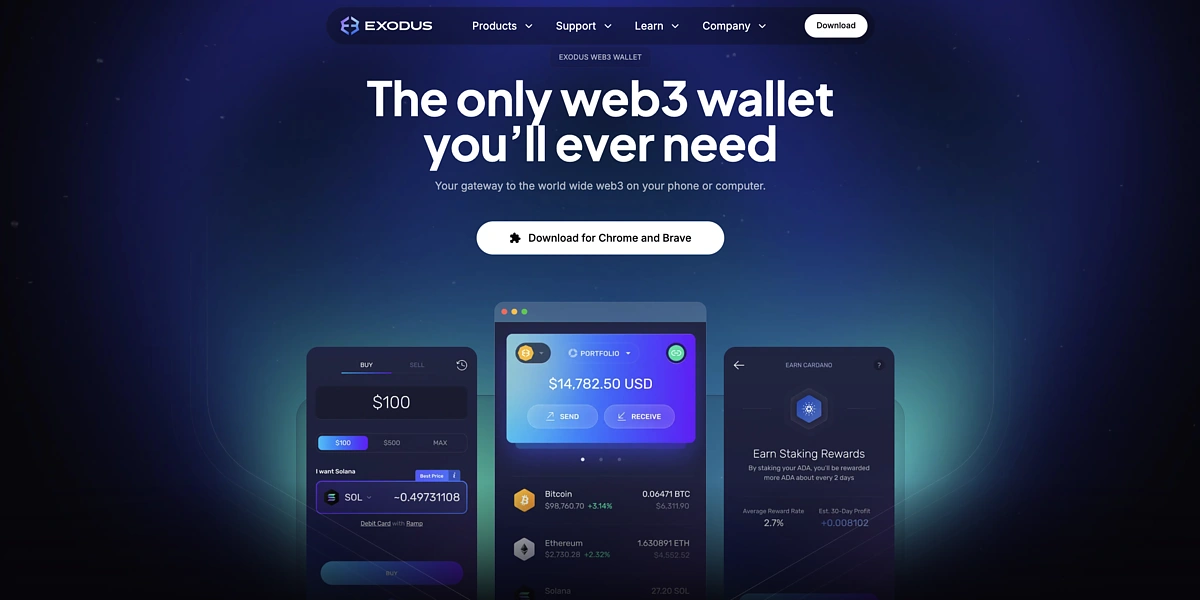
Founded in 2015 by JP Richardson and Daniel Castagnoli, Exodus was among the first non-custodial wallets to combine broad multi-asset support with an integrated swap engine and in-app staking — features that were uncommon at the time of its launch. Its focus on accessibility and cross-platform availability has helped it maintain a loyal following, and in 2021, the company completed a $75 million equity tokenization offering, becoming the first company to conduct a crypto-only public equity raise and listing on the NYSE American under the ticker EXOD.
Chain Coverage
Exodus supports 50+ blockchain networks and over 350 cryptocurrencies, including Bitcoin, Ethereum, Solana, Cardano, Cosmos, Polygon, Algorand, and VeChain. It is available across Windows, macOS, Linux, iOS, Android, and as a browser extension. Notably, the same wallet can be accessed and synced across desktop and mobile using QR codes.
Key Features
-
Staking: In-app staking for Cardano (ADA), Solana (SOL), Cosmos (ATOM), Algorand (ALGO), Injective (INJ), and Tezos (XTZ), with APR displayed in the wallet before you commit.
-
Built-in swaps: Routes to third-party providers (ChangeNOW, Changelly, SimpleSwap, and others) with the full quote shown before confirmation.
-
Exodus Pay: Launched in late 2025/early 2026 to facilitate mainstream stablecoin spending.
-
Trezor and Ledger integration: Pair with Trezor on desktop for cold-storage-grade signing; Ledger is supported on mobile for selected networks.
-
NFT gallery: View and manage Solana and Ethereum NFTs, with access to Magic Eden and OpenSea directly from the wallet.
-
Fiat on-ramp: Purchase crypto via Moonpay using debit/credit card in supported regions.
-
DeFi connectivity: Access to protocols like Aave and Compound Finance, as well as Web3 dApp integration via WalletConnect or the browser extension.
-
Privacy: No account required, no personal data collected, private keys stored locally.
Considerations
-
Exodus’s swap fees are routed through third-party providers and carry a variable spread, which can make trades more expensive than using a native DEX.
-
There is no built-in dApp browser on mobile; users must rely on WalletConnect for external connections.
-
Chain coverage is meaningful but not as broad as Trust Wallet’s 110+ networks.
7. Blockchain.com: Best for Regulated Custody & MiCA-Compliant Rewards
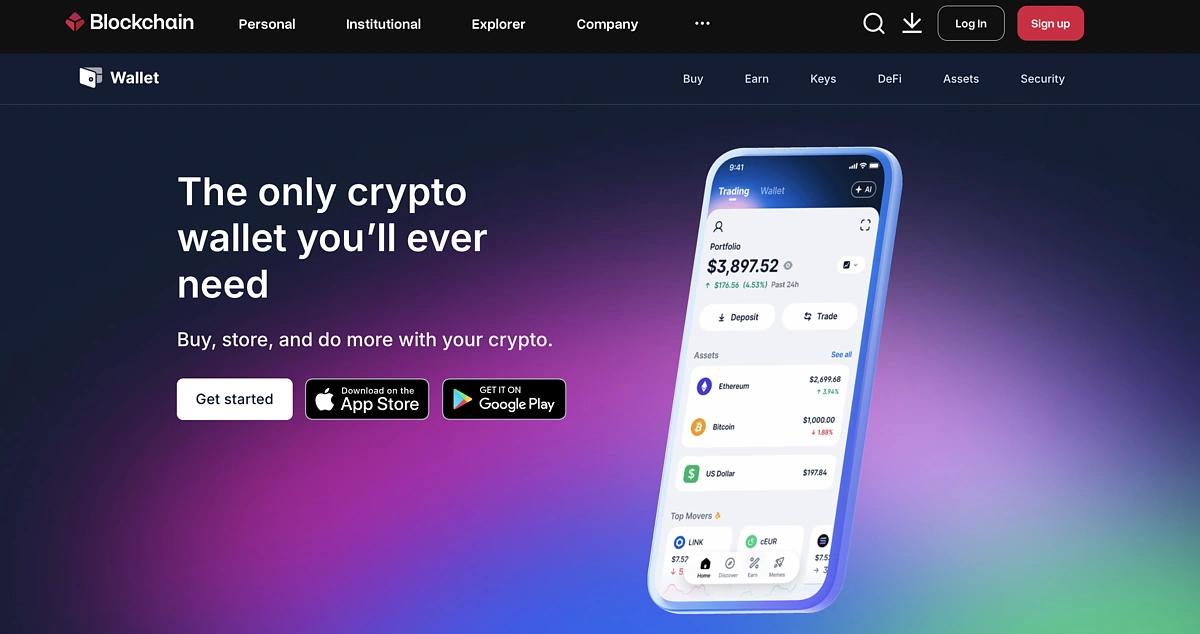
Blockchain.com is one of the oldest names in the industry, having operated since 2011. Its wallet has served a cumulative total of more than 86 million registered customers across over 200 countries since inception — a historical total rather than a monthly active figure, reflecting over 14 years of operation. While newer wallets have surpassed it on features, Blockchain.com retains a strong position thanks to its track record, its MiCA licence obtained from Malta’s Financial Services Authority (covering custody and wallet services across the EU), and its focused approach to Bitcoin and select major assets.
Chain Coverage
Blockchain.com focuses on the most established cryptocurrencies: Bitcoin, Ethereum, Bitcoin Cash, Stellar, Dogecoin, and a selection of major tokens. It supports 40+ trading pairs and four stablecoins. The wallet does not aim to compete with Trust Wallet or MetaMask on chain breadth; instead, it prioritises depth and reliability for its supported assets.
Key Features
-
Staking: Available for Polkadot (DOT), Algorand (ALGO), and Ethena (ENA), with daily reward payouts and annual yields of up to 10% depending on the asset and holding period.
-
Passive earning: Interest-earning features for qualifying long-term holders.
-
Security: Two-factor authentication, multi-signature transaction support, and full private key control.
-
HD wallet: Hierarchical Deterministic architecture generates a new address for each transaction.
-
Fiat integration: Buy and sell cryptocurrency using credit/debit cards or bank transfers in supported currencies (USD, GBP, EUR).
-
Multi-language support: Interface available in 25 languages, reflecting the wallet’s international user base.
Considerations
-
Blockchain.com Wallet is deliberately conservative in scope. It does not support a dApp browser, NFT management beyond basic token display, or the DeFi connectivity found in competing wallets.
-
Users who need broad multi-chain coverage or deep Web3 functionality will find Trust Wallet, MetaMask, or Coinbase Wallet more suitable.
-
Wallet Service Fees on Blockchain.com uses a “spread” model rather than a flat fee, usually ranging from 0.5% to 1.5% for wallet swaps.
8. Atomic Wallet: Best for Trustless Peer-to-Peer (HTLC) Swaps
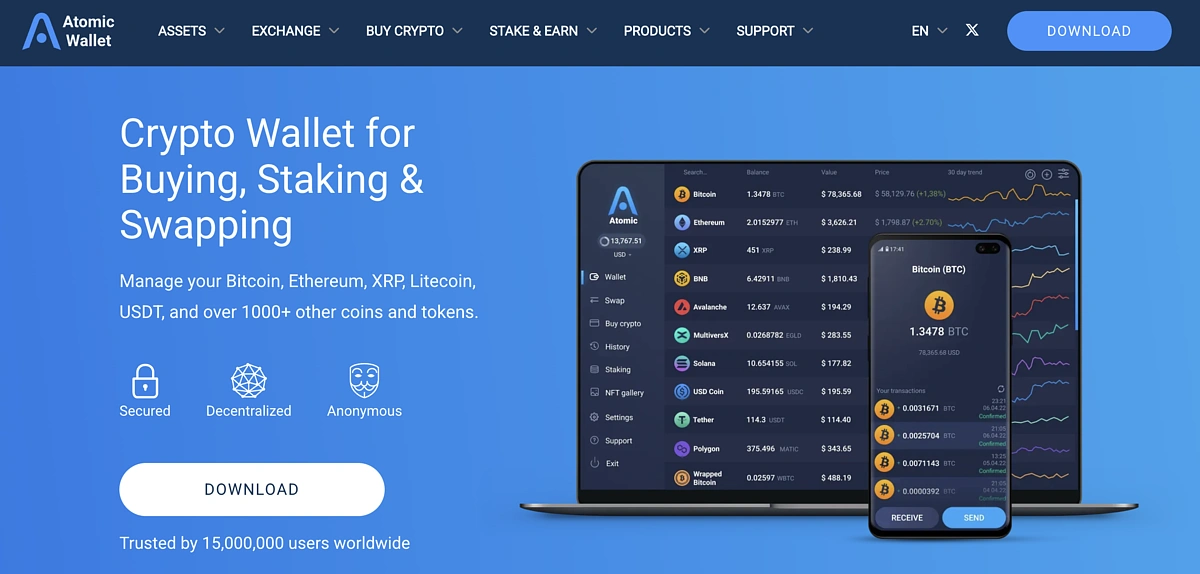
Atomic Wallet was founded in 2017 and positions itself as an all-in-one crypto management platform, emphasising breadth of asset support over depth of any single ecosystem. Led by Konstantin Gladych (former co-founder of Changelly) and with Charlie Shrem as a strategic adviser, the team is credentialed within the Bitcoin-native community.
Chain Coverage
Atomic Wallet supports over 1,200 coins and tokens across multiple blockchains, including Bitcoin, Ethereum, BNB Chain, Solana, Tron, Polygon, and many others. It generates native addresses for supported blockchains rather than simply tracking balances, enabling genuine send, receive, and management across the full supported list. Custom ERC-20 tokens can also be added manually via contract address.
Key Features
-
Atomic Swaps: Peer-to-peer, non-custodial exchanges using hashed time-locked contracts (HTLC) — a genuinely trustless swap mechanism that eliminates third-party counterparty risk.
-
Staking: In-app staking for multiple proof-of-stake assets, with annual yields displayed before committing.
-
AWC token rewards: 1% cashback in Atomic Wallet Coin (AWC) for in-app crypto purchases.
-
NFT gallery: View NFTs on Ethereum, Solana, and BNB Chain within the mobile app.
-
Web3 extension: A Chrome browser extension enables connection to Ethereum-compatible dApps and DeFi protocols including Uniswap, PancakeSwap, and 1inch.
-
Desktop availability: Windows, macOS, Linux, and mobile (iOS and Android)
Considerations
-
Atomic wallet is partially closed-source, where the underlying code for the application is not fully open for public audit.
-
Atomic Wallet experienced a significant security incident in June 2023, in which an estimated $35 million or more in user funds were stolen.
-
In an effort to restore trust following its 2023 incident, Atomic launched a $1 million Security Bounty Program in late 2025, offering rewards up to $100,000 for critical vulnerability reports.
-
True atomic swap functionality currently covers only select major assets, and native hardware wallet integration is absent.
-
Wallet Service Fees on Atomic Wallet are around 0.5% + spread, although the wallet offers a cashback program where holding AWC (Atomic Wallet Coin) can offset these fees.
How to Choose the Right Hot Wallet
The best hot wallet depends on how you use crypto. Here are some questions to consider when choosing a wallet:
Which blockchains do you use most?
If you are predominantly on Ethereum and EVM chains, MetaMask’s deep dApp integrations and Snaps ecosystem make it the strongest technical choice. For Solana and Solana NFTs, Phantom is purpose-built and best-in-class. If you hold assets across many different chains, Trust Wallet or Atomic Wallet give you the broadest single-wallet coverage.
Are you a beginner or an experienced user?
Coinbase Wallet and Exodus are among the most beginner-friendly options, offering clean interfaces, strong documentation, and approachable staking. MetaMask rewards experienced DeFi users on EVM chains who want full control and extensibility. Blockchain.com suits those who are Bitcoin-first and want simplicity above all else.
Do you need a desktop wallet?
Exodus is exceptional for desktop users, with polished apps for Windows, macOS, and Linux and seamless sync across devices. MetaMask’s browser extension is a strong desktop option for DeFi. Trust Wallet and Phantom are predominantly mobile-first, though both have browser extensions for desktop use.
How important is hardware wallet integration?
MetaMask, Exodus, and Coinbase Wallet all offer robust Ledger and/or Trezor integration, making them suitable for users who want to pair software convenience with hardware-grade private key security. Trust Wallet’s Ledger integration is limited to its browser extension. Tangem Mobile takes a different approach entirely: rather than connecting to a third-party hardware device, it stores private keys on the phone’s dedicated security chip from the outset, with an optional upgrade to tap-to-sign via a Tangem NFC card or ring — no separate hardware wallet purchase required to get started.
A Note on Hot Wallet Security
Because hot wallets remain connected to the internet, they carry inherent risks that cold wallets do not. Best practices for reducing exposure include:
-
Never share your seed phrase or private keys with anyone, including support staff or wallet developers.
-
Store your recovery phrase offline, on paper or a metal backup, in a secure location.
-
Use biometric or strong PIN protection on mobile devices.
-
Be cautious of phishing sites — always verify the official URL before connecting your wallet.
-
Regularly review and revoke token approvals to DeFi contracts using tools like Revoke.cash.
-
For holdings above your risk tolerance, consider pairing your hot wallet with a hardware wallet like Ledger or Trezor.
Conclusion
Hot wallets have evolved dramatically. What began as simple key management tools are now comprehensive financial platforms — enabling staking, cross-chain trading, NFT management, DeFi access, and even on-chain debit card payments from a single interface. The seven wallets reviewed here represent the leading options in 2026, each with a distinct strength:
- Tangem Mobile is the option for users who want hardware-backed key security.
- Trust Wallet excels at multi-chain breadth.
- MetaMask dominates EVM DeFi.
- Coinbase Wallet is the friendliest on-ramp to self-custody.
- Phantom owns the Solana NFT experience.
- Exodus is the most polished desktop wallet.
- Blockchain.com serves the Bitcoin-first long-term holder.
- Atomic Wallet covers the widest range of obscure assets.
Ultimately, the best wallet for your needs depends on your preferred chains and utility.
This article is for educational purposes only and does not constitute financial or investment advice. The wallets featured are included for informational purposes and their inclusion does not represent an endorsement. Always conduct your own research before using any wallet. Cryptocurrency involves risk, and you are solely responsible for securing your own funds.