


Axum support, one of the most popular web frameworks in the Rust ecosystem, is one of the highlights of the RustRover 2026.2 release. If you’re building web services, APIs, or distributed systems in Rust, this update makes it easier to navigate routes, understand request flows, and generate client calls directly from the IDE. Let’s take a closer look at why web development has become an important Rust use case, what makes Axum popular, and how RustRover can help you work with it more efficiently.
Why use Rust for web backend development?
For many years, Rust was primarily associated with systems programming, embedded development, and performance-critical infrastructure. While these remain important areas, the language has expanded into backend and web development. According to the Developer Ecosystem 2025 survey report, building web backends with Rust is the third most-popular use case, showing that Rust is increasingly trusted for building services and APIs. This shift matters because backend systems are often long-lived and business-critical, so this application of Rust signals confidence in its stability and ecosystem support.
Rust isn’t filling in the backend the same space as Node.js or Django. It appears where the stakes are high: in infrastructure APIs, data processing pipelines, high-throughput microservices, edge computing, and security-sensitive services, where memory safety bugs can have serious consequences.
The Rust ecosystem offers several mature web frameworks and libraries, each with its own strengths:
- Actix Web is known for its performance and mature ecosystem.
- Rocket focuses on developer-friendly APIs and conventions.
- warp emphasizes composable filters and type-safe routing.
- Poem provides simplicity with built-in OpenAPI support.
- Axum emphasizes ergonomics and modularity for HTTP routing and request handling.
Among them, Axum has emerged as one of the most widely adopted choices thanks to its ergonomic design, modular architecture, and seamless Tokio integration. Its popularity is reflected in more than 850K daily downloads on crates.io and over 25K GitHub stars.
What is Axum?
Axum is an HTTP routing and request-handling library that focuses on ergonomics and modularity. It is maintained by the Tokio team – the same people behind Rust’s most widely used async runtime – and that shows in the design. Axum builds on the infrastructure the Rust async ecosystem already has, and gets out of the way.
At a high level, Axum lets you:
- Route requests to handlers with a macro-free API – no #[get(“/”) ] decorators, just plain Rust functions.
- Declaratively parse requests using extractors, with compile-time validation of path parameters, query strings, and request bodies.
- Apply a simple and predictable error handling model that keeps error paths explicit.
- Generate responses with minimal boilerplate.
- Take full advantage of the Tower and tower-http ecosystem of middleware, services, and utilities.
That last point is what sets Axum apart from other frameworks. Axum doesn’t have its own middleware system – it uses tower::Service directly. This means Axum gets timeouts, tracing, compression, rate limiting, and authorization for free, just by pulling in Tower middleware. It also means middleware can be shared across applications built with hyper or Tonic – the wider Tokio ecosystem is your ecosystem.
Axum is designed to work with Tokio and hyper. Runtime and transport layer independence is not a goal at present, which keeps the design focused and the integration tight. You can learn more in the documentation.
Axum in production
Axum adoption spans commercial infrastructure and open-source tooling alike. The official Rust package registry, crates.io, runs on Axum. It is one of the highest-profile Rust web applications in existence, and it serves the entire Rust community on every cargo build. Cloudflare Workers support Axum directly through the workers-rs crate, allowing developers to write Cloudflare edge functions using the same Axum routing model they use in standard services.
Beyond these examples, Axum has become the recommended foundation for several Rust web stacks and starter templates. Loco, the Rails-inspired Rust framework, is built on top of Axum. It is also heavily used in production by Lichess for several of their core background services and microservices. Axum is increasingly the default answer when someone asks, “How do I build a web service in Rust?”
Navigate Axum routes and generate Reqwest calls faster
In Axum projects, route strings are the entry points to your service, but tracing them back to handlers, or related client calls, often still means searching through the code manually.
RustRover 2026.2 introduces support for the Axum and Reqwest libraries. The IDE now understands routes in your project, enabling URL resolution, endpoint discovery, and navigation between routes and handlers. Route calls include references and inlay hints that make endpoint relationships easier to understand at a glance. This release also adds Reqwest support with request generation and navigation features, helping you create client calls with less manual setup.
Route calls include references and inlay hints that make endpoint relationships easier to understand at a glance:
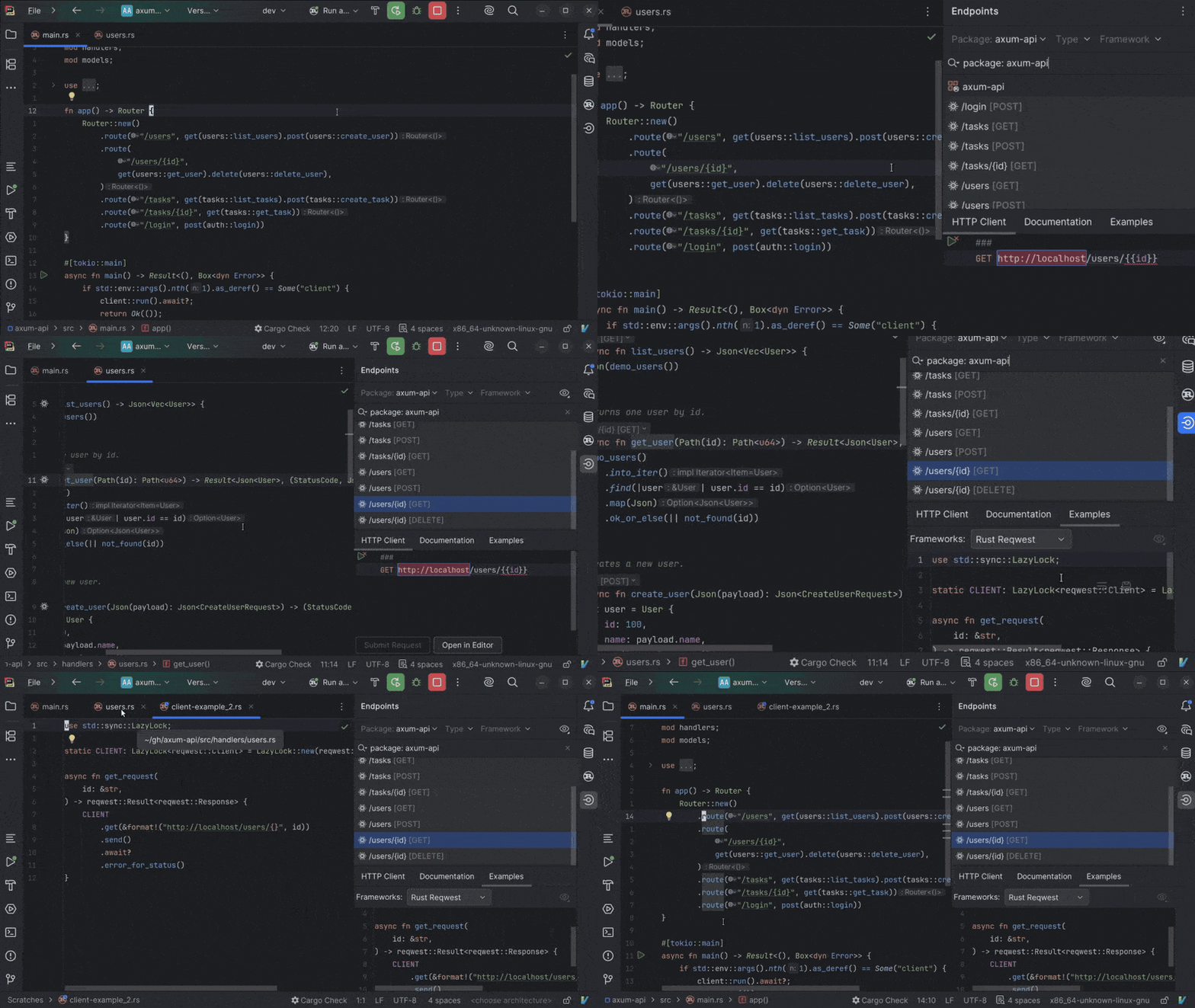
- Navigate from a route string to its handler and back using only the keyboard.
- Inlay hints on route declarations show the HTTP method and path inline, so the full picture of your API surface is visible in the editor.
- Reqwest support, including request generation and navigation features, helps you create client calls with less manual setup. RustRover can generate a Reqwest call for a given Axum endpoint and wire up the correct URL automatically.
In this release, Axum support is marked as initial. We’re continuing to invest in this area based on your feedback, so if something doesn’t work the way you’d expect, please report an issue or leave a comment below.
A note of gratitude
None of this would be possible without the sustained effort of the Tokio team and the Axum contributors, who have built and maintained an exceptional piece of open-source infrastructure. Axum is free, MIT-licensed, and relied upon by a growing number of production systems worldwide. If Axum is part of your daily work, consider sponsoring the Tokio project on GitHub. Open-source sustainability matters, and the Rust ecosystem gets better with every contributor who is able to keep showing up.
We’re grateful to everyone in the Rust community who has encouraged us to prioritize this integration and given us their feedback.
Download RustRover 2026.2 and try its Axum support for yourself. We’d love to hear what you’re building!

