

20 Years, 1 Mission
Meet Qodana Lead Alex Gopachenko
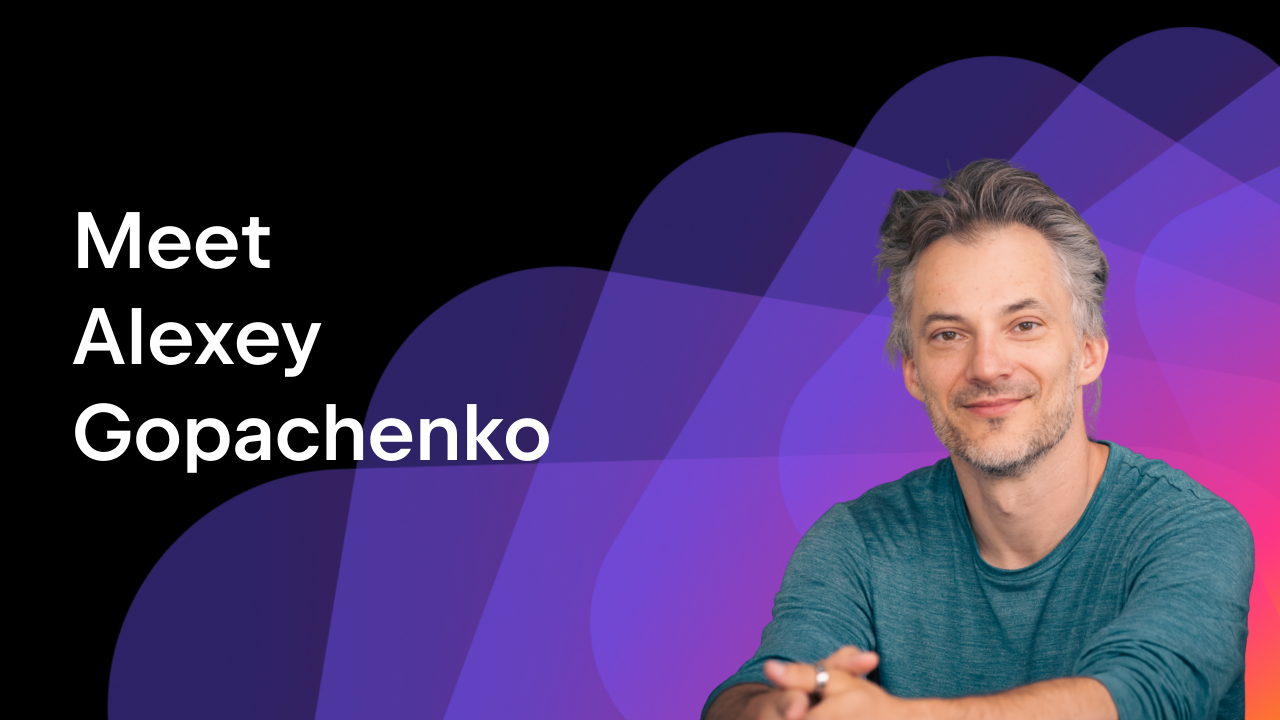
Twenty years is a lifetime in software engineering. Languages rise and fall. Frameworks become obsolete. Entire categories of developer tools appear, dominate the industry, and quietly disappear again. Yet through two decades of change at JetBrains, one engineer has remained focused on a remarkably consistent problem.
How do you help developers build better software?
This year marks Alexey Gopachenko’s twentieth anniversary at JetBrains. During that time, he has founded products including PhpStorm and WebStorm, helped build the analytics platform that today underpins product decisions across JetBrains, and helped Kateryna Shlyakhovetska with the evolution of Qodana from an internal idea into JetBrains’ code quality and security platform.
Looking back, however, Alexey doesn’t see those as separate achievements. “The funny thing is that from the very first day I became a JetBrains employee, I started making Qodana.”
At first, the statement sounds impossible. Qodana wouldn’t officially become a product until more than a decade later. But as Alexey explains, the foundations were already there.
Before Qodana had a name
Alexey joined JetBrains in 2007 as one of the first full-stack developers on TeamCity. His job was to export inspection results from IntelliJ IDEA into TeamCity, allowing engineering teams to monitor code quality as part of their build pipeline.
He built quality gates, inspection reports, project health dashboards and code coverage metrics before those ideas became common practice. “I was designing reports for inspection runs. If IntelliJ analyzed itself, you’d get one hundred thousand warnings. We needed quality gates. We needed project health. Looking back, it’s funny. It’s twenty years of making Qodana.”
Although the technology has evolved dramatically, the underlying mission hasn’t changed. “The purpose stayed the same. We need to make a sandbox where developers can experiment, but keep the quality.”
Changing PHP by building better tools

Alexey’s next challenge would become one of JetBrains’ defining success stories. As the creator of PhpStorm and later WebStorm, he wasn’t trying to build another IDE. His ambition was much simpler. He wanted PHP developers to experience what Java developers already had inside IntelliJ IDEA.
“I was fascinated with IntelliJ IDEA. You touched it and it just clicked immediately. I think many of our customers know that feeling. It’s like, ‘Shut up and take my money.’” At the time, PHP had a reputation for poor tooling. “It didn’t have good debugging. It didn’t have good tools,” says Alexey. The team set out to change that.
What followed was far more influential than a successful IDE. PhpStorm introduced advanced type inference, inspections and code intelligence that helped establish conventions across the PHP ecosystem itself. “We helped PHP become tool friendly.”
Some of those conventions would eventually influence features adopted by the language itself. It is an unusual example of tooling shaping a programming language rather than simply adapting to one.

Learning that data beats intuition
As PhpStorm matured, Alexey encountered a problem many product leaders eventually face. The obvious improvements had already been made. Choosing what to build next became significantly harder.
“At some point, those easy projections ended. You need much tighter feedback. You need to measure user interaction. You need to measure quality.” That realization fundamentally changed how he thought about product development.
“I have to make a conscious effort to understand that I’m maybe not a good proxy for a customer.” Instead of relying purely on instinct, Alexey helped build the analytics platform that now supports product teams across JetBrains.
He laughs when describing those early years. “Before that we were developing our super complex John Deere-type combine and dropping it into the wilderness. We designed it to harvest potatoes, then discovered people were trying to cut bananas with it.”
The lesson was simple: You don’t improve products by assuming how customers work, you improve them by observing how they actually work. “Sometimes people pulled rank. Sometimes we agreed to disagree. It was unproductive. Obtaining the data helped with that dramatically.”
The customer conversation that created Qodana
Although the technology already existed, the product still didn’t. That changed during a customer visit to a large online retailer that supported creators globally. Alexey suggested bringing TeamCity’s inspection capabilities into the company’s development process.
The engineers loved the idea. Unfortunately, they couldn’t adopt TeamCity itself. Their software delivery platform had evolved in a different direction. Standing outside afterwards with colleagues overlooking New York, the solution suddenly became obvious.
“We stepped back, looked at the bridge and the water, and realized: we need to take this part out.” Instead of selling an entire CI platform, JetBrains could separate the quality engine and allow it to integrate into any pipeline. That insight became Qodana.

AI has changed the problem, but not the mission
Today, software engineering faces another transformation. Developers generate more code than ever before. Alexey doesn’t believe the biggest challenge is quantity.
“Now every engineer produces ten times more code. The code is syntactically perfect… but the problems become harder.” Security, data flow, architecture, lifetime management.
These are the issues AI struggles to reason about consistently, and the areas where deterministic analysis becomes even more important. Alexey believes organizations need something AI alone can’t provide: repeatability, auditability and deterministic quality controls. “We don’t resell compute” he says. Instead, Qodana aims to provide engineering teams with reliable, repeatable safeguards that work regardless of how code is produced.
Twenty years later
Looking back across two decades, Alexey’s career appears remarkably consistent. PhpStorm professionalized development for one ecosystem. JetBrains Analytics changed how products are built internally.
Qodana is now redefining how organizations approach software quality in the age of AI. The technologies changed but the mission didn’t.
“We try to build the best tooling for JetBrains itself. Then we make it exportable so other companies can use it too” says Alexey. Twenty years after joining JetBrains, Alexey Gopachenko is still asking the same question he started with. How do we help developers build better software? Only now, the answer matters even more than it used to.
Want to stay up-to-date with Alex and the team’s work?
Subscribe to the Qodana blog.
