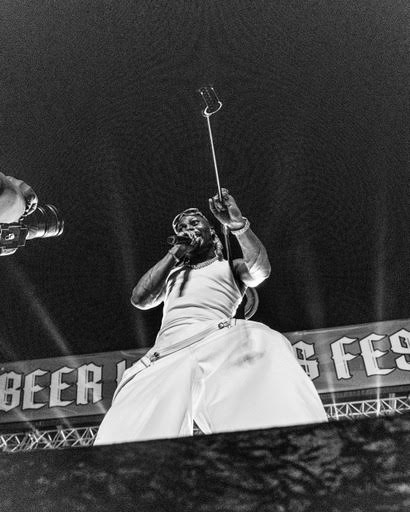

On Wednesday, Harry Styles begins his 30-night residency at Madison Square Garden, making him the latest in a wave of celebrities who are turning away from conventional touring and changing the experience of live music as a result.
In recent years, Adele, Bad Bunny, and Billy Joel have all had sold-out residencies in Munich, Puerto Rico, and New York, respectively. This means that fans can’t just wait for a visit to their hometown — they have to buy a ticket and book a trip, sometimes a very expensive one.
Residencies have become a high-profile example of how the economics of entertainment are changing how we experience culture, and who can even afford to have that experience.
There are a number of reasons for the trend: residencies are more cost-effective for musicians and crew, and they’re a lot easier in other ways. Burnout, exhaustion, and substance abuse have long been features of touring musicians’ stories from the road, and residencies alleviate some of that physical and mental toll — at least for the superstars who can book them.
The fans, however, especially the ones coming in from out of town, have to pick up that tab now. Today, Explained host Astead Herndon interviewed Billboard writer Robert Levine about this topic back in February. They discussed why this has happened — and how, for many fans, these costs can actually be worth it. Residencies create increased pressure to create a “sense of event,” and ensure every show offers something special — really delivering for the handful of people who can make the trip, and creating FOMO for those who can’t make it, which is kind of the goal of all of it.
There’s much more in the full podcast, so listen to Today, Explained wherever you get podcasts, including Apple Podcasts, Pandora, and Spotify.
I’m based in New York, so Harry Styles’s tour really perked my interest. He’ll be here for a 30-night residency and he has no other US shows on his tour. Can you explain to me the business of Harry staying put like this? Why has this become a thing for artists? What do we think this tour represents?
What’s interesting is all the writing and all the talk about the concert business focuses on the money that’s going in. Hardly anyone thinks about the money going out. As always, they have crew, they have musicians, they have expenses. The most expensive part is getting it all around. So imagine if you could minimize that expense and make the same amount of money.
So is that why we’re seeing someone like Harry Styles sit for 30 nights at MSG? It’s to lower travel costs?
Well, look, I mean haven’t talked to Harry Styles, so I’m just making an educated guess, but yes, I think so. And there’s the sort of capital-R residency that he’s doing. He’s declaring this a residency, and he’s making an event of it. But if you look at the concert business in general, you are seeing a trend — and sometimes people don’t notice it — toward playing more shows at fewer venues. The same kinds of economic forces are changing the nature of what we might call regular tours. Now you’re seeing more two-night stands, more three-night stands, more four-night stands.
And there’s also…this isn’t economics, but there’s also lifestyle considerations. All those classic rock songs about the romance of being on the road; “Turn the Page” by Bob Seger where he was talking about how burnt out he is. … There used to be a romance to being miserable and now there’s not.
Rock stars on tour, the crazy bus, all of that stuff.
We’re coming to your town, we’ll help you party down. Now you have to come to them and help them party down. And I think people realize a lot of the performers are getting older. They might not want to move around so much. But also remember when Elvis was in Vegas? This is not Elvis the teen sensation who wouldn’t be filmed below the waist. This is Elvis the middle-class performer, and in Vegas, he could stay in a really nice hotel rather than be in a van.
I’m going to ask about the New York piece. When we think about Harry Styles specifically, I think back to the fame, and I don’t have to go all the way back to Elvis for famous residencies in Vegas. Think about Celine Dion, or more recently, folks like Adele or even Usher.
Vegas had an advantage in that a lot of people were there with expense accounts always. That’s probably less the case today, but it’s still a convention in a conference town. If you’re charging people that amount of money, it doesn’t just need to be a great show. It needs to be part of a great weekend. It has to be a city with a lot to do. It has to have great air connections and a lot of hotel rooms. New York scores on all of those.
It seems as if from what you’re saying, it makes sense for the artist in terms of reducing travel costs. It makes sense because maybe resale markets have made it clear to the entertainment industry that the demand for higher prices is there. But it does, as you mentioned, also raise expectations of what fans expect to experience at the concert. I wonder: in your opinion, are fans getting more for their money at these shows since they’re more expensive now?
I think that’s so much in the eye of the beholder, right? For Adele in Munich, where she had a residency two summers ago, they built the biggest video screen in the world. Bigger than a football field. It was gigantic. I’m not that interested in a big screen. I don’t care if it’s the biggest screen. I’m not counting. She performed with fantastic musicians, and the staging was really creative. I thought it was an incredible show. I took the train four or five hours to go from Berlin. I thought it was fantastic and well worth it. Was I excited about the Ferris wheel? Honestly, not really.
What limits artists outside of the Adeles or Harry Styleses from adopting this residency model?
I think it’s less about the size of the artist and more about the implied specialness of it. It’s about FOMO. These are the biggest concerts, but there’s a lot of great concerts. How do you sell this as a special thing? Well, you play your marquee album, you promise two shows, two nights, no repeats. Metallica did that.
You really have to create a sense of event. You have to have a claim on people’s souls. In the modern concert business…it’s not so much, why do you want to see them? but, why now and not next year or the year after?
How do you see these residencies having an influence on the way the live event industry operates as a whole? Part of what we’ve been looking at are the changes that have occurred in the industry post-pandemic. Where do you see this piece fitting in?
I have to admit that a lot of people in the business and who write about the business have been very cautious about the boom in the industry. Look at the price spike post-Covid. But what happens when that ends? When will that bubble burst? Look at how high prices get, will people still have the money to go to other concerts?
And the truth is…the demand to see shows has proven all of this wrong. There’s always this idea that it’s a winner-take-all business: you’re going to travel to see Harry Styles, you’re not going to see other shows…logically, that money ought to be not spent on other concerts. But you don’t see that. And this is at a time when the economy is very, very good for some people and pretty lousy for most people. So that might be another reason why people are so interested in playing New York and LA because you get more people with disposable income. Other people can fly there, but at some point, I don’t know what the limit is. We don’t seem to get there.
People who might buy a cheaper pair of jeans or a cheaper television don’t seem to look at…concerts are not a competitive good. Who’s your second if you can’t go see Harry Styles? Who’s the artist most like Harry Styles, who’s also playing a concert? Who’s most like Beyonce, who’s not Beyonce? The answer is nobody.
Yeah. If Kelly Rowland was doing concerts, I would be moving in the same way. Right? It’s specific to that artist. And I can kind of see your point…that is what has made this shift be more permanent than folks expect now.
By the way, I bet some of those artists that you would say don’t compare to Beyonce, put on great shows.
For sure.