

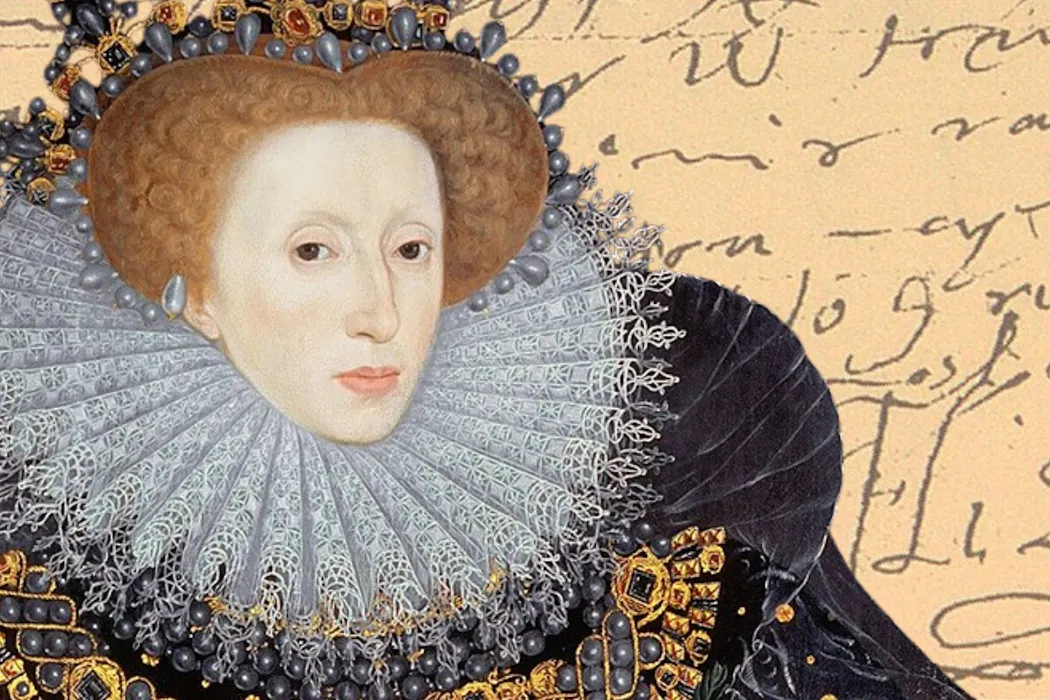
On February 10 1586, Elizabeth I wrote one of her most famous letters: a furious rebuke to her favourite, Robert Dudley, 1st Earl of Leicester. She sharply reprimanded him for disobeying her.
“How contemptuously we conceive ourself to have been used by you,” Elizabeth rages. “We could never have imagined that a man […] extraordinarily favoured by us would have in so contemptible a sort broken our commandment.” She demands that Leicester obey her directions, and warns him: “Fail you not as you will answer the contrary at your uttermost peril.”
The queen’s fury jumps off the page. Yet the only surviving copy of this letter is written in the hand of a secretary: Francis Mylles, servant to Elizabeth’s principal secretary, Francis Walsingham. Were Mylles and Walsingham involved in writing this apparently personal communication of the queen’s?
Without the original copy of this letter, we cannot say for certain. However, through careful analysis of over 500 other letters of Elizabeth’s, I have discovered that the expression of emotion in her letters was often carefully constructed by her secretaries.
Around 3,000 of Elizabeth’s letters survive, of which the overwhelming majority were penned by scribes. These so-called “scribal letters” have been severely neglected by historians, with priority given to those written in Elizabeth’s own hand.
Work on Elizabeth’s letters has focused on identifying the queen’s “voice” within them. Yet they were often the products of collaboration between Elizabeth and her secretariat.
Disentangling these collaborations, and recovering the contributions of Elizabeth’s secretaries, was the focus of my PhD research – part of the Feathers project. Led by Nadine Akkerman, professor of early modern literature at Leiden University, Feathers sought to distinguish between authorial and scribal voices in collaboratively produced manuscripts from the early modern period (around 1500-1800).
Finding Elizabeth’s voice
How can we distinguish between Elizabeth’s voice and that of her secretaries? It might be assumed that the more personal elements of her letters, including the expression of emotion, can be safely attributed to Elizabeth herself.

National Portrait Gallery
This is logical enough: daring to communicate or presume to know the queen’s feeling without her prior instruction would have been bold indeed. Further, early modern secretaries were expected to employ formal and impassive language and exert a tempering influence, moderating emotion to ensure the goodwill of the addressee.
However, as I dug into the archival material, a more complicated reality emerged. Elizabeth’s letters survive in a dizzying array of versions, including drafts, sent letters and copies. Through the reassembly of these different manuscripts, painstaking handwriting analysis and close textual comparison, I found evidence that the expression of emotion in Elizabeth’s letters was carefully crafted by her secretaries.
One example is a letter from Elizabeth to the Earl of Shrewsbury, written in May 1584. At this time, Shrewsbury was the custodian of Mary, Queen of Scots: claimant to the English throne and thorn in Elizabeth’s side.
In the letter, Elizabeth strongly criticises Mary and her son, James VI of Scotland. Elizabeth writes that Mary “shall never live to see those days that the Crown of England shall depend upon the Crown of Scotland”. She also criticises James heavily, claiming that he was “evil counselled when at the first entry into his government the same was seasoned with blood” (a reference to the 1581 execution of his regent James Douglas, Earl of Morton).
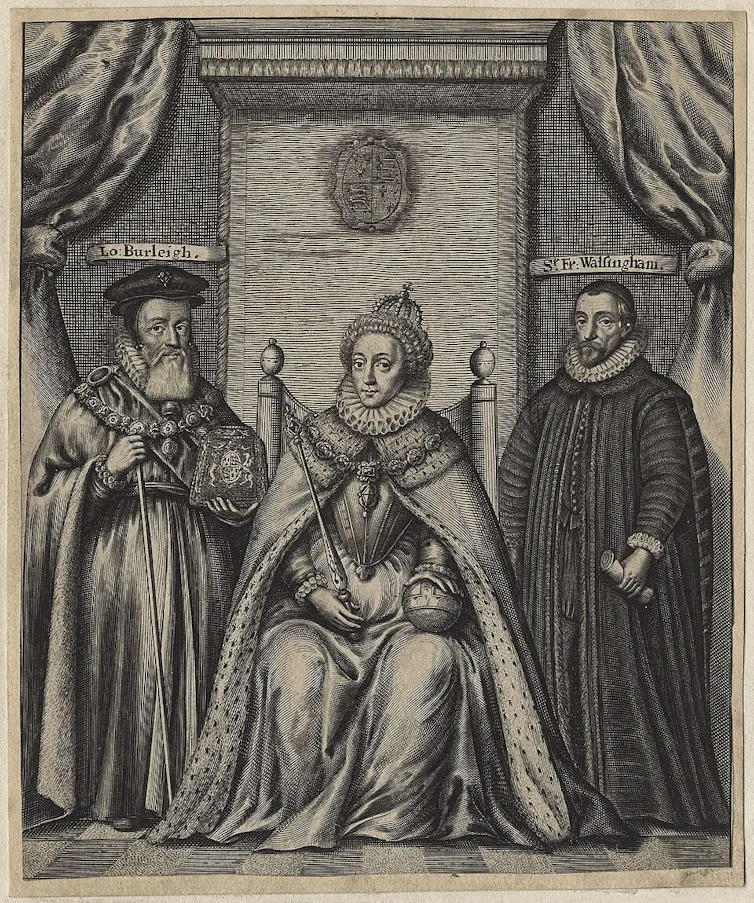
Identifying the draft of this letter, I discovered that it was substantially edited by Walsingham, whose handwritten revisions remain on the manuscript.
Walsingham’s edits intensify, rather than temper, Elizabeth’s criticisms of Mary and James. The vocabulary of these revisions bears significant overlap with that in Walsingham’s own writings. Evidently, it is Walsingham’s voice, not Elizabeth’s, that speaks in this letter – and possibly his emotion that spills out of it.
In another letter – written to Ralph Sadler, another of Mary Stuart’s custodians, and also intended for Mary’s eyes – Elizabeth again criticises Mary, but is more conciliatory. She describes the “liking we had for a time” of Mary’s friendship, and raises the potential for “a thorough reconciliation”.
Elizabeth has been assumed to have composed this letter; however, my recovery of a hitherto unnoticed draft – which is littered with Walsingham’s scribbled emendations – revealed that these expressions of goodwill were not Elizabeth’s, but Walsingham’s.
National Portrait Gallery
Walsingham’s alterations to both letters were made to manipulate Mary’s impression of her relationship with Elizabeth and move her to act in English interests.
By crafting an “angry” Elizabeth in the letter to Shrewsbury, Walsingham hoped to show Mary that refusing to cooperate with the English government would get her nowhere. By constructing a “nostalgic” Elizabeth in the letter to Sadler, he sought to convince Mary that Elizabeth’s favour could be regained, in the hope of dissuading the former from plotting against the latter.
That Walsingham crafted and even intensified the expression of emotion in Elizabeth’s letters is remarkable, and sheds important new light on this iconic queen. It provides an important corrective, for example, to Elizabeth’s reputation for emotional outburst.
Many anecdotes of Elizabeth’s short temper survive, and there is an inherited idea from the early modern period that these outbursts were evidence of a female irrationality. That the expression of anger in Elizabeth’s letters was crafted by her male secretaries reveals that, far from being overly emotional or irrational, Elizabeth strategically deployed emotion to achieve particular political goals.
She did so, crucially, through collaboration with secretaries such as Walsingham, who evidently had a far greater and more creative hand in constructing her letters than has been realised.
What does this mean for Elizabeth’s voice? As I unpicked these collaborations with her secretaries, I began to see that the voice we encounter in her letters is a carefully – and collaboratively – constructed rhetorical performance.
Rather than search for Elizabeth’s authentic voice, we might instead appreciate her political savvy and willingness to incorporate the suggestions of her advisors – qualities of a strong monarch indeed.

Clodagh Murphy’s PhD research was funded by the European Research Council (ERC).
