
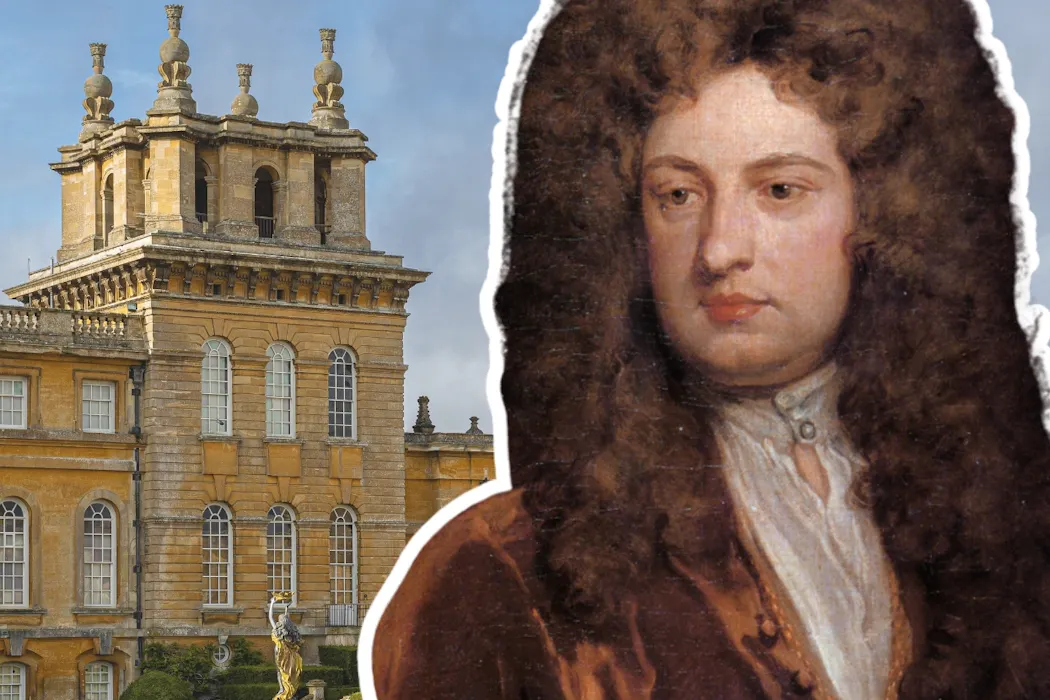
Every generation discovers its own heroes. I found mine in 2026. He died in 1726 and his name is John Vanbrugh (1664-1726). I’m not the first to discover him, of course, and I am in stellar company. This year has seen the Vanbrugh300 tercentenary celebrations of Vanbrugh’s life and legacy, looking at him in the round as soldier, playwright, architect and all round fun person to know.
In the 18th century, John Soane acknowledged Vanbrugh as “the Shakespeare of architecture”. Soane was professor of architecture at the Royal Academy of Arts, London from 1806. He declared:
It is impossible to contemplate the works of Sir John Vanbrugh without feeling those emotions which the happy efforts of genius alone can produce. In his bold flights of irregular fancy, his powerful mind rises superior to common conceptions, and entitles him to the high distinctive appellation of the Shakespeare of architects.
Few large country houses still represent current political power and extreme wealth that they did in the 18th century. So why value them now? Post-second world war reconstruction threatened historic city centres, and country houses were being demolished at an alarming rate. This continued well into the 1960s. Arguments to protect nature, beauty and art finally resulted in changes to the planning system in 1968.
Now the conversation has widened to how much people benefit from access to green space, sources of awe and wonder, and the past as a pool of creative inspiration. Country houses have been opened up to large-scale tourism since at least the 1960s; deference has been replaced by leisure and pleasure.

National Portrait Gallery
Can we still put Vanbrugh on a pedestal next to Shakespeare? Academic discourse has begun to step away from the idea of the lone genius. “Great men” striding through history hide the hard work, team effort and lucky breaks that accompany creative work. Historic buildings are truly bespoke, everything hand made by teams of highly skilled artisans. Vanbrugh’s creative partnership with architect Nicholas Hawksmoor (1631-1736), for example, was essential to his success.
Hawksmoor had trained in constructing buildings and managing sites, having worked in the office of Sir Christopher Wren, the architect of St. Paul’s Cathedral in London. Vanbrugh had social connections, great client management skills and something extra – the “bold flights of irregular fancy” that Soane identified.
Vanbrugh’s buildings represent joint authorship, with both men contributing designs. It is hard to distinguish between them, but Hawksmoor never got the same applause in his lifetime or afterlife that Vanbrugh received. Perhaps this was to do with their differing social status, or the fact that Vanbrugh died when the monumental style was still fashionable.
Staging the country house
Vanbrugh’s architectural practice was almost entirely about building country houses, designing landscape settings for them and, rather endearingly, building homes for himself and his family members in the London borough of Greenwich. One of the joys of being an architectural historian is the chance to go and meet the buildings. Vanbrugh’s houses deliver on sensory impact and stirred emotions – the wow factor.
There is much to experience, as his major country houses survive and welcome visitors. The grandest and largest is Blenheim Palace in Oxfordshire, the nation’s gift to the soldier who beat the French at the battle of Blenheim, Bavaria, in 1704, John Churchill, Duke of Marlborough. Blenheim is a world heritage site, for the significance of the house in its original designed landscape.
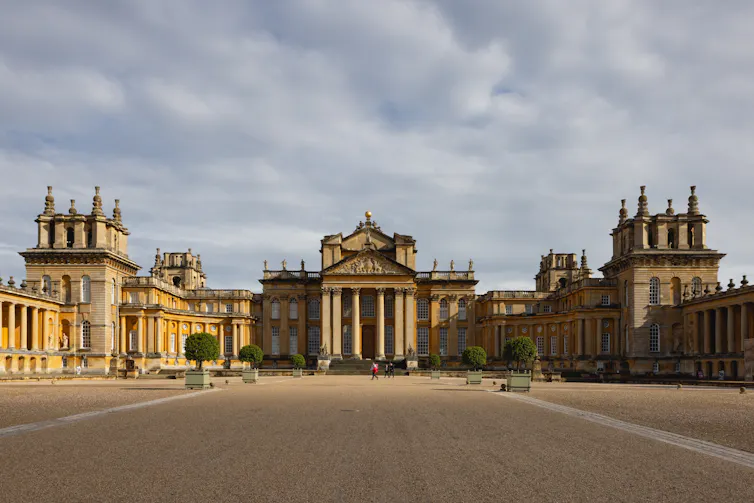
Radomir Rezny
The visitor route leads you through a massive golden stone archway, scaled up to make humans feel tiny – and this is just the side entrance. The house itself is best seen from the main entrance court, an architectural expression of national pride.
The skyline elevates the house into a theatrical scene, using the classical language of architecture but with massive masonry additions to emphasise verticality (Hawksmoor designed the sculptural tops of the towers), and Vanbrugh’s manipulation of the effects of light and shadow on the cliff-faces of walls that break forward and recede. This is the castle aspect recast in classical form.
Visitors could feel overwhelmed by the weight of history, acreage and the now alien way of life it enshrines. Instead, the present day interpretation breaks the site into several stories: the servant’s eye view; traditional showcase state rooms and the private rooms which are still lived in. We get to choose how we encounter its social history. Having a resident family with continuous occupation is a huge help in offering authenticity to the visitor experience.
In bracing contrast to Blenheim’s robustness, the fantastically fire-gutted Seaton Delaval Hall in Northumberland, is now owned by the National Trust.
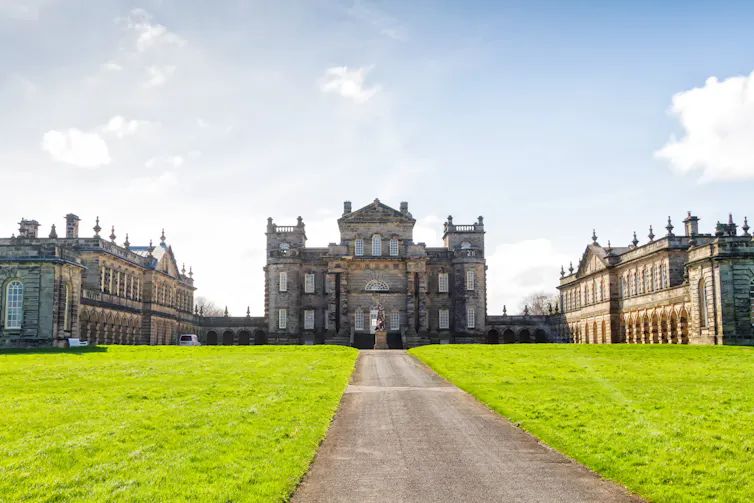
Milosz Maslanka/Shutterstock
Seaton Delaval suffered from a serious fire in 1822, destroying the interiors of the main house, but leaving the stone walls, marble floors and even plaster statues in place. The roofed ruin offers a theatrical spectacle of an ancient Roman house, especially in the great hall with Vanbrugh’s Roman arches beating out a visual rhythm.
Externally, you might recognise elements from Blenheim: the high central block and high towers at the corners. The unique seven-sided corner towers remind me of the Tudors and Stuarts, who also played with theatrical castle-like houses. The National Trust have kept the character of this stony monument, using the intact wings to “meet the family”, the rather jolly Delavals. Seaton is just north of Newcastle, surrounded by former mining towns; this estate offers a community garden and green space among urban development.
In Vanbrugh’s day, country house visiting was an activity for wealthy friends and family. Now we are invited in to share the experience on new terms, giving our cultural and civic support to the survival of works of art that we know will never be matched. Go and meet him.

Susie West does not work for, consult, own shares in or receive funding from any company or organisation that would benefit from this article, and has disclosed no relevant affiliations beyond their academic appointment.