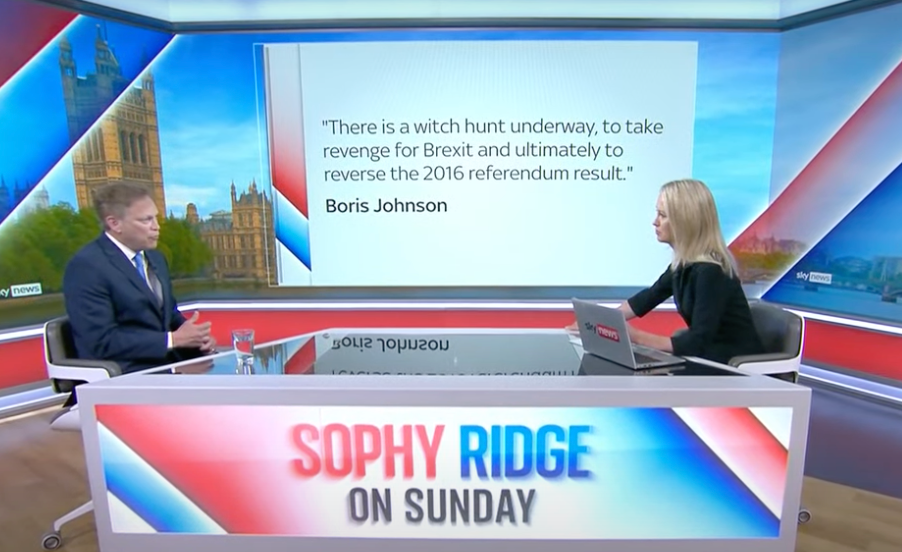
He said: “I happened to vote for Brexit as it happens, but I actually do think it’s working in favour for this country.”
But Twitter users were quick to point out that this flew in the face of what he said before and after the 2016 referendum.
Speaking before the country voted, Shapps told Sky News: “In the end I have come to the conclusion that because of concerns about the uncertainty of leaving, what it would mean for business, I will vote for Remain.”
Left 2023, "I actually happened to vote for Brexit."
Writing for the Brexit Central website six months after the referendum, Shapps said: “At the back of my mind as I voted to Remain on 23rd June, was the thought that divorce can be one of the most stressful things in life.
“I knew the pain of an EU divorce was never going to be comfortable. While the decision was a hugely difficult one, my view was that the short-term uncertainty of a member state leaving the EU would be bad for business.”
He even tweeted in 2018 about how he had voted for Remain two years previously.
I'm a #Brexit moderate who voted #Remain, but since we're going to #Leave we must make it work for us. I can't therefore see that either parliament or I would vote for Britain to be locked into a permanent open-ended customs union arrangement! https://t.co/8vY3g4SOH0
Elsewhere on his round of broadcast interviews this morning, Shapps wrongly claimed that Gordon Brown had issued a resignation honours list – forcing the BBC to issue a correction.
<img src="https://api.follow.it/track-rss-story-loaded/v1/tMDT0OzrlT6h1DLtMY4Uunn9ye8UNv30" border=0 width="1" height="1" alt="Justices validate IRS’s right to retain fraudulent pre-bankruptcy tax payments" title="Justices validate IRS’s right to retain fraudulent pre-bankruptcy tax payments"> <img width="150" height="150" src="https://www.scotusblog.com/wp-content/uploads/2025/03/supremecourt-6-150x150.jpg" class="attachment-thumbnail size-thumbnail wp-post-image" alt="Justices validate IRS’s right to retain fraudulent pre-bankruptcy tax payments" title="Justices validate IRS’s right to retain fraudulent pre-bankruptcy tax payments" style="float:right;" decoding="async" srcset="https://www.scotusblog.com/wp-content/uploads/2025/03/supremecourt-6-150x150.jpg 150w, https://www.scotusblog.com/wp-content/uploads/2025/03/supremecourt-6-570x570.jpg 570w, https://www.scotusblog.com/wp-content/uploads/2025/03/supremecourt-6-500x500.jpg 500w, https://www.scotusblog.com/wp-content/uploads/2025/03/supremecourt-6-1000x1000.jpg 1000w" sizes="(max-width: 150px) 100vw, 150px" /><p><a class="a2a_button_facebook" href="https://www.addtoany.com/add_to/facebook?linkurl=https%3A%2F%2Fwww.scotusblog.com%2F2025%2F03%2Fjustices-validate-irss-right-to-retain-fraudulent-pre-bankruptcy-tax-payments%2F&linkname=Justices%20validate%20IRS%E2%80%99s%20right%20to%20retain%20fraudulent%20pre-bankruptcy%20tax%20payments" title="Facebook" rel="nofollow noopener" target="_blank"></a><a class="a2a_button_linkedin" href="https://www.addtoany.com/add_to/linkedin?linkurl=https%3A%2F%2Fwww.scotusblog.com%2F2025%2F03%2Fjustices-validate-irss-right-to-retain-fraudulent-pre-bankruptcy-tax-payments%2F&linkname=Justices%20validate%20IRS%E2%80%99s%20right%20to%20retain%20fraudulent%20pre-bankruptcy%20tax%20payments" title="LinkedIn" rel="nofollow noopener" target="_blank"></a><a class="a2a_button_twitter" href="https://www.addtoany.com/add_to/twitter?linkurl=https%3A%2F%2Fwww.scotusblog.com%2F2025%2F03%2Fjustices-validate-irss-right-to-retain-fraudulent-pre-bankruptcy-tax-payments%2F&linkname=Justices%20validate%20IRS%E2%80%99s%20right%20to%20retain%20fraudulent%20pre-bankruptcy%20tax%20payments" title="Twitter" rel="nofollow noopener" target="_blank"></a><a class="a2a_button_email" href="https://www.addtoany.com/add_to/email?linkurl=https%3A%2F%2Fwww.scotusblog.com%2F2025%2F03%2Fjustices-validate-irss-right-to-retain-fraudulent-pre-bankruptcy-tax-payments%2F&linkname=Justices%20validate%20IRS%E2%80%99s%20right%20to%20retain%20fraudulent%20pre-bankruptcy%20tax%20payments" title="Email" rel="nofollow noopener" target="_blank"></a><a class="a2a_button_printfriendly" href="https://www.addtoany.com/add_to/printfriendly?linkurl=https%3A%2F%2Fwww.scotusblog.com%2F2025%2F03%2Fjustices-validate-irss-right-to-retain-fraudulent-pre-bankruptcy-tax-payments%2F&linkname=Justices%20validate%20IRS%E2%80%99s%20right%20to%20retain%20fraudulent%20pre-bankruptcy%20tax%20payments" title="PrintFriendly" rel="nofollow noopener" target="_blank"></a><a class="a2a_dd addtoany_no_icon addtoany_share_save addtoany_share" href="https://www.addtoany.com/share#url=https%3A%2F%2Fwww.scotusblog.com%2F2025%2F03%2Fjustices-validate-irss-right-to-retain-fraudulent-pre-bankruptcy-tax-payments%2F&title=Justices%20validate%20IRS%E2%80%99s%20right%20to%20retain%20fraudulent%20pre-bankruptcy%20tax%20payments" data-a2a-url="https://www.scotusblog.com/2025/03/justices-validate-irss-right-to-retain-fraudulent-pre-bankruptcy-tax-payments/" data-a2a-title="Justices validate IRS’s right to retain fraudulent pre-bankruptcy tax payments">Share</a></p><p><em>United States v. Miller </em>presents the kind of simple facts that populate law-school hypotheticals. A business is in financial distress. The shareholders (who control the business) use some of its funds to pay off their own debts, including taxes owed to the federal government. When the business files for bankruptcy, the creditors of the business justifiably complain that the shareholders should not have used the <em>business’s </em>money to pay off the <em>shareholders’</em> personal tax liabilities. Can the Internal Revenue Service keep the money? The Supreme Court <a href="https://www.scotusblog.com/case-files/cases/united-states-v-miller/">held last week</a> that the answer is yes.</p>
<p>Justice Ketanji Brown Jackson’s opinion (joined by all the justices except for Justice Neil Gorsuch) presents this as a straightforward textual exercise, turning on “the interplay” between two sections of the Bankruptcy Code. The first is Section 544, which creates a federal cause of action allowing the bankrupt to recover funds it paid out before bankruptcy whenever the transfer “is voidable under applicable law.” The second is Section 106, which waives the federal government’s sovereign immunity for a long list of particular sections of the Bankruptcy Code, including Section 544.<span id="more-319413"></span></p>
<p>For Jackson, the key to the case is the reality that under Utah law (the applicable fraudulent conveyance statute), the creditors of the failed business could not recover from the IRS, because the IRS’s sovereign immunity would protect it from a suit under the Utah statute. Thus, she concludes, the transfer to the IRS is not “voidable under applicable law” for purposes of Section 544. Jackson explains that the text of Section 106, “read as a whole, makes clear that it … does not establish any substantive rights against the Government.” All that Section 106 does is “give courts jurisdiction to hear [Section 544] claims against the government.” It does not change “the substantive requirements of the claim itself.”</p>
<p>Working from those premises, Jackson easily can reject the effort to “transform [Section 106] from a jurisdiction-creating provision into a liability-creating provision.” Jackson goes on to point out that her reading does not render useless the inclusion of Section 544 in the listed sections for which sovereign immunity is waived, because it would still allow creditors to invalidate improperly perfected tax liens under Section 544(a). Given the strong tradition of a narrow reading of waivers of sovereign immunity, the bankrupt cannot prevail.</p>
<p>Context is everything here. Congress included a waiver of sovereign immunity in the Bankruptcy Code in 1978. As I’ve written <a href="https://www.cambridge.org/core/books/bankruptcy-and-the-us-supreme-court/CBE06D6238D50A07E804196505D14222">elsewhere</a>, the Supreme Court in several cases nevertheless upheld claims of sovereign immunity by state and federal governments, concluding that the statutory waiver was insufficiently specific. Congress responded in 1994 by adding to Section 106 a list of pretty much every section of the Bankruptcy Code that grants an important power to sue and recover funds from third parties.</p>
<p>In <em>Miller</em>, the court essentially tells Congress, again, that it needs to do its homework better. If it actually wants to impose liability on the federal government, it will have to try even harder than it has in the past. Time will tell whether the third time will be a charm.</p>
<p>The post <a href="https://www.scotusblog.com/2025/03/justices-validate-irss-right-to-retain-fraudulent-pre-bankruptcy-tax-payments/">Justices validate IRS’s right to retain fraudulent pre-bankruptcy tax payments</a> appeared first on <a href="https://www.scotusblog.com">SCOTUSblog</a>.</p>
SPONSORED CONTENT FROM GILEAD From stigma to support: Ending HIV in Europe by 2030 With a new European Commission, a new European Parliament and several…