400,000 Policemen Inadequate To Secure Nigeria’s Huge Population – Abbas
<p><img width="600" height="350" src="https://www.naijanews.com/wp-content/uploads/2023/09/Tajudeen-Abbas.png" class="attachment-post-thumbnail size-post-thumbnail wp-post-image" alt="House Of Reps Speaker Appoints Prof. Dan-Azumi As Chief Of Staff" decoding="async" fetchpriority="high" srcset="https://www.naijanews.com/wp-content/uploads/2023/09/Tajudeen-Abbas.png 600w, https://www.naijanews.com/wp-content/uploads/2023/09/Tajudeen-Abbas-300x175.png 300w" sizes="(max-width: 600px) 100vw, 600px" /></p>
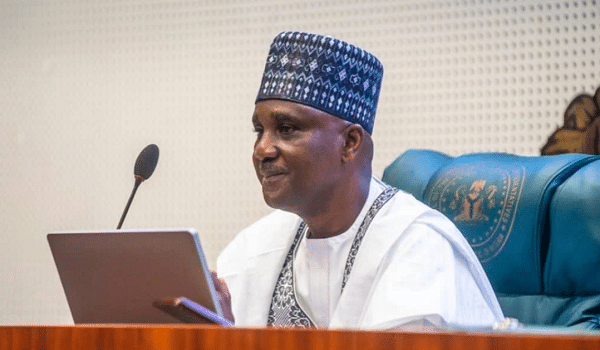
<h2>Speaker of the House of Representatives, <a href="https://www.naijanews.com/topic/tajudeen-abbas/" target="_blank" rel="noopener">Tajudeen Abbas</a>, argues that 400,000 police officers in Nigeria are insufficient to protect the country's 200 million citizens.</h2>
<p>Speaking on Thursday during a courtesy call by the Association of Clerks of State Houses of Assembly, Abbas—who was represented by the House's Deputy Speaker, Benjamin Okezie Kalu stated that the establishment of state police was essential.</p>
<p><strong>Naija News</strong> reports that he said state policing would increase internal security because the operators were already more familiar with the terrain than the police.</p>
<p>The creation of the state police, according to Abbas, is similar to the changes made by the 9th National Assembly to the railway and power industries, among other things, so that the states could utilize certain constitutional rights under the concurrent list.</p>
<p>He said,<em> “On other key nationally important matters like state police, for example, the House recognizes the diverse perspectives and needs across different states.</em></p>
<p><em>“We believe that through constructive dialogue and a willingness to find common ground, we can arrive at solutions that truly serves the best interests of all Nigerians.</em></p>
<p><em>“Talking about state police, you will remember also that we did something with the Correctional Services. These are issues that ordinarily fall into the exclusive list of the Constitution of the federal of republic of Nigeria which you had no business tampering with.</em></p>
<p><em>“But in the spirit of true federalism, the 9th and 10th Assemblies are determined to bring some of these for better governance, to take it from the exclusive list to the concurrent list. We did that with the railway and power in the 9th Assembly. The question is, how many of the states have drafted laws, domesticating that in their state?</em></p>
<p><em>“Now, the state police is here. We want to use the legislative intervention to improve the needs in our society. One of our needs is security. And we have tried the one layer police system and they overwhelmed us.</em></p>
<p><em>“The truth remains that 400, 000 policemen, policing over 200 million people can never give you the expected security. It is not even in line with the international best practices on police per citizen policing.</em></p>
<p><em>“How do we make it trickle down and achieve what we are looking for. Imagine a brother of mine trained in Sokoto or Kaduna during his training as a policeman and he finished and was sent to Bayelsa, a riverine area where the culture is different, language is different, even the way of movement is different -they use mainly boats and this our brother has a phobia for water, how do you expect him to police the people who swim?</em></p>
<p><em>“The policing will not be thorough. But take a man from that community who knows the in and out of the geography of the area, train him around that place, send him to police, you will agree with me that he will police better. The same thing if you take my brother from Bayelsa to Sokoto, he will not police better than the Sokoto man.</em></p>
<p><em>“Yet, the spirit of one nation, national integration, federal character is key and cannot be tampered with. That is why the federal police can have the coloration of what it is at the moment.</em></p>
<p><em>“And another thing is, if we don’t streamline it, you will see pockets of organizations, vigilante groups springing up everyday, getting armed everyday. If tomorrow we are not able to manage them in line with the core principle of policing, we may end up creating monsters that will add to insecurity.”</em></p>
<p>The post <a href="https://www.naijanews.com/2024/02/22/400000-policemen-inadequate-to-secure-nigerias-huge-population-abbas/">400,000 Policemen Inadequate To Secure Nigeria’s Huge Population – Abbas</a> appeared first on <a href="https://www.naijanews.com">Naija News</a>.</p>
Speaker of the House of Representatives, Tajudeen Abbas, argues that 400,000 police officers in Nigeria are insufficient to protect the country’s 200 million citizens.
Speaking on Thursday during a courtesy call by the Association of Clerks of State Houses of Assembly, Abbas—who was represented by the House’s Deputy Speaker, Benjamin Okezie Kalu stated that the establishment of state police was essential. Naija News reports that he said state policing would increase internal security because the operators were already more familiar with the terrain than the police. The creation of the state police, according to Abbas, is similar to the changes made by the 9th National Assembly to the railway and power industries, among other things, so that the states could utilize certain constitutional rights under the concurrent list. He said, “On other key nationally important matters like state police, for example, the House recognizes the diverse perspectives and needs across different states.“We believe that through constructive dialogue and a willingness to find common ground, we can arrive at solutions that truly serves the best interests of all Nigerians.“Talking about state police, you will remember also that we did something with the Correctional Services. These are issues that ordinarily fall into the exclusive list of the Constitution of the federal of republic of Nigeria which you had no business tampering with.“But in the spirit of true federalism, the 9th and 10th Assemblies are determined to bring some of these for better governance, to take it from the exclusive list to the concurrent list. We did that with the railway and power in the 9th Assembly. The question is, how many of the states have drafted laws, domesticating that in their state?“Now, the state police is here. We want to use the legislative intervention to improve the needs in our society. One of our needs is security. And we have tried the one layer police system and they overwhelmed us.“The truth remains that 400, 000 policemen, policing over 200 million people can never give you the expected security. It is not even in line with the international best practices on police per citizen policing.“How do we make it trickle down and achieve what we are looking for. Imagine a brother of mine trained in Sokoto or Kaduna during his training as a policeman and he finished and was sent to Bayelsa, a riverine area where the culture is different, language is different, even the way of movement is different -they use mainly boats and this our brother has a phobia for water, how do you expect him to police the people who swim?“The policing will not be thorough. But take a man from that community who knows the in and out of the geography of the area, train him around that place, send him to police, you will agree with me that he will police better. The same thing if you take my brother from Bayelsa to Sokoto, he will not police better than the Sokoto man.“Yet, the spirit of one nation, national integration, federal character is key and cannot be tampered with. That is why the federal police can have the coloration of what it is at the moment.“And another thing is, if we don’t streamline it, you will see pockets of organizations, vigilante groups springing up everyday, getting armed everyday. If tomorrow we are not able to manage them in line with the core principle of policing, we may end up creating monsters that will add to insecurity.”
MINNEAPOLIS – Suspected drug dealers rammed a Minneapolis police squad car in downtown Wednesday afternoon, leading to a chase and crash that hurt an innocent…
<img src="https://www.mtlblog.com/media-library/view-from-above-of-a-canadian-supermarket-checkout.jpg?id=56823495&width=1200&height=800&coordinates=0%2C1%2C0%2C2"/><br/><br/><p> If you feel like you're <a href="https://www.mtlblog.com/tariffs-more-expensive-canada" target="_blank">spending more at grocery stores</a> in Quebec lately, you're definitely not alone. The <a href="https://www.mtlblog.com/tag/cost-of-living" target="_blank">cost of living</a> has been climbing, and food prices are a major part of that.
</p><p> But how do <a href="https://www.mtlblog.com/grocery-prices-canada-tariffs" target="_blank">grocery prices in Quebec</a> actually stack up against the rest of Canada
</p><p> New data from <a href="https://www150.statcan.gc.ca/t1/tbl1/en/tv.action?pid=1810024501" target="_blank">Statistics Canada</a> breaks it all down — and depending on what you're buying, you could be <a href="https://www.mtlblog.com/montreal-rent-rising-march" target="_blank">paying a lot more</a> (or a lot less) than shoppers in other provinces.
</p><p> The latest numbers reveal that as of January 2025, Quebec sits just above the national average for grocery costs overall, but when you dig into specific items, what you put in your cart could make a huge difference.
</p><p> Fresh fruits and vegetables? You're probably paying less than anywhere else in Canada. But beef or pork? That's another story.
</p><p> Here's a look at the biggest grocery price differences in Quebec compared to the rest of the country.
</p><h2>How prices are counted</h2><p>To get a clear picture of grocery costs across the country, Statistics Canada collects data from thousands of grocery stores every month. This information is pulled directly from transactions at checkout, reflecting the most popular items shoppers are buying that month and the price they're actually paying for them (including any active discounts or promotions).</p><p>It's worth noting that these figures aren't the same as the Consumer Price Index (CPI), which focuses on tracking price changes over time for directly comparable items. Instead, this data is specifically about what people are buying and spending in a given month — and since factors like brand availability and product quality can vary from province to province, they can affect average prices. </p><h2>How expensive are groceries in Quebec?</h2><p> According to the latest data, the total cost of a grocery basket filled with 109 of the most popular items in January 2025 comes to $677.46 in Quebec.
</p><p> That puts the province just 43 cents above the national average of $677.03, but still decently lower than B.C., which is the most expensive of the 10 provinces at $725.79.
</p><p> On the other hand, Ontario has the cheapest grocery basket in the country at $666.65.
</p><p> While that might not seem like a big difference overall, it's when you start looking at individual items that things get interesting.
</p><h3>The good news: Quebec has some of the cheapest groceries in Canada</h3><p> Looking at items individually, Quebec actually has the cheapest prices of any province for about one third of all items measured. </p><p>In particular, the province has the cheapest produce in the entire country — the vast majority of fresh fruits and vegetables on the list are lowest in Quebec, and sometimes by a huge margin. For example:
</p><ul>
<li>A head of broccoli is around $2.13 in Quebec — less than half of what you'll pay in B.C. ($4.78), Manitoba ($4.59), Saskatchewan ($4.54) or Alberta ($4.53).</li>
<li>A 10-lb bag of potatoes costs over 70% more in Manitoba ($7.77), Saskatchewan ($7.73), B.C. ($7.61) or Alberta ($7.55) than it does in Quebec ($4.36).</li>
<li>A cucumber averages $1.69 in Quebec, while in all four Maritime provinces, it's between $2.58 and $2.74. While that might not seem like a big difference when individual prices are so low, it's a jump of over 50%!</li>
<li>It's not just home-grown produce either — an avocado costs $1.86 in Quebec, compared to $2.47 in B.C. (47% more).</li>
</ul><p>But it's not just fruits and veggies — Quebec also has some of the cheapest prices in Canada for pantry staples and protein. Here are some of the other items that are surprisingly cheap in Quebec (compared to other provinces, at least):</p><ul>
<li>Chicken: drumsticks cost around $5.65 per kg in Quebec, while chicken breasts are $12.20/kg — compared to $7.96 and $16.81 in B.C. (around 40% more). A whole chicken costs $5.20 per kg in Quebec, while in Alberta, it's $6.93. (Oddly, though, Quebec has the most expensive chicken <em>thighs</em> in Canada — they're $13.69/kg, compared to $9.28 in Newfoundland.)</li><li>Canned baked beans are cheapest in Quebec and a whopping 60% pricier in Nova Scotia.</li><li>Wieners are also cheapest here at just $3.18 for a 400-g package, while in B.C. you'll pay nearly 50% more ($4.66).</li>
<li>A litre of milk is $2.79 in Quebec, which is much cheaper than Ontario at $3.81 — though Manitoba beats everyone at just $1.98.</li>
<li>Personal care items are also a bargain in Quebec — toothpaste, deodorant and shampoo are all the cheapest in Canada.</li>
<li>Other basics like eggs, block cheese, flour, sugar, canned tuna, dry beans and legumes, ground beef and even meatless burgers are also the lowest in the country here.</li>
</ul><p> So if you're shopping in Quebec, sticking to fresh produce and dairy might help keep your bill lower than in most other provinces. But it's not all good news...
</p><h3>The bad news: Some items cost way more in Quebec</h3><p> While Quebec keeps produce prices low, some meats, pantry staples and household essentials are among the most expensive in the country. If you're buying beef, pork or even something as simple as pasta sauce, you could be paying way more than shoppers elsewhere.
</p><p> The difference is particularly stark when it comes to meat:
</p><ul>
<li>Pork shoulder is $9.26 per kg in Quebec, making it the most expensive in Canada. In Ontario, it's $5.14 — nearly half the price.</li>
<li>Chicken thighs are $13.69 a kilo in Quebec, while in Newfoundland, they're about a third less at $9.28.</li>
<li>Beef rib cuts cost a whopping $36.75/kg in Quebec, but in Ontario, they're just $25.50.</li>
<li>Beef top sirloin is $25.29 per kg in Quebec, compared to $21.80 in Saskatchewan.</li>
</ul><p>Some non-meat essentials are also noticeably pricier in Quebec:</p><ul> <li>A jar of pasta sauce is $3.96 in Quebec — almost a full dollar more expensive than anywhere else in Canada and over 40% more than in Saskatchewan ($2.76).</li>
<li>A loaf of white bread averages $3.82 in Quebec, compared to $3.01 in Ontario.</li>
<li>Peanuts and almonds are most expensive in Quebec, each setting you back around 25% more than in Ontario.</li>
<li>Laundry detergent is most expensive in Quebec at $14.72 for a 4.43-L jug, compared to $12.40 in Newfoundland and Labrador.</li>
<li>White rice costs $10.50 for a 2-kg bag in Quebec — 25% more expensive than in B.C., where it's $8.36.</li></ul><h2>The bottom line</h2><p>While Quebec is far from the most expensive place to buy groceries in Canada, it's not the cheapest either — and it really all depends on what you're putting in your cart. </p><p>If you're loading up on fresh fruits and vegetables, Quebec is one of the best places in the country to shop. But if you're buying meats or certain pantry staples, you could be paying way more than others across the country — and even compared to neighbours like Ontario and New Brunswick.</p><p>For now, one thing is clear: Grocery prices in Canada are far from equal, and where you live can seriously impact how much you're paying at the checkout.</p><p>
<em>Love this? Check out our <a href="https://www.mtlblog.com/notices/" target="_blank">MTL Blog noticeboard</a> for details on jobs, benefits, travel info and more!</em>
</p><p>
<em>AI tools may have been used to support the creation or distribution of this content; however, it has been carefully edited and fact-checked by a member of MTL Blog's Editorial team. For more information on our use of AI, please visit our <a href="https://www.mtlblog.com/editorial-standards" target="_blank">Editorial Standards page</a>.</em>
</p>