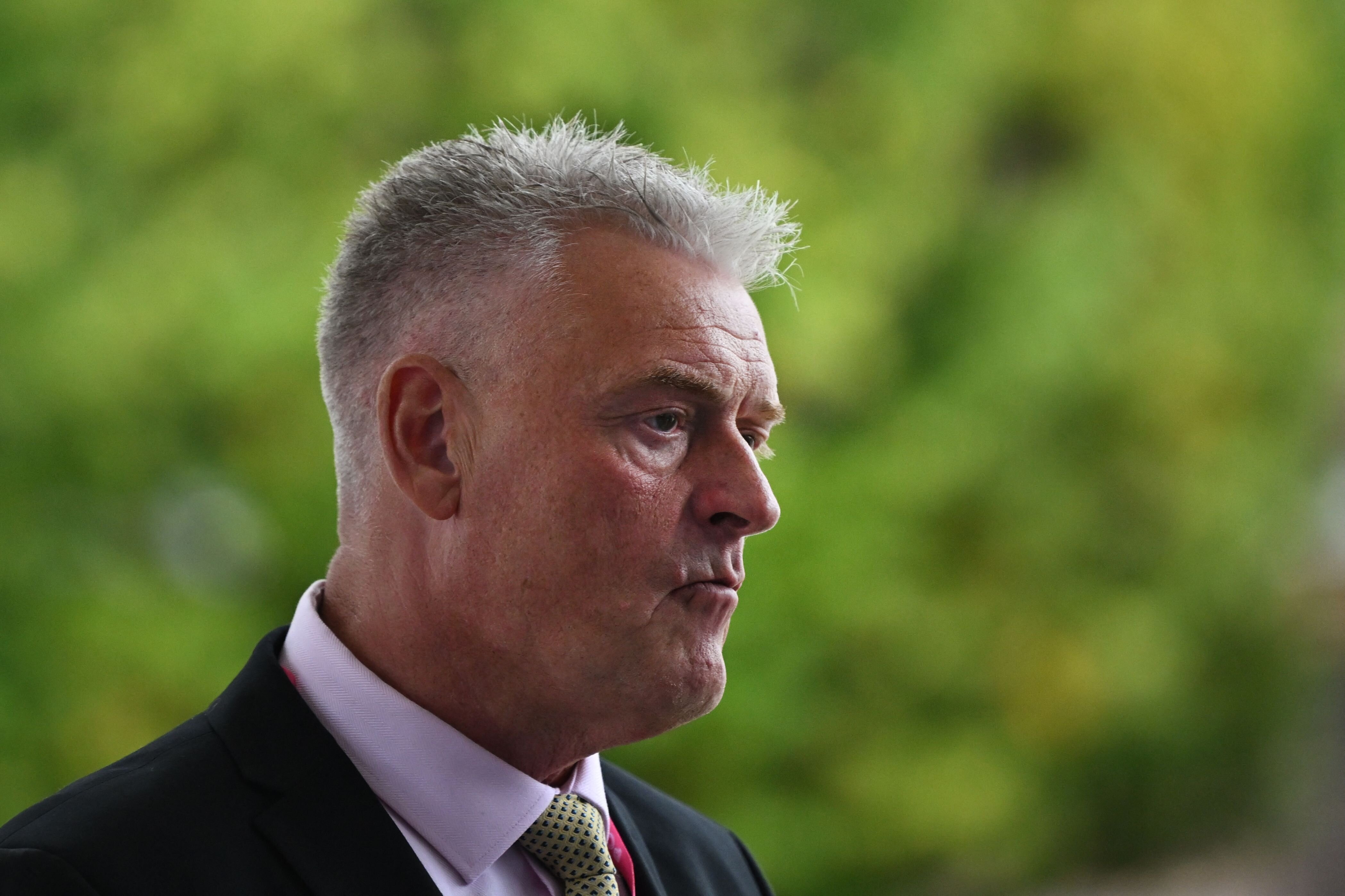
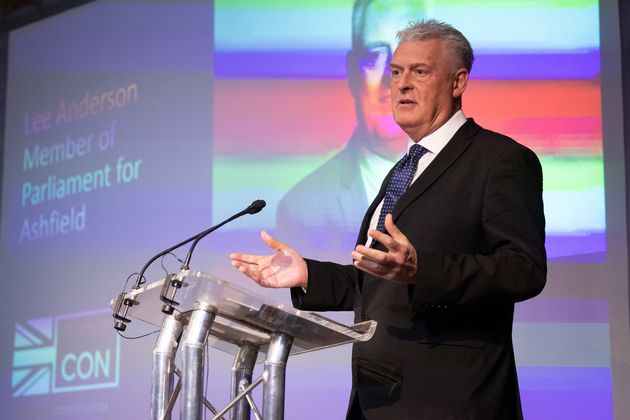
Lee Anderson speaks at the launch of the ‘Popular Conservatism’ movement in London earlier this month.
Lee Anderson is at the centre of a racism row after he claimed Islamists have “got control of” Sadiq Khan.
The former Tory Party chairman provoked a furious backlash by saying the London mayor, who is Muslim, had “given our capital city away to his mates”.
His comments, on GB News, were apparently a reference to the pro-Palestine marches which have taken place in London since the outbreak of the conflict between Israel and Hamas.
They came after former home secretary Suella Braverman claimed that “Islamists” are now running the country.
Anderson said: “I don’t actually believe that these Islamists have got control of our country, but what I do believe is they’ve got control of Khan and they’ve got control of London.”
He added: “This stems with Khan. He’s actually given our capital city away to his mates … beware, because if you let Labour in through the back door, expect more of this and expect our cities to be taken over by these lunatics.”
Conservative MP Lee Anderson tells GB News that he thinks Sadiq Khan has "given our capital city away" to Islamists, who are "his mates".
"Islamists have got control of Khan and they’ve got control of London," he says. pic.twitter.com/XnGbXMyB2y
Labour chairwoman Anneliese Dodds said: “Lee Anderson’s comments are unambiguously racist and Islamophobic. Rishi Sunak needs to immediately remove the whip. If he is too weak, then people will take their own view of the modern Conservative Party.”
A London Labour source: “This sort of vile Islamaphobia is exactly how the Tories campaigned against Sadiq Khan in 2016. Surely they will not tolerate it this time round?”
Lib Dem deputy leader Daisy Cooper said: These comments from a Conservative MP are despicable. Rishi Sunak should remove the Conservative whip. There should be no space for this in our country, let alone in parliament.”
Former Tory MP Gavin Barwell, who was also Theresa May’s chief of staff when she was prime minister, said Anderson’s comments were “a despicable slur”.
In his first speech as PM, @RishiSunak said he would "unite our country". If he allows the likes of Anderson to spread hate and division like this, those words will be revealed as a sham https://t.co/MreUDW0Nzg
But a Conservative Party source defended Anderson’s comments.
He told HuffPost UK: “Lee was simply making the point that the mayor, in his capacity as police and crime commissioner for London, has abjectly failed to get a grip on the appalling Islamist marches we have seen in London recently.”
Those comments were then slammed by shadow health secretary Wes Streeting.
If I were this ‘Conservative source’ I’d be ashamed to put my name to these comments, too.
Let’s see how many Tory Ministers and MPs are willing to be complicit in this and how many are willing to stand up for decency in our democracy. https://t.co/IcXSlOQQn0
Yes, it’s obviously true that a 34-count felony conviction would be enough to demolish the career of any normal politician. Yes, it’s obviously true that…
<img src="https://api.follow.it/track-rss-story-loaded/v1/VI8Twb0pEws_Z69G-AZG1nn9ye8UNv30" border=0 width="1" height="1" alt="Supreme Court limits scope of environmental review " title="Supreme Court limits scope of environmental review "> <p>The Supreme Court on Thursday <a href="https://www.supremecourt.gov/opinions/24pdf/23-975_m648.pdf">unanimously ruled</a> to limit the scope of environmental review required under a seminal 1970s environmental protection law. The move brought a proposed 88-mile railroad line that would transport crude oil from oilfields in northern Utah to refineries on the Gulf Coast one step closer to production. Environmental groups and a neighboring Colorado county had told the justices that the federal agency that approved the project had failed to consider its broader environmental costs. </p> <span id="more-528882"></span> <p>In ruling for the railroad, the justices sketched out a relatively narrow role for courts reviewing future decisions under the National Environmental Policy Act, the landmark environmental law at the center of the case. Emphasizing that the “goal of the law is to inform agency decisionmaking, not to paralyze it,” Justice Brett Kavanagh explained that courts should give “substantial deference” to the agency’s determination as to what should be included in the environmental impact statement prepared for a project. “In deciding cases involving the American economy,” Kavanaugh concluded, “courts should strive, where possible, for clarity and predictability.” </p> <p>The court’s three Democratic appointees agreed more narrowly with the result that their colleagues reached, even if they did not agree with the reasoning that they used to arrive at that conclusion. Justice Sonia Sotomayor stated that the majority “unnecessarily ground[ed] its analysis largely in matters of policy,” but the board, based on the statute itself, did not have the power to reject the application to build the railroad based on any negative effects that might flow from products carried on the railway. </p> <p>The dispute before the court began after the U.S. Surface Transportation Board approved a proposal by a group of Utah counties to build a railroad line that would connect with the broader interstate freight rail network to “facilitate the transportation of crude oil” from the state’s oil-rich Uinta Basin to refineries in states like Louisiana and Texas. The proposed train would quadruple production at Utah’s largest oil and gas fields. In August 2021, the board released an environmental impact statement that was more than 3,600 pages long and addressed the environmental consequences of the project. In approving the project in December of that year, the board explained that the project’s “substantial transportation and economic benefits” outweighed those environmental effects.</p> <p>Several environmental groups and Eagle County, Colorado, challenged the board’s decision in the U.S. Court of Appeals for the District of Columbia Circuit. That court threw out the board’s order approving the project. It reasoned that the board should have taken a “hard look” at all of the railroad’s environmental effects. This would include, the court of appeals said, both the “upstream” effects – effects from oil drilling in the basin – and the “downstream” effects – effects from oil refining along the Gulf Coast.</p> <p>On Thursday the Supreme Court reversed. Kavanaugh explained that although NEPA requires agencies to prepare an environmental impact statement “identifying significant environmental effects of the projects, as well as feasible alternatives,” the law at its core “is purely procedural.” In reaching its decision about whether a project should go forward, he wrote, “an ‘agency is not constrained by NEPA from deciding that other values outweigh the environmental costs.’” </p> <p>When courts are reviewing these determinations, Kavanaugh continued, “the central principle” is “deference.” Kavanaugh acknowledged that since last year’s decision in <em><a href="https://www.scotusblog.com/cases/case-files/loper-bright-enterprises-v-raimondo/">Loper Bright Enterprises v. Raimondo</a></em>, courts generally do not provide deference to an agency’s interpretation of a statute, instead taking a fresh look at the law. “But when” – as in this situation – “an agency exercises discretion granted by a statute,” Kavanaugh wrote, courts instead look at whether the agency action “was reasonable and reasonably explained.” In NEPA cases, he stated, “an agency’s only obligation is to prepare an adequate report.” </p> <p>Kavanaugh spelled out the limits on the role of the courts even more clearly, stressing that “it is critical to disaggregate the agency’s role from the court’s role. So long as the EIS addresses environmental effects from the project at issue,” he wrote, “courts should defer to agencies’ decisions about where to draw the line—including (i) how far to go in considering indirect environmental effects from the project at hand and (ii) whether to analyze environmental effects from other projects separate in time or place from the project at hand.” </p> <p>Kavanaugh also criticized courts that have in the past, in his view, not provided the kind of deference that NEPA requires. In doing so, he suggested, those courts “have slowed down or blocked many projects and, in turn, caused litigation-averse agencies to take ever more time and to prepare even longer EISs for future projects.” And as a result, he concluded, “NEPA has transformed from a modest procedural requirement into a blunt and haphazard tool employed by project opponents (who may not always be entirely motivated by concern for the environment) to try to stop or at least slow down new infrastructure and construction projects.” </p> <p>The effects of that transformation, Kavanaugh explained, are significant. “Fewer projects make it to the finish line” or even “the starting line,” he stated – and the ones that do make it are more expensive. “A 1970 legislative acorn has grown over the years into a judicial oak,” he said, “that has hindered infrastructure development ‘under the guise’ of just a little more process.” </p> <p>The D.C. Circuit’s ruling was also wrong, Kavanaugh added, because the board was not required to address the environmental effects of “projects that are separate in time or place from the” railroad itself. Indeed, Kavanaugh observed, “those separate projects fall outside the Board’s authority and would be initiated, if at all, by” other parties. </p> <p>In an 11-page opinion, Sotomayor faulted the majority for relying on policy considerations but explained that the board did not have the power to reject railroad applications based on the ways that other entities would use the products carried on the proposed railroad. As a result, she reasoned, the board could not have rejected the Utah counties’ request based on a desire to “prevent the harmful effects of oil drilling and refining.” Therefore, she concluded, she agreed with her colleagues’ decision to reverse the D.C. Circuit’s ruling “requiring the Board to consider in further detail harms caused by the oil industry.” </p> <p>Justice Neil Gorsuch was recused from the case. A <a href="https://www.supremecourt.gov/DocketPDF/23/23-975/333350/20241204161910549_Letter%20from%20the%20Clerk%20in%20No.%2023-975.pdf">Dec. 4 letter</a> from Scott Harris, the clerk of the Supreme Court, indicated only that Gorsuch was not participating “consistent with the Code of Conduct” <a href="https://www.supremecourt.gov/about/Code-of-Conduct-for-Justices_November_13_2023.pdf">adopted by the justices in 2023</a>. However, Gorsuch has long had close ties with Philip Anschutz, a billionaire with investments in the energy sector, including a company that filed a “friend of the court” brief in this case. </p>
<p>The post <a href="https://www.scotusblog.com/2025/05/supreme-court-limits-scope-of-environmental-review/">Supreme Court limits scope of environmental review </a> appeared first on <a href="https://www.scotusblog.com">SCOTUSblog</a>.</p>