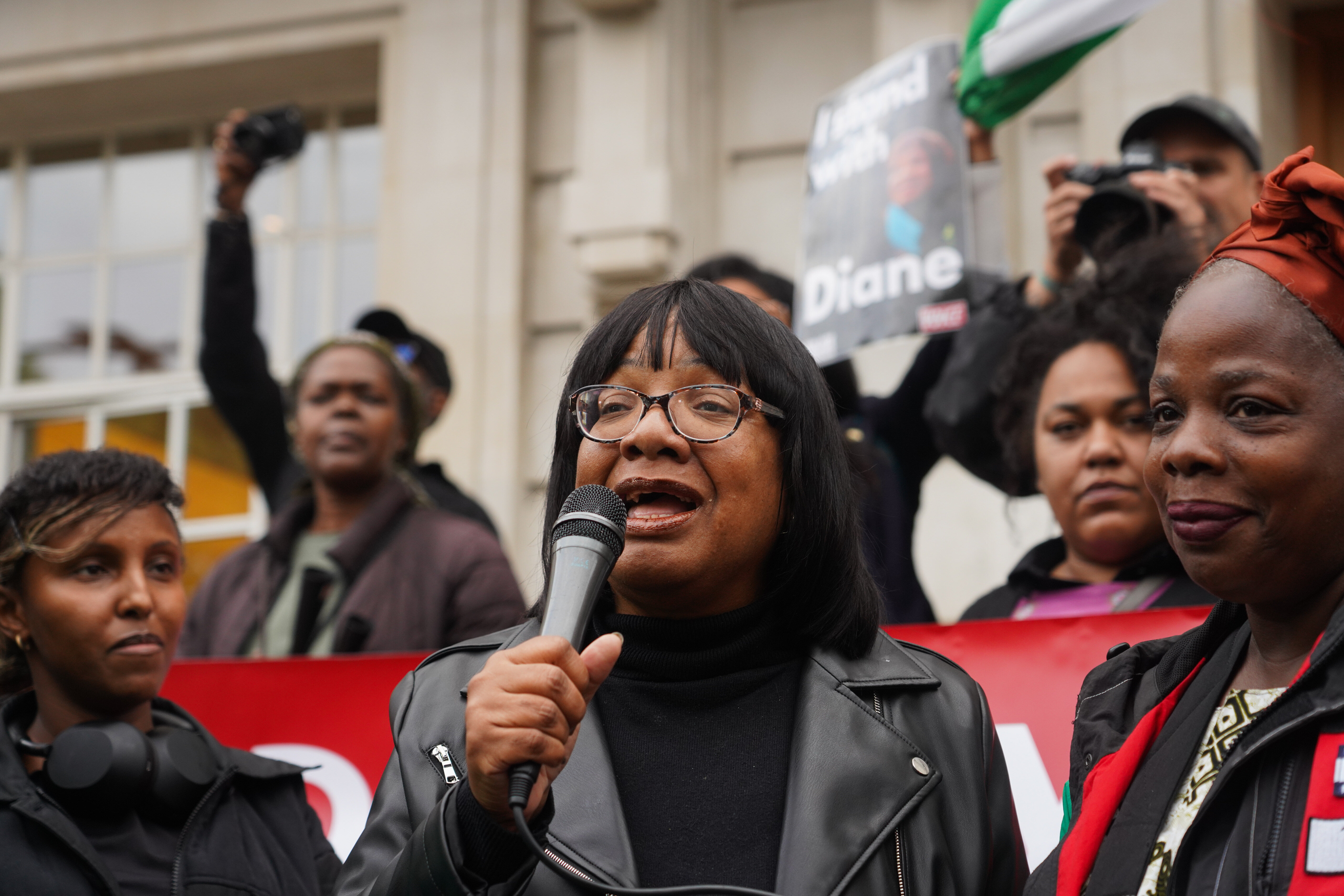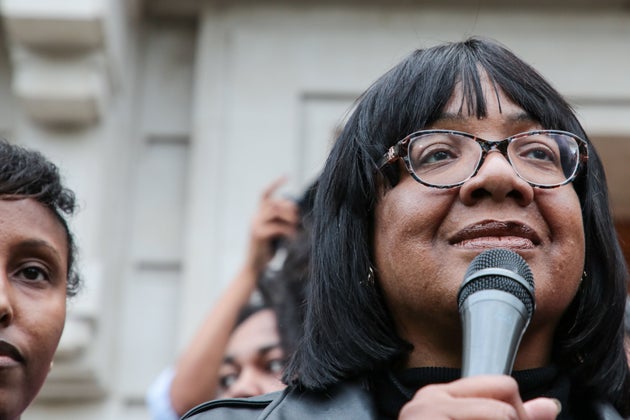
The veteran MP, first elected in 1987, has been the subject of much speculation in recent weeks over whether or not she would run for Keir Starmer’s party.
In a social media post on Sunday, Abbott said: “I intend to run and to win as Labour’s candidate.”
While she had the Labour whip returned to her last week – after 13 months of suspension – there were also reports she would be still banned from standing in her constituency of Hackney North and Stoke Newington.
This sparked uproar from Abbott’s supporters. At a rally arranged in her honour earlier this week, she told backers that Labour “just want me excluded from parliament”.
Starmer initially side-stepped questions about her candidacy.
However, when his deputy Angela Rayner said Abbott should be allowed to stand, he U-turned.
The Labour leader said the veteran MP was “free” to represent his party at the polls on Friday.
But Abbott dispelled these claims, writing on X: “This is factually incorrect.
“I have never been offered a seat in the Lords, and would not accept one if offered.
“I am the adopted Labour candidate for Hackney North & Stoke Newington.
“I intend to run and to win as Labour’s candidate.”
This is factually incorrect. I have never been offered a seat in the Lords, and would not accept one if offered. I am the adopted Labour candidate for Hackney North & Stoke Newington. I intend to run and to win as Labour's candidate.https://t.co/lAfrehJdVm
Abbott was suspended by the party in April last year over a letter she sent to The Observer suggesting that Jewish, Irish and Traveller people are not subject to racism “all their lives”.
She later apologised and retracted the remarks.
Labour’s probe into her actions concluded in December.
National Executive Committee then issued her with a “formal warning” for “engaging in conduct that in the opinion of the NEC, prejudicial and grossly detrimental to the Labour Party”.
At the committee’s request, Abbott completed an “online e-learning module” in February, a move allegedly acknowledged by the chief whip, although she did not get the whip back until May.
Rishi Sunak has hit his lowest ever rating in the ConservativeHome survey. Rishi Suank’s popularity has plummeted among Tory Party members following a series of…
<p>The Supreme Court on Monday morning declined to take up a challenge to New York’s caps on the price that its low-income residents pay for broadband internet access. The denial of review in New York State Telecommunications Association v. James came on a list of...</p>
<p>The post <a href="https://www.scotusblog.com/2024/12/court-wont-take-new-york-broadband-case-or-states-epa-challenge/">Court won’t take New York broadband case or states’ EPA challenge</a> appeared first on <a href="https://www.scotusblog.com">SCOTUSblog</a>.</p>
<img src="https://api.follow.it/track-rss-story-loaded/v1/Hss63mFCsiG0iaUxoukcNHn9ye8UNv30" border=0 width="1" height="1" alt="Transgender service members urge justices to let them continue to serve" title="Transgender service members urge justices to let them continue to serve"> <p>A group of transgender service members urged the Supreme Court on Thursday to leave in place an order by a federal judge that bars the government from enforcing a policy that would prohibit them from serving in the U.S. military. Putting the order on hold, they told the justices, would “upend the <em>status quo</em> by allowing the government to immediately begin discharging <em>thousands</em> of transgender servicemembers, including” the plaintiffs in this case, “thereby ending distinguished careers and gouging holes in military units” </p> <p>The Trump administration came to the court last week, asking the justices to put the order on hold while the service members’ challenge to the policy continues in the lower courts. The order, it said, had usurped the executive branch’s “authority to determine who may serve in the Nation’s armed forces.” </p> <span id="more-505582"></span> <p>The proceedings now before the court began as a challenge to a policy issued in February by the Department of Defense that, subject to narrow exceptions, disqualifies anyone who has gender dysphoria – that is, psychological distress caused by a conflict between the sex that someone is assigned at birth and that person’s gender identity – or has undergone medical interventions to treat gender dysphoria. </p> <p>Seven of the eight individual plaintiffs are currently members of the armed forces and have collectively served more than 100 years and received more than 70 medals. The eighth individual plaintiff would like to join the military. </p> <p>The lead plaintiff is Commander Emily Shilling, a naval aviator who has flown more than 60 combat missions and served as a naval test pilot. During her nearly two decades of service, she says, the Navy has spent more than $20 million on her training. </p> <p>The plaintiffs contend that the policy violates, among other things, the Constitution’s guarantee of equal protection. </p> <p>Senior U.S. District Judge Benjamin Settle, a George W. Bush appointee, agreed with the plaintiffs and barred the government from enforcing its policy anywhere in the United States. He called the policy a “de facto blanket prohibition on transgender service.” </p> <p>When the U.S. Court of Appeals for the 9th Circuit declined to pause Settle’s order while the government appealed, the Trump administration went instead to the Supreme Court on April 24. Solicitor General D. John Sauer stressed that an expert panel during Trump’s first administration had concluded that allowing people with gender dysphoria to serve in the armed forces would be “contrary to ‘military effectiveness and lethality.’” Indeed, he noted, the justices during that administration had allowed the government to enforce a policy “materially indistinguishable from the one at issue here.” </p> <p>The plaintiffs reject the premise of the policy. Instead, they maintain, “equal service by openly transgender servicemembers has <em>improved</em> our military’s readiness, lethality, and unit cohesion, while discharging transgender servicemembers from our Armed Forces would <em>harm</em> all three, as well as the public fisc.”</p> <p>It is immaterial, the plaintiffs say, that the Supreme Court allowed the military to implement a “much narrower and different policy” in 2019. That policy allowed active-duty service members who had already transitioned to remain in the armed forces and retain their healthcare. The earlier policy, they contend, also “lacked the animus-laden language” of the 2025 policy and the executive order that led to it, “which disparage transgender people as inherently untruthful, undisciplined, dishonorable, selfish, arrogant, and incapable of meeting the rigorous standards of military service.” Moreover, the policy before the court in 2019 was “based on <em>predictions</em> about open service by transgender people.” But since then, they emphasize, transgender people have served openly in the military, without any negative effect on military readiness or lethality. </p> <p>The plaintiffs push back against the government’s insistence that the ban only applies to people with gender dysphoria, not to transgender people, dismissing that argument as “folly.” The ban requires members of the armed forces to “only serve in accordance with their [birth] sex,” they note, and prohibits them from serving if they have ever tried “to transition to any sex other than their [birth] sex.” Indeed, they add, Secretary of Defense Pete Hegseth and the department itself have repeatedly referred to the ban as applying to transgender service members. </p> <p>The Trump administration will now have an opportunity to reply to the plaintiffs’ brief. After that, a ruling on the government’s request could come at any time. </p>
<p>The post <a href="https://www.scotusblog.com/2025/05/transgender-service-members-urge-justices-to-let-them-continue-to-serve/">Transgender service members urge justices to let them continue to serve</a> appeared first on <a href="https://www.scotusblog.com">SCOTUSblog</a>.</p>