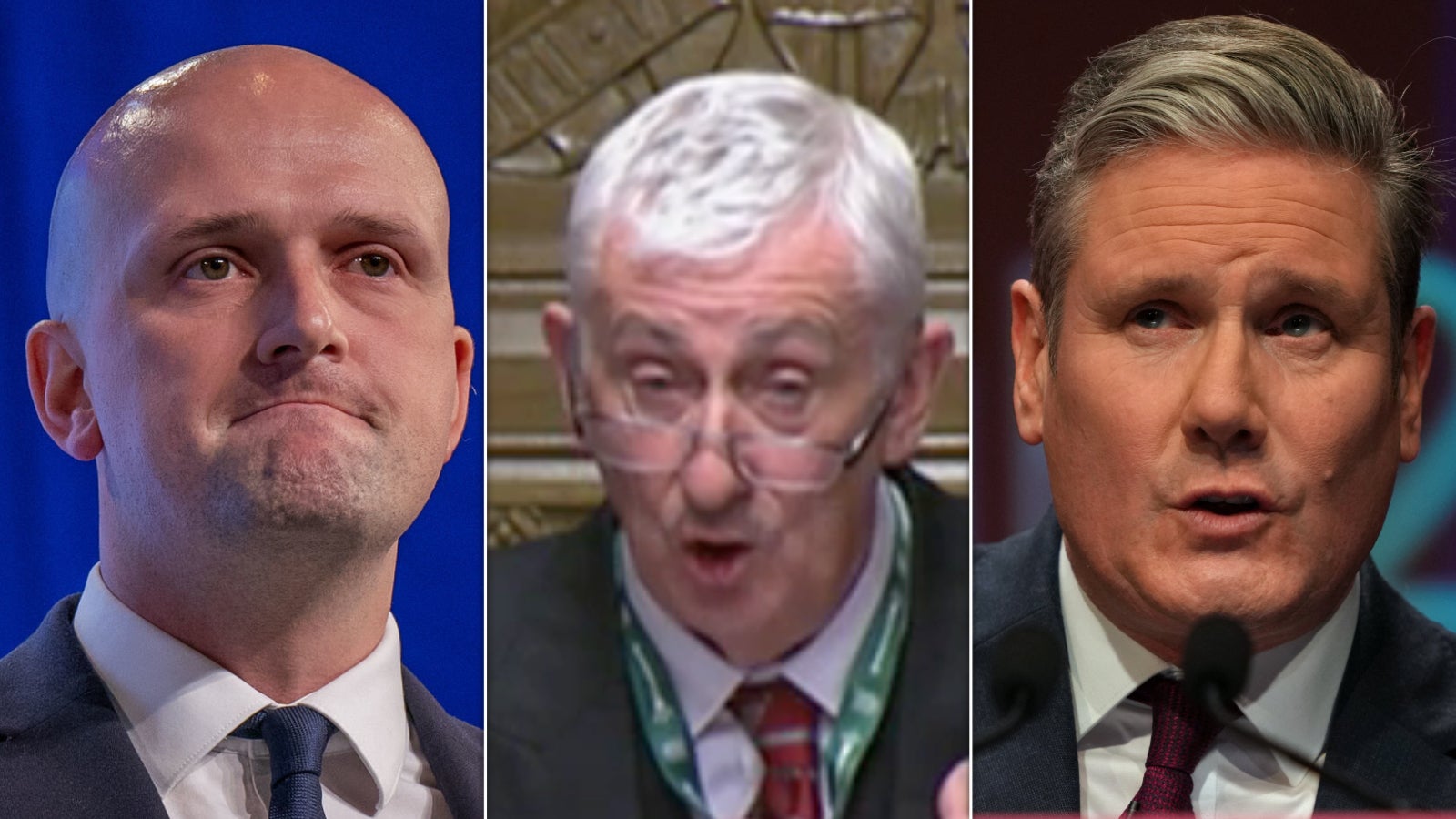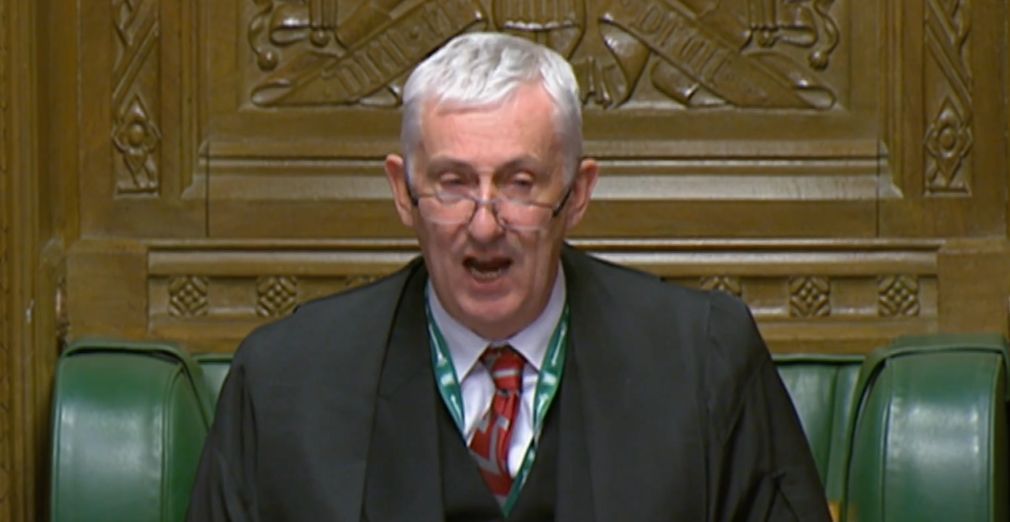
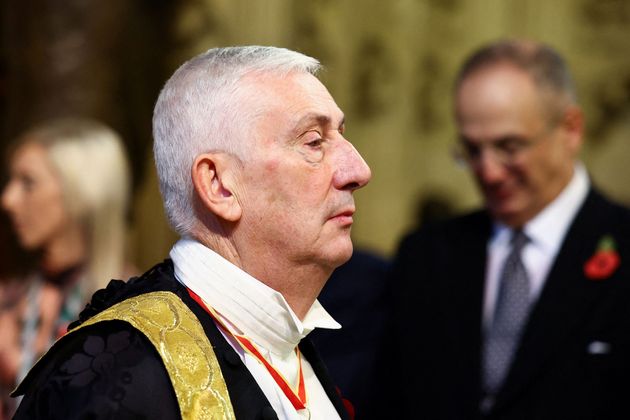
Lindsay Hoyle’s position as Commons Speaker is “untenable” and he should be dumped by MPs, Stephen Flynn has declared.
The SNP’s Westminster leader told Hoyle he was responsible for the “farce” which took place in the Commons last night following a debate on the war in Gaza.
Hoyle has faced accusations of bias after controversially selecting a Labour amendment to an SNP opposition day motion calling for an “immediate ceasefire” in the war between Israel and Hamas.
That had the effect of preventing what was expected to be a major rebellion by Labour MPs who had planned to vote with the SNP.
Some 59 Tory and SNP MPs have signed a motion of no confidence in the Speaker, who was forced to come to the Commons to apologise amid chaotic scenes last night.
Hoyle was back in his chair today and was told directly by Flynn that he should go.
He said: “As I have expressed to you privately prior to proceedings here today, we do not on these benches believe that you can continue in your role as Speaker.
“We do not have confidence in your ability to do so.”
Flynn told Hoyle that a vote of no confidence in him should be held “at the earliest possible occasion”.
Speaking to Sky News later, the SNP chief said: “I absolutely do think that Lindsay Hoyle’s position is untenable and I wish we weren’t in this position.
“I have a lot of respect for Lindsay, but ultimately he made a decision yesterday which was politically partisan and he cannot continue in his role as a neutral chair of the House of Commons.”
As he fought a rearguard action to cling on to his position, Hoyle repeated his apology for his decision.
“I regret it, I apologise to the SNP, and to the House,” he told the Commons. “I made a mistake – we do make mistakes, I own up to mine.”
Hoyle insisted he had done so to protect MPs who faced a backlash from pro-Palestine campaigners if they failed to vote for a ceasefire.
He said: “I have a duty of care, and if my mistake is looking after members, I am guilty.”
"The details of the things that have been brought to me are absolutely frightening"
Meanwhile, Labour leader Keir Starmer has also “categorically” denied threatening Hoyle in the run-up to Wednesday’s Commons debate.
It has been reported by the BBC and Sky News that Labour warned Hoyle he could be replaced as Speaker after the election if he did not pick the party’s amendment.
But speaking in Sussex on Thursday, Starmer denied he had dangled Hoyle’s job in front of him to get his way.
“I can categorically tell you that I did not threaten the Speaker in any way whatsoever,” the Labour leader said.
“I simply urged to ensure that we have the broadest possible debate.
“So that actually the most important thing , which is what do we do about the situation in Gaza, could be properly discussed by MPs with a number of options in front of them.”
<img src="https://api.follow.it/track-rss-story-loaded/v1/pkiIGJc0hnpdc5gGKGTUAXn9ye8UNv30" border=0 width="1" height="1" alt="Justices likely to allow damages suit against Palestinian Authority to go forward in U.S. courts" title="Justices likely to allow damages suit against Palestinian Authority to go forward in U.S. courts"> <img width="150" height="150" src="https://www.scotusblog.com/wp-content/uploads/2025/04/supremecourt-1-150x150.jpg" class="attachment-thumbnail size-thumbnail wp-post-image" alt="Justices likely to allow damages suit against Palestinian Authority to go forward in U.S. courts" title="Justices likely to allow damages suit against Palestinian Authority to go forward in U.S. courts" style="float:right;" decoding="async" srcset="https://www.scotusblog.com/wp-content/uploads/2025/04/supremecourt-1-150x150.jpg 150w, https://www.scotusblog.com/wp-content/uploads/2025/04/supremecourt-1-570x570.jpg 570w, https://www.scotusblog.com/wp-content/uploads/2025/04/supremecourt-1-500x500.jpg 500w, https://www.scotusblog.com/wp-content/uploads/2025/04/supremecourt-1-1000x1000.jpg 1000w" sizes="(max-width: 150px) 100vw, 150px" /><p><a class="a2a_button_facebook" href="https://www.addtoany.com/add_to/facebook?linkurl=https%3A%2F%2Fwww.scotusblog.com%2F2025%2F04%2Fjustices-likely-to-allow-damages-suit-against-palestinian-authority-to-go-forward-in-u-s-courts%2F&linkname=Justices%20likely%20to%20allow%20damages%20suit%20against%20Palestinian%20Authority%20to%20go%20forward%20in%20U.S.%20courts" title="Facebook" rel="nofollow noopener" target="_blank"></a><a class="a2a_button_linkedin" href="https://www.addtoany.com/add_to/linkedin?linkurl=https%3A%2F%2Fwww.scotusblog.com%2F2025%2F04%2Fjustices-likely-to-allow-damages-suit-against-palestinian-authority-to-go-forward-in-u-s-courts%2F&linkname=Justices%20likely%20to%20allow%20damages%20suit%20against%20Palestinian%20Authority%20to%20go%20forward%20in%20U.S.%20courts" title="LinkedIn" rel="nofollow noopener" target="_blank"></a><a class="a2a_button_twitter" href="https://www.addtoany.com/add_to/twitter?linkurl=https%3A%2F%2Fwww.scotusblog.com%2F2025%2F04%2Fjustices-likely-to-allow-damages-suit-against-palestinian-authority-to-go-forward-in-u-s-courts%2F&linkname=Justices%20likely%20to%20allow%20damages%20suit%20against%20Palestinian%20Authority%20to%20go%20forward%20in%20U.S.%20courts" title="Twitter" rel="nofollow noopener" target="_blank"></a><a class="a2a_button_email" href="https://www.addtoany.com/add_to/email?linkurl=https%3A%2F%2Fwww.scotusblog.com%2F2025%2F04%2Fjustices-likely-to-allow-damages-suit-against-palestinian-authority-to-go-forward-in-u-s-courts%2F&linkname=Justices%20likely%20to%20allow%20damages%20suit%20against%20Palestinian%20Authority%20to%20go%20forward%20in%20U.S.%20courts" title="Email" rel="nofollow noopener" target="_blank"></a><a class="a2a_button_printfriendly" href="https://www.addtoany.com/add_to/printfriendly?linkurl=https%3A%2F%2Fwww.scotusblog.com%2F2025%2F04%2Fjustices-likely-to-allow-damages-suit-against-palestinian-authority-to-go-forward-in-u-s-courts%2F&linkname=Justices%20likely%20to%20allow%20damages%20suit%20against%20Palestinian%20Authority%20to%20go%20forward%20in%20U.S.%20courts" title="PrintFriendly" rel="nofollow noopener" target="_blank"></a><a class="a2a_dd addtoany_no_icon addtoany_share_save addtoany_share" href="https://www.addtoany.com/share#url=https%3A%2F%2Fwww.scotusblog.com%2F2025%2F04%2Fjustices-likely-to-allow-damages-suit-against-palestinian-authority-to-go-forward-in-u-s-courts%2F&title=Justices%20likely%20to%20allow%20damages%20suit%20against%20Palestinian%20Authority%20to%20go%20forward%20in%20U.S.%20courts" data-a2a-url="https://www.scotusblog.com/2025/04/justices-likely-to-allow-damages-suit-against-palestinian-authority-to-go-forward-in-u-s-courts/" data-a2a-title="Justices likely to allow damages suit against Palestinian Authority to go forward in U.S. courts">Share</a></p><p>The Supreme Court on Tuesday appeared inclined to allow a lawsuit by U.S. victims of terrorist attacks in Israel against the Palestinian Authority and the Palestine Liberation Organization to go forward. A majority of the justices appeared skeptical of contentions by the PA and the PLO that a law allowing those victims to sue them in U.S. courts violates the Constitution’s guarantee of due process, even if there was not necessarily any agreement on the bench on exactly how courts should reach that conclusion.</p>
<p>During nearly two hours of debate, the justices often seemed to be grappling with broader questions as well, such as the extent to which courts should defer to national-security and foreign-policy judgments made by the other branches of government. </p>
<p>At issue the case is the concept of personal jurisdiction – whether courts have the power to hear a case against certain defendants. In 2019, Congress passed the Promoting Security and Justice for Victims of Terrorism Act to give federal courts personal jurisdiction over cases by terrorism victims abroad. The law provides that the PLO and the PA “shall be deemed to have consented to personal jurisdiction” in any civil case brought under the Anti-Terrorism Act, no matter when the act of international terrorism occurred, if they make payments to the families of terrorists who injured or killed a U.S. citizen or engaged in any activities within the United States. The law carves out a few narrow exceptions to the latter criterion – for example, for conduct relating to official United Nations business or meeting with government officials.</p>
<p>The U.S. Court of Appeals for the 2nd Circuit ruled that the dispute now before the court, brought by U.S. citizens injured in terrorist attacks in Israel, as well as the families of U.S. citizens killed in such attacks, could not move forward. It reasoned that the Palestine Liberation Organization, which is the official representative of the Palestinian people for foreign affairs, and the Palestinian Authority, the governing body for parts of the West Bank and Gaza Strip, had not agreed to have U.S. courts exercise jurisdiction over them. Nor, the court of appeals added, is the conduct that the PSJVTA targets the kind of conduct from which it would be fair to infer consent.</p>
<p>After the full court of appeals, over a dissent by four judges, declined to reconsider the decision, the victims and families came to the Supreme Court, which agreed last fall to weigh in.</p>
<p>Representing the victims and families, Kent Yalowitz urged the court to reverse the 2nd Circuit’s decision and revive his clients’ lawsuit. The PSJVTA provided the PLO and the PA with “fair warning,” he said. “Their conduct was knowing and voluntary.” And the law “reasonably advances legitimate government interests in the context of our federal system.”</p>
<p>Much of the oral argument focused on whether the due process clauses in the 14th Amendment (which applies only to the states) and the Fifth Amendment (which applies to the federal government) impose the same limits on jurisdiction – and, if they impose different limits, what those limits are for cases under the Fifth Amendment.</p>
<p>Yalowitz insisted that the two amendments have different limits. He reasoned that the 14th Amendment has to account for the interests of the states involved, so that one state does not infringe on the sovereignty of another by exercising jurisdiction over a defendant with minimal contacts with the state. But the “federal government doesn’t suffer from that limitation,” Yalowitz maintained, because its “powers are more expansive.”</p>
<p>Justice Sonia Sotomayor asked whether Yalowitz was “basically saying there is no due process protection under the Fifth Amendment even for U.S. citizens?” Could Congress say, she enquired, that a U.S. citizen could face trial in California for an act in New York?</p>
<p>Yalowitz insisted that he was not advocating for a rule that would eliminate a requirement that the exercise of jurisdiction be fair or reasonable, to protect “citizens and non-citizens alike from arbitrary federal action.” But the PSJVTA meets such a requirement, he maintained.</p>
<p>Justice Amy Coney Barrett asked whether, if the court were to interpret the Fifth Amendment as requiring that the defendant have some connection with the United States, the justices would effectively be overruling some of the 19th century cases interpreting the Fifth Amendment’s due process clause more to provide fewer protections.</p>
<p>Yalowitz acknowledged that at the very least, such an interpretation would be “in tension” with the older cases.</p>
<p>Deputy Solicitor General Edwin Kneedler told the justices that the PSJVTA is “an integral part of the foreign policy and national security policy of the political branches, including the securing of compensation for victims of terrorism.” Both kinds of conduct that can trigger the PSJVTA’s jurisdictional provision are, he said, “knowing and voluntary. They have a clear nexus to United States territory and to United States nationals and to the compelling U.S. interests in deterring terrorism.” Moreover, he added, the jurisdiction triggered by the law “is narrowly limited to terrorism cases.” “Congress’s judgment on these issues, as in all issues of national security and foreign policy, are entitled to great deference,” Kneedler concluded.</p>
<p>But Chief Justice John Roberts was unimpressed by the rule that the government was advancing. “It sounds like it’s a grab bag,” Roberts scoffed. It’s just “a bunch of words.”</p>
<p>Justice Neil Gorsuch saw what he characterized as a “tension” in the government’s position. On the one hand, as Kneedler agreed, under the Fifth Amendment the Supreme Court should play almost no role in “saying that what Congress has done is improper” with a law like the PSJVTA. But on the other hand, Gorsuch complained, the federal government wants a “safety valve” for the Supreme Court “to overrule” Congress in some cases.</p>
<p>Justice Elena Kagan suggested that the federal government might be reluctant to take a position “where anything Congress says goes” – that is, that there is essentially no role for courts to play in reviewing laws creating personal jurisdiction – because, among other things, there would be foreign-policy implications from “extremely broad” assertions of jurisdiction over foreign nationals, which could in turn encourage other countries to retaliate against U.S. nationals and companies.</p>
<p>Justice Ketanji Brown Jackson made a similar point, observing that without limits imposed by the Fifth Amendment on what Congress and the president can do, it could open a Pandora’s Box of other problems. She posited that the court could simply rule that the 14th and Fifth Amendments do not impose the same requirements and then send the case back to the lower courts.</p>
<p>But Barrett pushed back against any suggestion that such concerns might lead to the court issuing a narrower ruling. “[T]hese judgments about foreign policy considerations are for Congress and the president to make,” she emphasized.</p>
<p>Justice Samuel Alito chimed in, telling Kneedler that if the court looks at the 19th-century Fifth Amendment cases “you don’t want us to adopt that fully” and “and say ‘anything goes,’” then the court would have to “say what the test is. And then,” Alito asked, “what is the test?”</p>
<p>Justice Brett Kavanaugh clearly believed that the role of the courts in reviewing laws like the PSJVTA should be very limited. This is a case involving national security and foreign policy, he stressed, in which Congress and the president have already agreed on the proper role of the courts and acted pursuant to their constitutional powers to regulate the conduct of the PLO and the PA. Courts can still weigh in, he acknowledged, “to make sure they’re not crossing some other constitutional line,” but it’s normally “a very sensitive judgment” for courts to make, because Congress and the executive branch are generally going to be responsible for determining whether a law like the PSJVTA is fair.</p>
<p>Representing the PLO and the PA, Mitchell Berger told the justices that his clients’ conduct does not “support a presumption” that they consented to be sued in the United States under the PSJVTA. “Among other things,” he noted, when Congress passed the PSJVTA, two courts of appeals had already held that the same kinds of conduct that can now trigger jurisdiction under the PSJVTA “are constitutionally insufficient to support jurisdiction” over the PLO and the PA. “Continuing to engage in jurisdictionally insufficient conduct is the exact opposite of submitting to the court’s jurisdiction,” Berger argued.</p>
<p>Alito had a more practical question. “What exactly,” he queried, “is the unfairness in this case? Is it too burdensome to litigate this in New York, where the PA and the PLO,” at the U.N., engage in some activities?</p>
<p>Berger countered that the “unfairness” is the idea that the PA and the PLO can lose “a liberty interest for engaging in activity previously held constitutionally insufficient to support jurisdiction.”</p>
<p>Alito was dubious, telling Berger that his answer didn’t “sound like a personal jurisdiction argument.”</p>
<p>Berger then compared the situation of the PLO and the PA to a situation in which someone is “on a train where it’s sitting still and another train is moving backwards.” “That’s what Congress keeps doing with these statutes,” Berger told the justices, “which is we’re doing the same thing, and Congress keeps moving the context around us. And that’s what makes this statute as applied” to the PLO and the PA unconstitutional, Berger concluded.</p>
<p>But by the time the justices left the bench a few minutes later, it seemed likely that Congress would not need to tinker further with the law, and that this dispute – which Yalowitz described as “old enough to go to law school” – would go forward. </p>
<p><em>This article was <a href="https://amylhowe.com/2025/04/01/justices-likely-to-allow-damages-suit-against-palestinian-authority-to-go-forward-in-u-s-courts/">originally published at Howe on the Court</a>. </em></p>
<p>The post <a href="https://www.scotusblog.com/2025/04/justices-likely-to-allow-damages-suit-against-palestinian-authority-to-go-forward-in-u-s-courts/">Justices likely to allow damages suit against Palestinian Authority to go forward in U.S. courts</a> appeared first on <a href="https://www.scotusblog.com">SCOTUSblog</a>.</p>
BRUSSELS — European leaders will reconvene for a special summit in Brussels on February 1, 2024 to discuss new financial aid to Ukraine, European Council…