

Aztec Network Overview
What Is Aztec Network?
Founded in 2018 by Zac Williamson, a former software engineer at Rothschild & Co., and Tom Walton-Pocock. Aztec is an innovative ETH L2 that has the ambitious vision to build a fully private blockchain while at the same time fully supporting complex smart contracts and decentralized applications. This was a novel concept as most privacy-focused blockchains (such as Monero) were only limited to simple transfers and token swaps, never the full suite of DeFi products (such as lending, perps and more).
To do this, Aztec introduces several key innovations:
1. Privacy-First Architecture Using zkSNARKs
At its core, Aztec uses zkSNARKs (Zero-Knowledge Succinct Non-Interactive Arguments of Knowledge) — a form of cryptographic proof that allows one party to prove they know certain information without revealing the information itself.
Here’s a simple analogy: imagine you want to prove to a bouncer that you’re over 21 without showing them your ID with your name, address, and exact birthdate. A zkSNARK would let you prove “I am over 21” without revealing any other personal information. That’s the power of zero-knowledge proofs.
Aztec uses zkSNARKs to:
-
Hide transaction amounts: No one can see how much value is being transferred.
-
Hide sender and receiver identities: The parties involved in transactions remain confidential.
-
Enable private smart contract execution: The inputs, outputs, and state of smart contracts can remain encrypted.
2. Programmable Privacy: The Best of Both Worlds
Unlike privacy-focused blockchains like Zcash or Monero, which primarily focus on private transfers, Aztec offers programmable privacy. This means developers can build complex decentralized applications — like lending protocols, decentralized exchanges, or voting systems — with built-in privacy.
Think of it as the difference between having a private messaging app (which only does one thing) versus having a private smartphone operating system (where any app can be built with privacy by default).
3. Layer 2 Scalability
Aztec functions as a Layer 2 solution (a secondary network built on top of Ethereum that processes transactions off the main chain to reduce costs and increase speed). This means Aztec inherits Ethereum’s security while offering:
-
Lower transaction costs compared to Ethereum mainnet.
-
Higher transaction throughput (more transactions per second).
-
Final settlement on Ethereum for maximum security.
4. Encrypted Public Blockchain
Aztec describes itself as building the first “encrypted public blockchain”. This might sound like a contradiction — how can something be both encrypted and public? Here’s what it means:
-
Public: Anyone can participate, verify proofs, and run nodes.
-
Encrypted: The actual data (transaction amounts, smart contract states, user balances) remains encrypted despite being publicly available.
5. Compliance-Friendly Privacy
Unlike some privacy solutions that operate in legal gray areas, Aztec is designed with selective disclosure in mind. This means users can maintain privacy by default but provide specific information to regulators or auditors when required. This is important as privacy projects often face scrutiny from regulators as they can potentially enable cyber criminals to evade surveillance.
For example, a business using Aztec could keep its transactions private from competitors but still prove to tax authorities that it paid the correct amount of taxes. This makes Aztec suitable for institutional adoption where regulatory compliance is non-negotiable.
Use Cases for Aztec Network
Aztec’s technology enables several compelling use cases that weren’t previously possible on public blockchains:
Private Decentralized Finance (DeFi)
Currently, using DeFi protocols on Ethereum means exposing your entire financial activity to the public. Anyone can see:
-
How much you’ve deposited.
-
Your trading strategies.
-
Your portfolio holdings.
-
Your borrowing and lending activity.
For individuals, this creates privacy concerns. For institutions and high-net-worth traders, this is completely unacceptable as it exposes them to front-running (when someone sees your pending transaction and places their own order first to profit from your trade) and competitive intelligence gathering.
Aztec enables private DeFi where users can trade, lend, and borrow without exposing their positions or strategies. Several projects are already building private DeFi applications on Aztec.
Confidential Voting and Governance
Transparent voting on blockchains creates problems because everyone can see how individuals voted. This can lead to:
-
Social pressure to vote certain ways.
-
Strategic voting based on early results.
Aztec enables private on-chain voting where votes are encrypted but the final tally is publicly verifiable. This combines the transparency benefits of blockchain with the privacy protections of traditional secret ballots.
Private NFTs and Digital Assets
While most NFTs (non-fungible tokens, unique digital assets like art or collectibles) are public by design, there are use cases for private NFTs:
-
Private ownership records: Proving you own a valuable asset without advertising it to potential thieves.
-
Confidential business assets: Supply chain tracking where competitors shouldn’t see your operations.
-
Private credentials: Educational degrees, licenses, or certifications that prove qualifications without revealing unnecessary personal information.
Institutional Adoption
Perhaps the biggest opportunity for Aztec is enterprise blockchain adoption. Businesses have been hesitant to use public blockchains because they can’t expose sensitive information like:
-
Supplier relationships and pricing
-
Customer data
-
Financial transactions
-
Trade secrets
The AZTEC Token Sale: What You Need to Know
Aztec Network has announced its upcoming token generation event (TGE) and initial coin offering (ICO), with the public sale scheduled for December 2, 2025 to December 6, 2025. Whitelisted addresses may join this pre-sale early from November 13, 2025 to December 1, 2025.
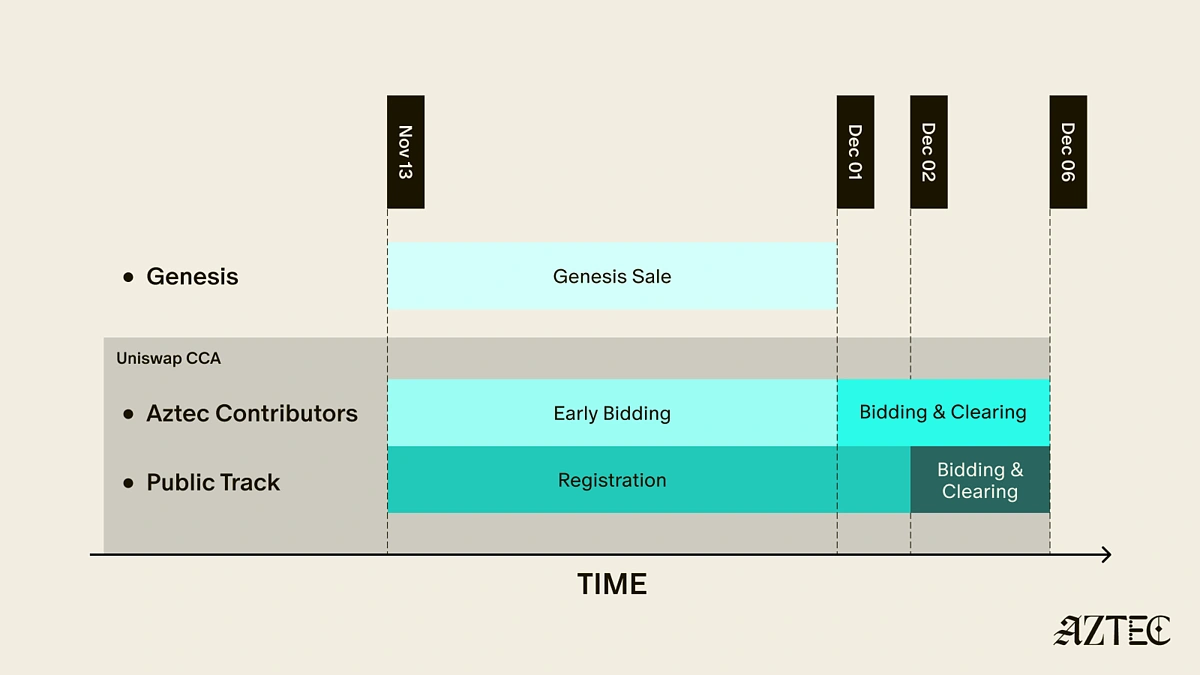
Source: https://sale.aztec.network/
What Is the AZTEC Token?
The AZTEC token will serve as the native cryptocurrency of the Aztec Network. While the complete tokenomics details have not been fully disclosed yet, here’s what we know so far:
-
AZTEC will have a maximum token supply of 10,350,000,000 tokens (10.35 billion).
-
1,547,000,000 tokens (14.95% of total supply) is allocated for the pre-sale.
-
The core team and investors will not participate in staking or token governance for 12 months.
-
The team has a 36-month lockup/vesting schedule.
Public Sale Details
-
Over 300 thousand wallet addresses have been whitelisted for early participation.
-
Token sale starts at a $350 million fully diluted valuation (FDV).
-
Sale conducted on the Ethereum network.
-
Allocated tokens are locked until at least February 11, 2026.
Risks to Consider
While Aztec has reputable backing, potential token sale participants should be aware of risks:
-
Liquidity risk: According to the project, allocated tokens are non-transferable until at least February 11, 2026. Thereafter the community can pass a governance vote to make the token transferable. Should the vote fail (although this is unlikely), allocated tokens will unlock linearly up till November 13, 2026. Participants should be mindful that they cannot sell their tokens until at least February 2026.
-
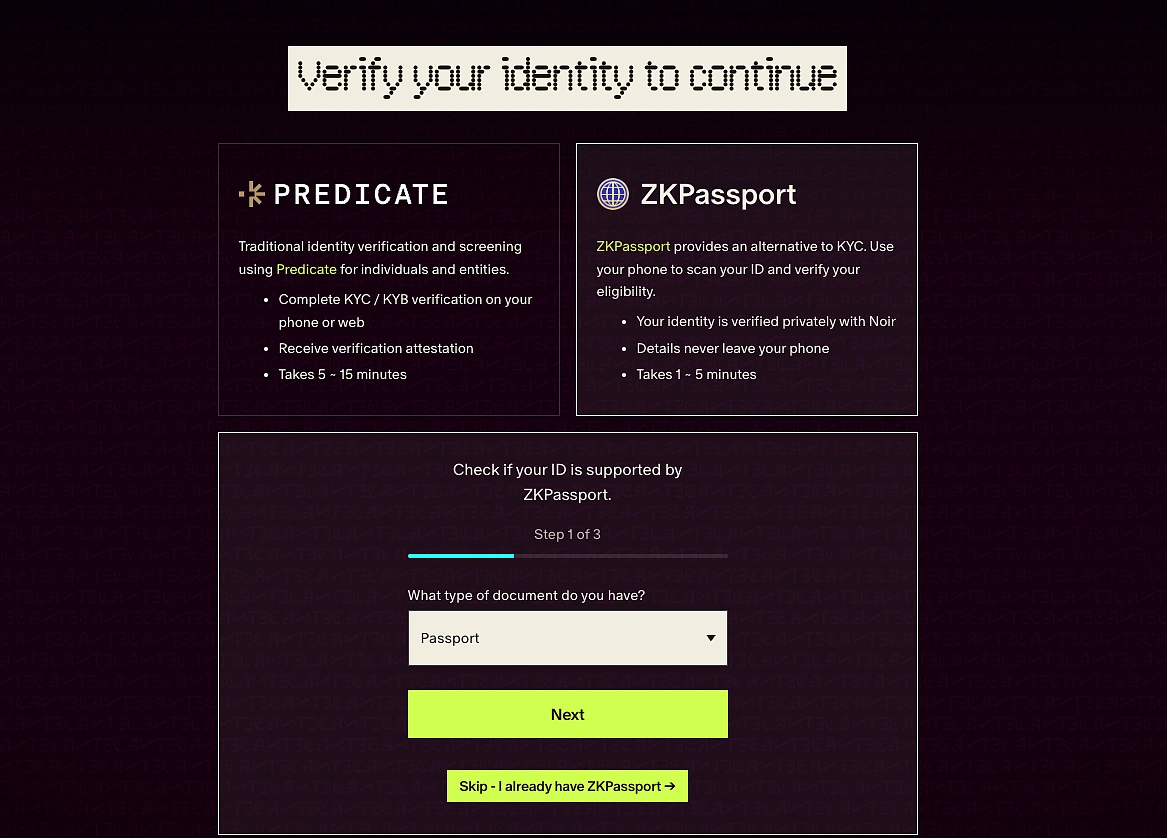
Privacy risk: Ironically, despite being a privacy-focused project, pre-sale participants are required to complete KYC processes, potentially disrupting the anonymity of your personal crypto wallets.
-
Regulatory risk: Increased scrutiny as privacy-focused crypto projects such as Monero or Tornado Cash are known to face increased regulatory scrutiny.
-
Market risk: Token prices are completely speculative, users have raised concerns that Aztec asking for more funds (through a pre-sale) despite having raised $170 million is a potential red flag.
-
Competition: Other projects such as Zcash (ZEC) are also building privacy solutions, creating a competitive landscape.
-
Adoption risk: The project has not launched yet and adoption rates have yet to be proven.
How to Participate in the Pre-sale
For the general public, the pre-sale will commence on December 2, 2025, whitelisted addresses however, may participate early up till December 1, 2025 as mentioned before. You may check your whitelist eligibility at: https://sale.aztec.network/.
Whitelisted communities include:
-
Sequencers and provers of Aztec testnets.
-
ETH solo stakers, including select StakeCat ETH operators, Obol Silver, Rocketpool, LidoCSM, and Stakers Union.
-
zk.money users.
-
Engaged community members.
-
Uniswap traders (3k randomly selected from active traders in the last 30 days).
-
Nansen Ice, North, and Star tiers (soul bound tokens).
Here are the general steps to participate in the pre-sale:
-
Go to https://sale.aztec.network/ and connect your wallet.

-
Complete the KYC process.
-
Commit ETH (Ethereum mainnet) for the sale. While there is no minimum requirement, each wallet can only submit a maximum bid of 240 ETH (~$850,000).
-
Receive your allocated tokens by December 6.
Conclusion
Aztec Network represents one of the most technically sophisticated attempts to bring privacy to Ethereum and the broader blockchain ecosystem. With over $170 million in funding from elite venture firms and Ethereum’s co-founder, years of development, and a public token sale scheduled for December 2, 2025, Aztec is positioned as a major player in the next generation of blockchain infrastructure.
For users who are keen on participating in the pre-sale, be mindful of the illiquid period from December 6, 2025 till February 11, 2026 where you cannot sell or transfer any allocated AZTEC tokens. As with any emerging technology in the crypto space, the path forward contains both immense potential and significant risks. The December token sale will mark an important milestone, but it’s just the beginning of Aztec’s journey to bring privacy to public blockchains.
This article is for educational and informational purposes only and should not be construed as financial, investment, legal, or tax advice. Cryptocurrency investments, including participation in token sales or ICOs, carry substantial risk including the potential loss of your entire investment. Always conduct your own thorough research, understand the risks involved, before making any investment decisions.
