

For generations of Canadians, a six-figure salary was the ultimate financial finish line, a milestone that promised a detached home, a comfortable retirement, and freedom from monthly budgeting anxiety. But in 2026, that salary milestone doesn’t hold nearly as much weight. As housing prices in Canada’s economic engines decouple from local wages, earning $100,000 is not the same as it once was.
After all, the disconnect between statistical wealth and purchasing power has never been more stark. As reported by Spring Financial, the line between the middle class and Canada’s top earners is surprisingly thin. The income threshold for the top 10% of earners is now $125,945, just slightly above the upper middle-class ceiling of $106,717. This narrow gap of less than $20,000 suggests that many statistically wealthy Canadians are effectively living an upper-middle-class reality. They are high earners on paper, but in the housing market, they might not even be able to afford entry-level condos in big cities.
Methodology
To determine whether someone earning $100,000 a year can afford an average home in different Canadian cities, we used the CIBC Mortgage Affordability Calculator for a standardized stress test. We set the gross income at $100,000 to see whether this is enough for homeownership today. The analysis applies a standard 25-year amortization and a 3.89% interest rate (sourced from Ratehub’s 5-year fixed closed rate).
Importantly, this report avoids the unrealistic idea of a 20% down payment with no debt. Instead, it uses the average annual salary in each province from Statistics Canada as the down payment amount. This amount reflects what buyers might save on their own, plus help from family, a growing reality in Canada. As reported by CIBC, receiving help from family has become the norm for Canadian homebuyers, with the national average parental gift reaching $167,000. In the country’s most expensive markets, this figure climbs to $189,000 in Ontario and a whopping $230,000 in British Columbia.
To better show what buyers can actually borrow, the model also includes the average non-mortgage debt per person, from Equifax’s November 2025 report. By factoring in common debts such as student loans and car payments, Zoocasa provides a more realistic picture of what a single six-figure earner faces when buying a home.
Where Six Figures Buys a Home Comfortably
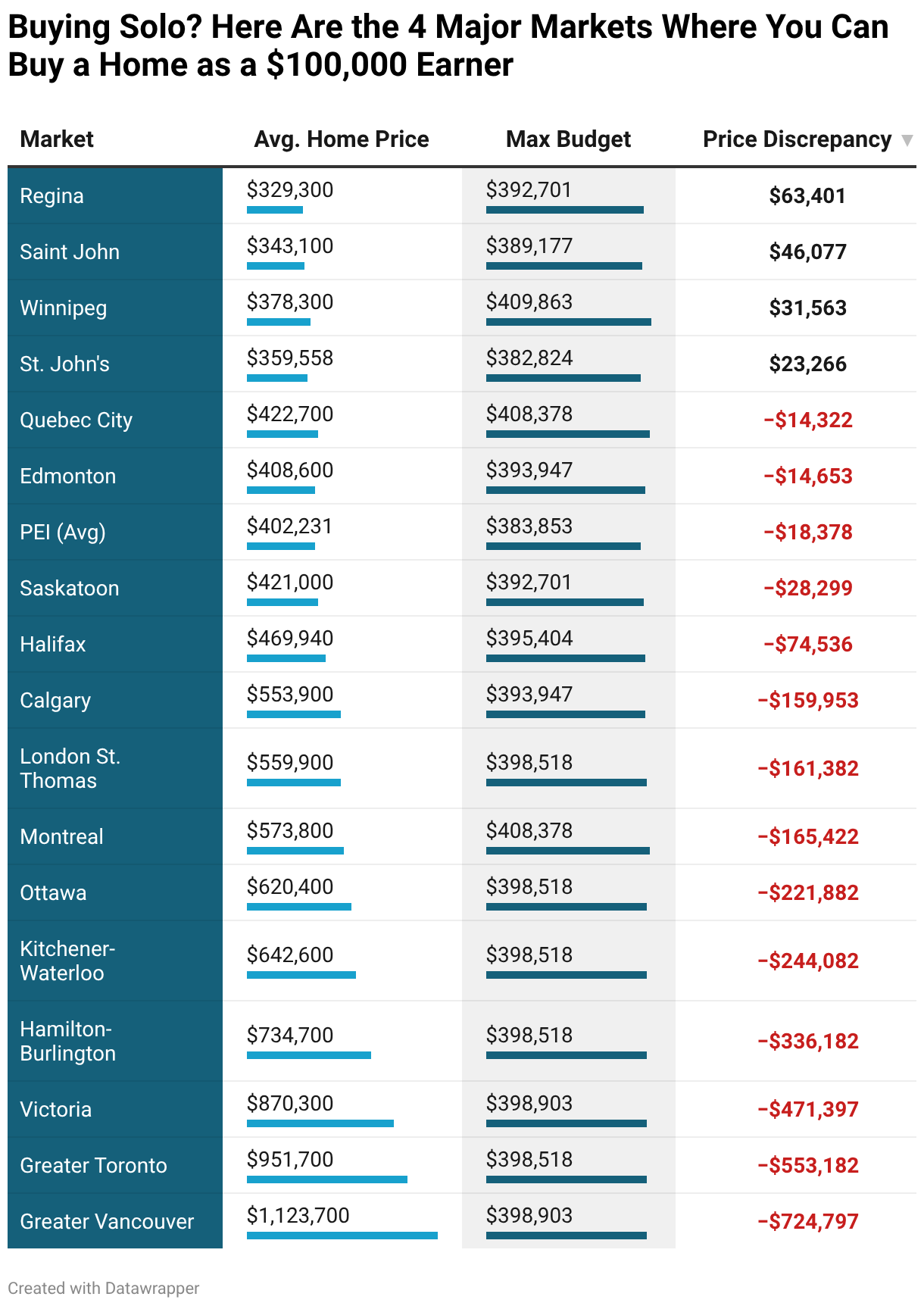
If you earn $100,000, your money works hardest in the Prairie and Atlantic provinces. Regina stands out as the most affordable market in the country, with an average home price of $329,300. A six-figure earner enjoys a massive surplus of $63,401. This trend of high purchasing power extends to Saint John and Winnipeg, where buyers have a comfortable cushion ranging from $46,077 to $31,563.
The Hard Reality: Major Cities Are Out of Reach
The narrative shifts drastically in Canada’s economic engines, where a $100,000 salary is insufficient for the average detached home. In the Greater Toronto Area, a single earner faces a staggering deficit of $553,182, while the gap in Greater Vancouver widens to nearly $724,797. Most surprisingly, Calgary has graduated from an affordable alternative to a premium market; a $100k salary now falls short by $159,953.

Where The “Stepping Stone” Strategy Still Works in 2026
Buyers priced out of the detached home market often turn to condos as an affordable entry point. For those eager to start investing in real estate, several condo markets are still within reach on a single earner’s six-figure salary. Edmonton offers the best value. With an average condo price of $193,577, buyers are left with a surplus of over $200,370, enough to essentially buy a second apartment. Following suit, Winnipeg and Saskatoon, alongside Atlantic Canada markets, are also the best places for apartment buyers earning $100,000.
Meanwhile, in Ontario, only London St Thomas, and Kitchener-Waterloo are within the affordability range for condo-apartments. Ottawa presents the only “close call” for condo buyers (average of $432,500), with a deficit of just $2,947; this market is still manageable with minor financial adjustments.

Why Canada’s Big Cities Still Remain Unaffordable for Many
In Canada’s most expensive cities, a $100,000 salary is not enough to secure even an average apartment without a dual income. Greater Vancouver remains the most exclusive market, with an average condo-apartment price of $710,000, creating a $311,097 deficit. Greater Toronto and Victoria follow closely, with shortfalls exceeding $250,000, with average condo-apartment prices of $663,227 and $653,110, respectively. Even Hamilton–Burlington, often viewed as a cheaper big city alternative to Toronto, leaves a single earner $174,808 short of the average condo apartment price of $573,326.
All in all, thanks to inflation, the cost of living, and the likelihood of incurring debt, earning a six-figure salary is a far less attainable goal than it once was. Opportunities and limitations depend greatly on local market trends.
Whether you’re buying or renting, the right real estate agent will help you navigate your next move with confidence. Start your search today.
The post Most Major Housing Markets in Canada Are Still Unaffordable for $100k Earners in 2026 appeared first on Zoocasa Blog.


