
If you’ve ever tried to wedge a six-foot cat tree into a 540-square-foot condo, you already know the problem. It needs a corner with sightlines, vertical clearance, and at least 24 inches of base width that isn’t fighting your sofa or your kitchen island for space. Most floor plans aren’t built with that math in mind, which is why finding condo floor plans for cat trees has become one of the more specific search problems in the Canadian condo market.
According to Statistics Canada, one in five Canadian households owned at least one cat as of 2023. With more of those households living in condos, the question of whether a unit can actually fit a tall cat tree is becoming part of how buyers evaluate a layout.
Here’s what actually makes a floor plan work for a six-foot tower, and where to look for those layouts in today’s market.
The Three Floor Plan Types That Actually Work
Corner Units With Dual Exposures
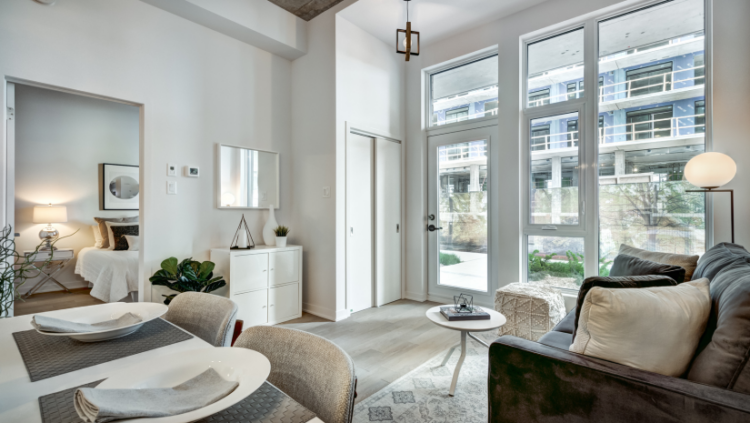
Corner units are the gold standard. The L-shaped living area created by two perpendicular window walls gives you what designers call “dual anchors”, where a cat tree can stand against a window without obstructing sightlines or transit paths.
Light enters from two directions, which means more “Cat TV” hours for the cat and a more open-feeling room for everyone else.
Boxy or Square Layouts
Common in high-rise towers across Toronto and Vancouver, long and narrow one-bedroom layouts are the worst for fitting a cat tree. They force movement into a single path and compress the living area into a tight, hallway-like space.
Square or near-square units, often found in boutique mid-rise buildings, spread the space more evenly across all four walls. Structural columns and entry niches can create small “dead corners” of about four to six square feet. These spots are just enough room for a 72-inch cat tree without cutting into the main living area.
One-Bedroom-Plus-Den, With the Den as a Dead End
The “1+D” floor plan is common in the GTA, but not all dens work well for this purpose. The best ones are dead-end alcoves. These are small nooks, about 5 by 7 feet, with no windows and no foot traffic, often located near the entry. They are marketed as home offices, but they also work as quiet pet zones where a cat tree can stay in place without getting in the way.
The dens that don’t work are the “walkthrough” dens, where you have to pass through them to reach the living room. Placing a 90-pound cat tree in a main path creates a safety risk and can also violate building codes.
If you’re looking at a 1+D floor plan, trace the route from the front door to the living room with your finger. If your finger goes through the den, place the cat tree somewhere else.
The Designer Math: Clearances That Matter
For any floor plan you’re evaluating, four measurements decide whether a six-foot cat tree will actually fit:
1. Walkway Clearance
Building codes and good design both require at least 32 inches of clear space for walking between major furniture pieces. A 24-inch cat tree base needs to sit off to the side, tucked into a corner or alcove that is not in the main path.
2. Vertical Clearance
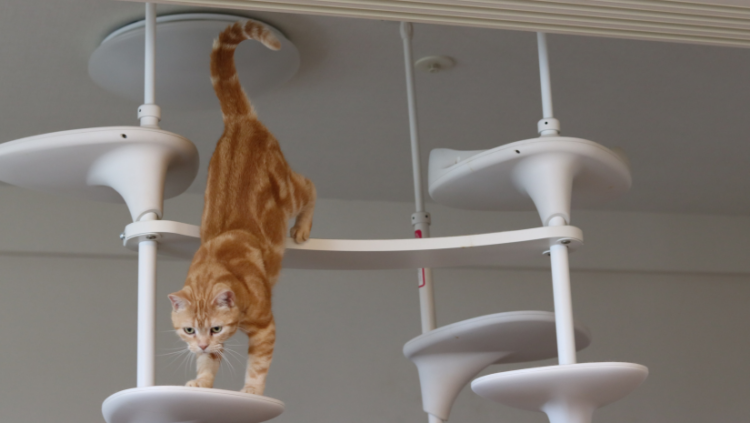
A 72-inch cat tree under an 8-foot ceiling leaves about 24 inches of space above it. That is enough for a cat to sit, but not enough if it is placed directly under an HVAC bulkhead, smoke detector, or sprinkler head. Nine-foot ceilings work much better, while 10-foot ceilings, often found in luxury buildings, remove the issue entirely.
3. Window Proximity
Cats that ignore the cat tree usually do so because the tree has no view. Window-anchored placements consistently outperform “tucked in the corner” ones because the tree becomes a vertical bridge between the floor and the windowsill.
4. Walk and Floor Compatibility
Floor-to-ceiling tension-pole towers can crack drywall or damage the ceiling if they are not set under a structural joist. Most modern condos use luxury vinyl plank or laminate flooring, which can handle the weight and resist scratches. However, uneven floors can cause a heavy tower to wobble.
What to Look For on a Floor Plan
When you’re scrolling through floor plans on a listing or a developer site, these are the green flags:
- Ceiling height of at least 9 feet
- A dead-end den at least 5 feet wide
- Floor-to-ceiling windows or low sills
- An open-concept living area wide enough to maintain a 32-inch walkway with a 24-inch base in the corner
- Non-carpeted flooring (LVP, laminate, or tile)
- A corner unit with two perpendicular window walls
And the red flags:
- A galley living room less than 9 feet wide
- A walkthrough den
- 8-foot ceilings with bulkheads in the living area
- Cat tree placement that would block an HVAC vent or door swing
Making Space for Vertical Living
A six-foot cat tree isn’t optional for a Maine Coon or a Ragdoll, but the floor plan you choose to put it in absolutely is. The right condo floor plans for cat trees treat the tower the same way a designer treats a bookcase, as a permanent piece that needs its own corner and spacing around it.
Looking for a condo with a layout that actually works? Start your search with Zoocasa today.
The post How to Choose a Condo Floor Plan That Actually Fits a 6-Foot Cat Tree appeared first on Zoocasa Blog.