

Deputy Chief Whip of the Senate, Onyekachi Nwaebonyi, has defended the credibility of the All Progressives Congress (APC) primaries and the provisions of the Electoral Act, insisting that internal democracy within political parties has been strengthened and that controversies surrounding primaries are largely the result of party-level management issues rather than legal or institutional failures.
Speaking in an interview with ARISE NEWS on Wednesday, Nwaebonyi argued that the Electoral Act, as amended, has restored decision-making power to party members and improved transparency in the selection of candidates ahead of the 2027 general elections.
Explaining the legal framework guiding party primaries, the Deputy Chief Whip said the law clearly outlines how political parties must conduct their selection processes.
“I want to take you and all Nigerians through the provisions of the Electoral Act 2026 as amended, in particular Section 84, subsections 1, 2, 3 and 4, which outline the modalities political parties must adhere to in observing their primaries for the purposes of electing their candidates for the forthcoming general election in 2027,” he said.
He added that the reforms had shifted power back to political parties and their members.
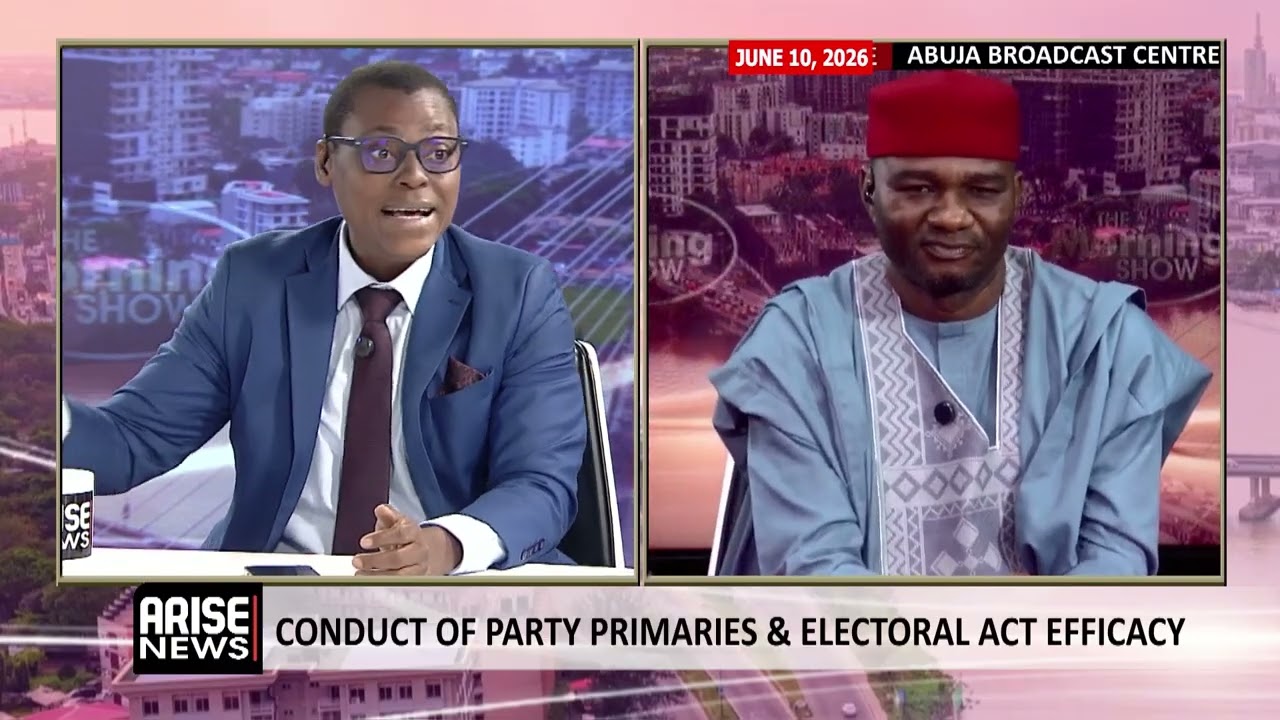
“The Electoral Act gives power back to the people and more power to the party. Gone are the days when party supremacy was only on the lips. By virtue of the Electoral Act as amended, power has returned fully back to the party. And what do I mean by that? By making sure that all primary elections pass either through direct primaries or consensus,” he said.
Describing direct primaries, he stated:
“By direct primaries, all card-carrying members of the party have a say as to who flies the flag of the party.”
He maintained that the All Progressives Congress (APC) conducted one of the most credible primaries in Nigeria’s political history.
“If you watch what happened in the APC, my own party, you will discover that it is the most credible, most free and most rancour-free primaries since the political history of this country. I give credit to the legislature that thought it wise to tailor the Electoral Act in that direction.”
Addressing reports of dissatisfaction and defections following the primaries, Nwaebonyi said electoral losses and internal disagreements were normal in politics, stressing that the real challenge lies in party administration.
“Now I am coming to some problems arising from the primaries. Of course, as a politician, you should know it is normal — some will lose while some will win. But the problem is not the Electoral Act. The problem is not the institution. The problem is not the government. The problem is party management by party members,” he said.
He insisted that the APC remained united despite isolated grievances.
“For example, if you watch what transpired in my own party, the APC, the biggest party in Africa, you will discover that yes, there may be complaints here and there, but I assure you that our party is united and has firm leadership that every party member in Nigeria trusts and believes. At the end, we could speak in one voice.”
On concerns about the role of the Independent National Electoral Commission (INEC) and the judiciary ahead of 2027, the senator said both institutions must act within their constitutional responsibilities.
“Well, the institutions you mentioned are established by law and they have their statutory functions. The court, of course, is the last hope of the common man. If you are aggrieved by the activities of your political party or feel that INEC has not observed the law, everybody will resort to the courtroom for redress. So I think that should be an issue.”
He added that INEC must ensure credible elections while the courts remain impartial arbiters.
“INEC must live up to the expectation of Nigerians by granting free, fair and credible elections. And we expect the courts to be upright in giving decisions that may arise as a result of party members who may feel aggrieved.”
Responding to claims that some candidates were imposed during primaries in parts of the country, including Lagos and other states, Nwaebonyi maintained that the party has internal mechanisms for dispute resolution.
“We are not in heaven, we are on earth. And inasmuch as we are on earth, some people must allege anomaly in every process. But our party is guided by rules and regulations as contained in our constitution and electoral guidelines,” he said.
He explained that appeals structures exist within the party.
“We have an appeal panel which is saddled with the responsibility of addressing any complaint arising from the primaries. These committees are set up in the 36 states of the federation including the FCT, and believe you me, they are working. I can tell you boldly that our party is united.”
Citing his own experience, he said:
“In my own case, it was a Zonal rally and the governor said, ‘Has anybody been shortchanged our senator?’ and unanimously everybody said no, going by my achievements. And they asked again, does anybody want to contest against our senator? And the answer was unanimously no. That is democracy. That is internal democracy. That is giving power back to the people.”
Reacting to reports of protests in some state party secretariats, including Lagos, he dismissed such actions as procedurally wrong.
“If the person is listening to my line of submission, I think he should channel his complaint to the appropriate party, not at the party secretariat or by protest. Our party constitution does not allow protests as a way of addressing one’s grievances.”
On insecurity in the country, Nwaebonyi acknowledged national concern but suggested that some incidents may be politically motivated ahead of the 2027 elections.
“As one of the leaders in this country, I must admit that our duty primarily is to protect the lives and properties of all Nigerians. We feel pain as leaders that we are still having pockets of attacks and kidnappings across Nigeria,” he said.
He added:
“This is a calculated attempt. I won’t use politics, but we know what is happening. This is increasing because 2027 is around the corner, all geared towards discrediting the government of the day.”
He referenced religious commentary in his argument:
“I can borrow from Reverend Father H.G. Mbaka when he said Nigeria should resist this assumption that insecurity is being caused by the government of the day. It is aimed at discrediting the government.”
He expressed confidence in government efforts:
“Our president is a very proactive leader. If you look at the measures and strategies he has deployed, I assure you we are going to win this enemy of humanity.”
When challenged over claims that he has underperformed in his senatorial district, Nwaebonyi strongly defended his record.
“If you listen to my submission, I wouldn’t respond to that question because it is coming from you. But I can tell you that I do not have any other party in Ebonyi and I do not know the man you mentioned,” he said.
He listed constituency projects as evidence of performance:
“Even the blind can walk on this 10 kilometres of concrete road I did. They will ask who did this and they will be told it was done by a senator. Tell me any senator in the entire Ebonyi State who has done that number of roads.”
He added:
“I am currently doing another five kilometres of road network with 10 culverts and four mini-bridges. I have renovated schools and equipped them with furniture for students and teachers.”
On education and empowerment, he said:
“In 2023, I promised Ebonyi that I would set a standard. In three years, I have set a standard that those who have been there for 12 years have not achieved a quarter. My facts speak for me and my achievements speak for me.”
Nwaebonyi maintained that the strength of the APC and Nigeria’s democratic process lies in adherence to internal party rules, improved electoral laws, and continued engagement with citizens, urging political actors to focus less on online politics and more on grassroots engagement.
Boluwatife Enome
