

We are thrilled to announce new SCOTUSblog merch, just in time for the heart of opinion season. There are premium hats and tees in exciting colors – ready to ship nationwide. Check them out here and prepare to live blog in style.
Plus, a reminder: If you’d like to attend our term-in-review event on July 8 at Johns Hopkins University Bloomberg Center, don’t forget to register your interest here. The event will feature a fireside chat with the ACLU’s Cecillia Wang, who argued the birthright citizenship case before the Supreme Court; a discussion of the historical framework of birthright citizenship from Johns Hopkins professor Martha S. Jones; and a live taping of the Advisory Opinions podcast.
At the Court
The court has indicated that it may announce opinions this morning. We will be live blogging beginning at 9:30 a.m. EDT.
After any opinion announcements, the justices will meet in a private conference to discuss cases and vote on petitions for review. Orders from today’s conference are expected on Monday at 9:30 a.m. EDT.
Morning Reads
Why the Supreme Court Is Debating Which Founding Fathers Were Drunks
James Romoser, The Wall Street Journal (paywalled)
This term, as in all terms, the Supreme Court’s oral argument “docket is chockablock with tough cases on modern-day problems.” But to decide them, the justices are “looking deep into the past” for such information as “the drinking habits of the Founding Fathers” and “a long-forgotten voting practice from the Civil War,” according to The Wall Street Journal. “The time machine is driven by the ascendance of originalism—the legal philosophy, pioneered by conservatives, that says the meaning of the Constitution’s words shouldn’t evolve over time. Though the theory has been fashionable for decades, the court’s conservative supermajority has embraced it with new fervor, sending attorneys scrambling for historical nuggets that once were more useful for Trivial Pursuit.”
Texas death row inmate asks Supreme Court to allow appeal challenging hypnotized witness
Ayden Runnels, The Texas Tribune
At their private conference on Thursday, the justices will consider a petition for review from Charles Don Flores, who “was sentenced to death in 1999 for the robbery and murder of 64-year-old Betty Black” in Texas. At Flores’ trial, “prosecutors leaned on the testimony of Jill Barganier,” whom investigators hypnotized in hopes of improving her description of what she saw the day Black was killed. In his petition, Flores contends “that Barganier’s recollection was improperly influenced” by the hypnosis session and that he has a right to challenge his conviction under a Texas law that “allows inmates to challenge convictions that relied on now-debunked science or procedures,” according to The Texas Tribune.
US Refunds $22 Billion in Tariffs, Offsetting Customs Revenue
Daniel Flatley and Laura Curtis, Bloomberg (paywalled)
In May, the U.S. Treasury “refunded nearly $22 billion in tariff revenue,” as it began making repayments after “the Supreme Court struck down a major component of President Donald Trump’s trade policy,” according to Bloomberg. Treasury Department data for the month shows that the refund amount “was roughly equal to tariffs taken in during” May, “meaning that refunds essentially canceled out the government’s duties revenue.” Treasury Secretary Scott Bessent said last week that the administration expects tariff revenue to increase later this year to levels seen when the now-invalidated tariffs were in place once planned replacement tariffs – which are being "imposed using other authorities" – are fully implemented.
How a coming Supreme Court decision on mail-in ballots could impact California
Sophie Brams, The Hill
The Supreme Court will soon decide Watson v. Republican National Committee, a case on “whether states can accept mail-in ballots that arrive after election.” The ruling “could invalidate the so-called grace period in places like California,” which counts ballots that arrive at secure drop-off locations by 8 p.m. on Election Day or are postmarked by Election Day and arrive by the following Tuesday, and it “will come after enormous attention was paid across the country to the results in both the California governor’s contest and the battle for mayor of Los Angeles,” according to The Hill. Although the “decision would likely have no bearing on those races because they are state and local and not federal,” “it could have consequences for U.S. House races in the fall,” if states like California are required to “change their vote-counting rules.”
A Year After Supreme Court Decision, Kid Lit Creators are Buoyed by Community
Kara Yorio, School Library Journal
Last year, the court in Mahmoud v. Taylor allowed religious parents to opt their children out of school lessons involving books that highlight LGBTQ+ themes. The decision disappointed the authors and illustrators of the challenged books, but it also “created a steadfast community of authors and illustrators not only committed to supporting each other and fighting censorship, but continuing to create books with LGBTQIA+ characters,” according to the School Library Journal, which noted that the creators call their community the “SCOTUS Book Club.”
On Site
From the SCOTUSblog Team
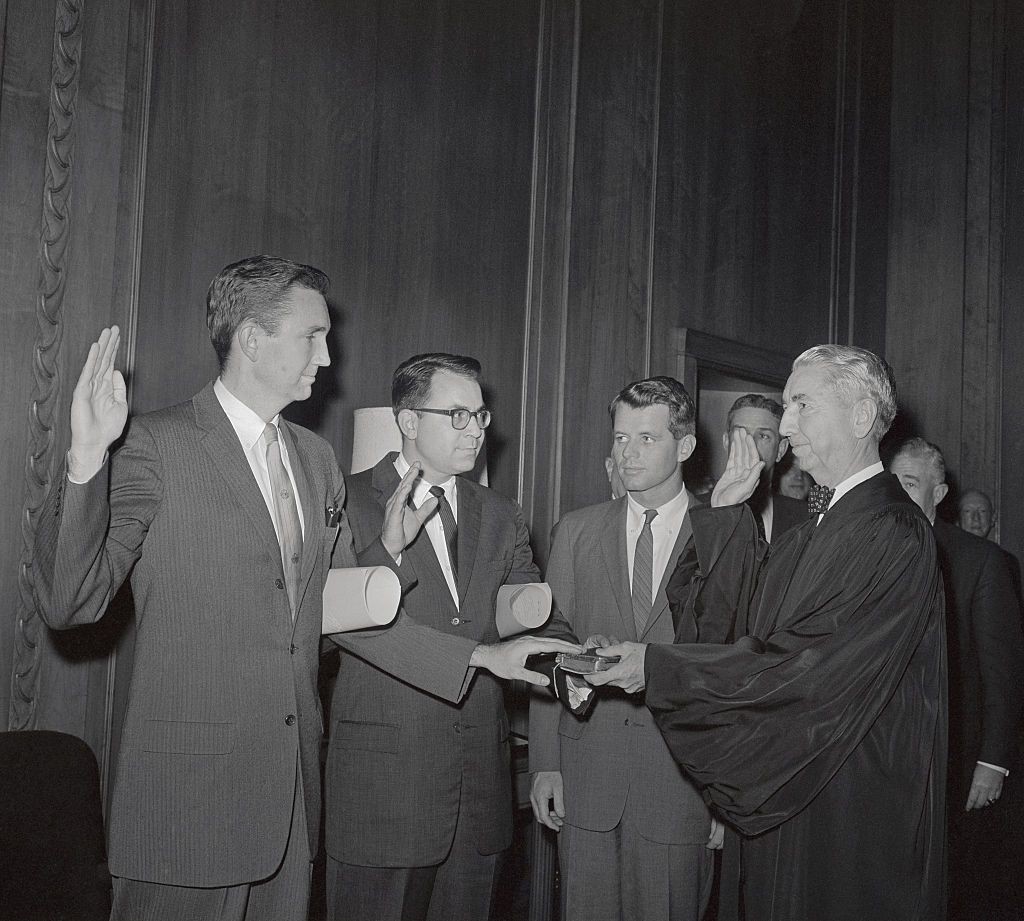
When must justices recuse themselves over family members’ acts?
Late last month, the news site NOTUS reignited the perennial debate about Supreme Court recusals when it reported that Justice Samuel Alito’s son, Philip Alito, is working as a lawyer in the Treasury Department. This is not the first time a justice has navigated perceived or real ethical issues related to their loved ones’ actions, and, indeed, a justice once retired due to his concerns about conflicts of interest raised by his son’s new job.
Relist Watch
Race and recorded calls
In his Relist Watch column, John Elwood highlighted two petitions for review that will be considered by the justices for a second time at today’s conference: United States v. Carter, on whether race can be a relevant factor in the Fourth Amendment test for determining when a police encounter constitutes a seizure; and Grayson v. United States, on whether there is a “clean hands” exception permitting admission of illegally intercepted evidence when the government played no part in the interception.
Contributor Corner
The Supreme Court’s confusing use of “principles”
In his ScotusCrim column, Rory Little explored the court’s recent use of “principles” with unknown origins, such as the party presentation principle, to decide criminal cases, contending that the justices “should precisely describe and define these ideas,” particularly when they are “employed as ‘rules’ to justify keeping a person in prison.”
Podcasts
Amarica's Constitution
Bigotry vs Bureaucracy: State Action and Private Freedom
There’s some highly questionable behavior going on in an area of Missouri, where a fringe group seeks to establish a whites-only enclave. Objectionable? Akhil Amar and Andy Lipka think so. Unconstitutional? Therein lies an opening to a whole host of questions.
A Closer Look
Newman v. Moore
At their private conference on Thursday, the justices are scheduled to consider a petition for review from the oldest active federal judge in the United States, who has been fighting for more than three years to regain her ability to hear and decide cases. Judge Pauline Newman, 98, was suspended by her colleagues on the U.S. Court of Appeals for the Federal Circuit in 2023 over her refusal to provide medical records and undergo testing related to her mental fitness, and she is urging the Supreme Court to clear the way for her suspension to be reviewed in federal court.
Even before the suspension saga began, Newman was a prominent figure in the legal world. She “helped create the Federal Circuit in 1982” and went on to become its “great dissenter,” dissenting nearly 300 times in patent cases over her four decades of service, “more than three times as often as the next-closest judge on the court,” according to The Washington Post, which cited a 2017 study on her work.
Newman contends that those dissents helped motivate her suspension, which she characterizes as a form of “bullying” in her petition for review. But her colleagues, including Federal Circuit Chief Judge Kimberly Moore, counter that the investigation into Newman’s fitness for service and subsequent suspension stem, instead, from concerns about how long it was taking her to complete opinions, her behavior with staff members, and signs of paranoia and memory loss.
In May 2023, while the investigation was in its initial stages, Newman filed the federal lawsuit that led to the petition now before the Supreme Court. She contended that the Judicial Council of the Federal Circuit had violated her due process rights by refusing her request for another circuit to conduct the investigation, that the council had exceeded its authority, and that the statute allowing for judges to be suspended from hearing cases was facially unconstitutional and unconstitutional as applied to her.
A federal district court in Washington, D.C., and the U.S. Court of Appeals for the District of Columbia Circuit held that the Judicial Councils Reform and Judicial Conduct and Disability Act of 1980 barred them from reviewing most of Newman’s claims and rejected the remaining ones. Specifically, they pointed to the Disability’s Act’s section on judicial review, which states that a “judge aggrieved by an action of the judicial council … may petition the Judicial Conference of the United States for review,” but that “orders and determinations” made in the proceedings “shall not be judicially reviewable.”
In her petition for review to the Supreme Court, Newman contends that the D.C. Circuit misinterpreted the Disability Act’s restrictions on judicial review and applied them too broadly. “Nothing” in the act, according to Newman, “purports to prevent litigants from seeking” forward-looking relief that would, for example, bar a judicial council from extending an existing suspension, and the act also doesn’t prevent review of decisions that the council never had the authority to make in the first place. The Judicial Council of the Federal Circuit’s suspension orders amount to such a decision, Newman asserts, because the council “effectively remov[ed] her from office despite the life tenure promised by Article III.”
Newman points to “three expert evaluations” showing that she has “the mental ability of someone decades younger,” and notes that, less than three months before “Moore began pressuring her to resign” over her alleged mental deterioration, she penned a “characteristically excellent” dissent that the Supreme Court later drew on “when it reversed the Federal Circuit” in a case on veterans’ education benefits. Newman urges the Supreme Court to step in and allow judicial review of her claims. As it stands, according to Newman, “[e]very judge who gets crosswise with her chief judge or her colleagues must now worry whether similar tactics could be used to remove them.”
In their response to Newman’s petition, which was filed by U.S. Solicitor General D. John Sauer and which is partially redacted, Moore, the two other members of the special committee that investigated Newman, and the Judicial Council of the Federal Circuit assert that the petition fails the Supreme “Court’s criteria for review many times over,” in large part because it raises claims that were not “adequately pressed or passed upon below.” The brief further argues that the claims find no support in the text of the Disability Act, which “broadly provides that ‘all orders and determinations’ by a judicial council or the Judicial Conference ‘shall not be judicially reviewable on appeal or otherwise.’” “‘All’ means all,” Sauer wrote, and the petition “should be denied.”
Newman v. Moore is scheduled to be considered by the justices for the first time at their private conference on Thursday.
SCOTUS Quote
JUSTICE GINSBURG: “Yes, but Title VII doesn't say ‘right to sue.’ It's a name that the agency uses, but it's not – it's not in the statute. The statute doesn't say you have a right to sue.”
MR. McCONNELL: “Well, what the statute says is you may bring a suit in court. And so, if this Court – I do not see how the Court can say that the right – that the language ‘the right to sue’ is different from a right of action. It certainly – it's – it is the same thing.”
CHIEF JUSTICE ROBERTS: “One way you could do it is that the right to sue is more familiar colloquially. If somebody, you know, hits your car and you jump out angrily and say – you can say: I'm going to sue you. You're not likely to say: I'm going to bring a cause of action against you.”
— CompuCredit Corp. v. Greenwood (2011)
