
Today is our term-in-review event at Johns Hopkins University Bloomberg Center. The event, titled Executive Power and its Limits, will feature a fireside chat with the ACLU’s Cecillia Wang, who argued the birthright citizenship case before the Supreme Court; a discussion of the historical framework of birthright citizenship from Johns Hopkins professor Martha S. Jones; and a live taping of the Advisory Opinions podcast. Tomorrow’s newsletter will include a brief overview of the discussion.
Morning Reads
Justices Kagan and Barrett on tap to testify on Capitol Hill next week
Jordain Carney and Katherine Tully-McManus, Politico
Justices Elena Kagan and Amy Coney Barrett are expected to “testify on Capitol Hill next week, marking the first time since 2019 that members of the high court will testify on their annual budget request to Congress,” according to Politico. They “will appear July 14 before the House Appropriations Subcommittee on Financial Services and General Government, which has jurisdiction over the annual spending measure that funds the Supreme Court.” “They will also give testimony that same day to members of the Senate Appropriations Committee, according to a person granted anonymity to disclose scheduling not yet made public.” Kagan and Barrett will address a requested boost in security funding.
Trump Again Asks Supreme Court to Toss Out Carroll Award
Greg Stohr, Bloomberg (paywalled)
On Monday, President Donald Trump asked the Supreme Court “to take the unusual step of reconsidering its June 29 rejection of” his appeal of a $5 million jury verdict entered against him in a sexual abuse and defamation case filed by E. Jean Carroll. Bloomberg noted that the court “almost never reconsiders its decisions not to hear an appeal. Under the court’s rules, rehearing petitions are appropriate only to address ‘intervening circumstances of a substantial or controlling effect’ or ‘to other substantial grounds not previously presented.’” “In his new filing, Trump says the jury’s finding was tainted by discussion at trial of statements he made while he was president. Trump’s lawyers contend those are official acts, for which he is immune under the 2024 Supreme Court ruling that derailed criminal charges against him for trying to overturn his 2020 election loss.”
Half of Americans disapprove of the way the Supreme Court is handling its job
Alexander Rossell Hayes, YouGov
A new “Economist/YouGov Poll finds that half (50%) of Americans somewhat or strongly disapprove of the way the court is handling its job. Only 36% approve of the Supreme Court’s job handling.” “One source of disapproval … may be the view of many Americans that the court’s recent decisions have given too much power to the president. Nearly half (45%) of Americans think the court’s decisions have given the president too much power, more than the 38% who think recent decisions either have been about right (29%) or have given the president too little power (9%).” The survey showed that Republicans are generally much more supportive of the court and its rulings than Democrats.
Former EEOC commissioner drops lawsuit challenging dismissal after Supreme Court ruling
Sophie Brams, The Hill
Following the June 29 ruling in Trump v. Slaughter, in which the court cleared the way for the president to more freely remove the heads of independent agencies, Jocelyn Samuels, “[a] former Democratic appointee to the Equal Employment Opportunity Commission,” has dropped her challenge to President Donald Trump’s decision to fire her last year, according to The Hill. “I strongly disagree with the Supreme Court’s legal analysis in Trump v. Slaughter, which overturned an almost century-old precedent and undermined Congress’s authority to limit the President’s removal power over commissioners of independent agencies,” Samuels said in a Monday statement. “The Court’s opinion, however, leaves me without a viable path forward to continue contesting my termination.”
AP’s long-time Supreme Court reporter Mark Sherman reflects on front row seat to legal history
Mark Sherman, Associated Press
After covering the court for 20 years, Associated Press reporter Mark Sherman retired at the end of the 2025-26 term. He wrote an essay for the AP about how the court changed during his tenure, which overlapped with the emergence of the court’s current conservative supermajority. Among other shifts, he noted that “[s]ecurity concerns have grown exponentially over the years.” “It’s remarkable how unobtrusively justices used to move around town,” Sherman wrote. “It was not uncommon to run into Ginsburg and her family at a movie or a play, see Thomas making his way to and from Mass most mornings, bump into Kagan at a supermarket or get in line behind Sotomayor at a weekend farmer’s market on Capitol Hill.”
On Site
Contributor Corner
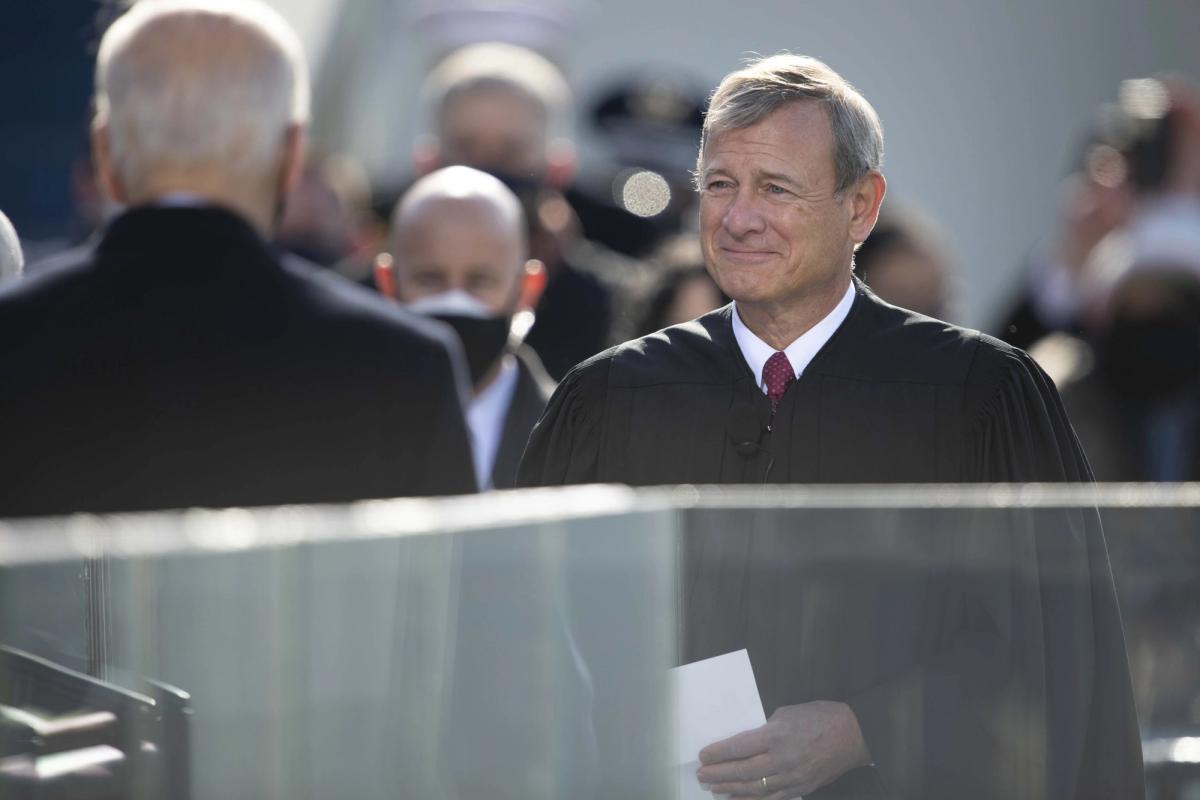
Is Chief Justice Roberts moderating from the front?
In his Controlling Opinions column, Richard Re reflected on claims that Chief Justice John Roberts is not a “true institutionalist.” “There is something right about this view,” he wrote, “but it misses that institutionalism must adjust to changing conditions.”
Contributor Corner
Justice Jackson reignites the interpretation wars, adding to textualism’s emerging cracks
In her Clear Statements column, Abbe R. Gluck considered whether Justice Ketanji Brown Jackson is “starting a statutory-interpretation revolution.” Gluck pointed out that several of Jackson’s separate opinions this term “were written specifically to protest the majority’s refusal to consult legislative history in statutory cases.”
Contributor Corner
The Supreme Court’s disturbing approach to federal spending
In his Courtly Observations column, Erwin Chemerinsky revisited Landor v. Louisiana Department of Corrections, in which the court on June 23 “held that there cannot be suits against individual government officials” under the Religious Land Use and Institutionalized Persons Act “unless they consent to being sued.” He contended that the decision “is based on a premise with troubling, and massive, implications: federal spending programs should be treated as contracts.”
Podcasts
Advisory Opinions
Complicating the Polarization Narrative
Sarah Isgur and David French discuss SCOTUSblog’s Stat Pack, look at the dissents in the birthright citizenship case, and answer listeners’ questions about everything from the 14th Amendment being sex-blind to whether independent agencies could be recreated with the legislative branch.
Ask Amy
Given all of the recent buzz about the possibility that Justice Samuel Alito might retire this summer, when do justices typically announce their retirement? Is there a standard protocol?
There is no standard protocol. And although many people associate late June or early July – when the justices finish issuing opinions in argued cases and head out for their summer recess – with retirement announcements, there have only been three such announcements during the past 35 years: Justice Thurgood Marshall on June 27, 1991; Justice Sandra Day O'Connor on July 1, 2005, and Justice Anthony Kennedy on June 27, 2018.
Five other justices in that period have announced their retirements earlier in the court's term, between January and early May: Justice Byron White on March 19, 1993; Justice Harry Blackmun on April 6, 1994; Justice David Souter on May 1, 2009; Justice John Paul Stevens on April 9, 2010; and Justice Stephen Breyer on Jan. 27, 2022.
Finally, three justices have died while in office during that stretch: Chief Justice William Rehnquist on Sept. 3, 2005; Justice Antonin Scalia on Feb. 13, 2016; and Justice Ruth Bader Ginsburg on Sept. 18, 2020.
SCOTUS Quote
JUSTICE SCALIA: “Mr. Waxman, you have a habit of not pausing between sentences. You pause in the middle of the sentence, and you end a sentence and go right on to the next. So I apologize for interrupting, but –”
MR. WAXMAN: “Not at all.”
JUSTICE SCALIA: “– but you leave me no alternative.”
(Laughter.)
MR. WAXMAN: “It's the red light.”
JUSTICE SCALIA: “Yes, I understand.”
MR. WAXMAN: “The tyranny.”
— Amgen Inc. v. Connecticut Retirement Plans and Trust Funds (2012)