
Generated Image
“Wetin she sef go find for him house?” “Why wasn’t she dressed decently?” “Na her waka waka and bad lifestyle cause am.” In the Nigerian context, these are a few of the common perspectives expressed against female victims of sexual assault or rape.
While it is incorrect to dismiss the possibility of male rape victims, data consistently indicates that women are disproportionately affected by sexual violence. Although the exact ratio varies by country and reporting source, the common denominator is the higher likelihood of a rape victim being female. This may be because most male rape cases occur when victims are at a younger age. Data from the VIRAGE survey, Sexual violence against men is committed by other males, mainly during childhood, by Lucie Wicky supports this opinion. On the other hand, while females also experience high rates of sexual violence during childhood and youth, their likelihood of being assaulted does not necessarily decrease as they get older. This is not to imply that male sexual violence is any less severe than when a female is the victim; rather, it underscores the prolonged and broader exposure females face to sexual violence over their entire lifetimes.
Sexual violence remains one of the most harrowing experiences a person can endure, leaving deep physical, emotional, and psychological scars that can last a lifetime. Physical scars frequently manifest as chronic pain conditions, severe sleep disturbances, reproductive health impacts and acute bodily trauma. Alongside these are deep emotional scars, where survivors battle intense, misplaced shame, profound emotional numbness, and a persistent, exhausting sense of vulnerability in everyday spaces. Many survivors grapple with debilitating Post-Traumatic Stress Disorder, dissociation and compartmentalisation, severe anxiety, clinical depression, and deep-seated intimacy issues that fracture their ability to trust others.
Unfortunately, due to the underreporting of sexual assault and rape cases owing to stigma surrounding the subject matter, it is difficult to determine the exact number of rape victims in any society—however, daily interactions and the news show that it is an endemic issue. Specifically in Nigeria, it seems as though every time you come online or listen to the news, there is another tragic tale of a young girl or woman who has been recently victimised. What is more heartbreaking is the response to this unsavoury news: in between the outrage that accompanies such reports, there are those who insist on placing the blame squarely on the victim.
I recall the horror I felt reading about the Ozoro fertility festival that took place in March 2026 in Delta State. There were reports that women were warned not to come out during the festival, and as far as the perpetrators were concerned, a woman who violated that decree was fair game and had opened herself up to being targeted. I thought to myself, “So men who were participants in this festival that promotes such heinous acts of violence will return home afterwards to their wives, sisters and daughters; then what? Will the women in their lives welcome them with open arms, cook for them, obey their demands?” I simply could not wrap my head around how a traditional ceremony could be used as a medium to perpetrate sexual violence.
The incident shows how women are reduced to the wants and wishes of men. The villainous men obviously believed the women were theirs to take. Hence, they required no consent from them, and their protesting voices were sounds to be silenced and ignored, because who were these women to deny them their rights? It also speaks to the moral decadence in society and how graceless a society can become when people take matters that should be taken seriously for granted or overlook them.
An example of how sexual violence is trivialised is embodied in jokes made by some men. You will hear them blatantly utter statements like, “Do you want to tell me she didn’t enjoy it?” “Abeg, make person come rape me too”, “I wish I could be raped too.” All of which are utterances that dismiss the gravity of the crime. Some will even go as far as making mocking videos, imitating women crying over being violated.
Another example of a frequent occurrence that is being overlooked or not taken seriously is the physical and verbal abuse women are forced to endure at the hands of male traders at marketplaces. I was one of those who would most times shout at the traders for pulling my arm or touching any other part of my body. On one such occasion, the trader responded with, “Wetin dey your body?” As the disrespectful trader rightly observed, it was my body, which means even if it is the ugliest body to walk the face of the earth, I should have a say on whether I want it touched or not. In many cases, the physical abuse is accompanied by verbal abuse characterised by name-calling. The worst part is that these incidents are normalised, and when you try to fight against being touched at the market, you get told by observers that, “Your own sef is too much.” What people fail to realise is that these seemingly ignorable acts compound and become the foundation for enabling perpetrators of sexual violence and victim blaming.
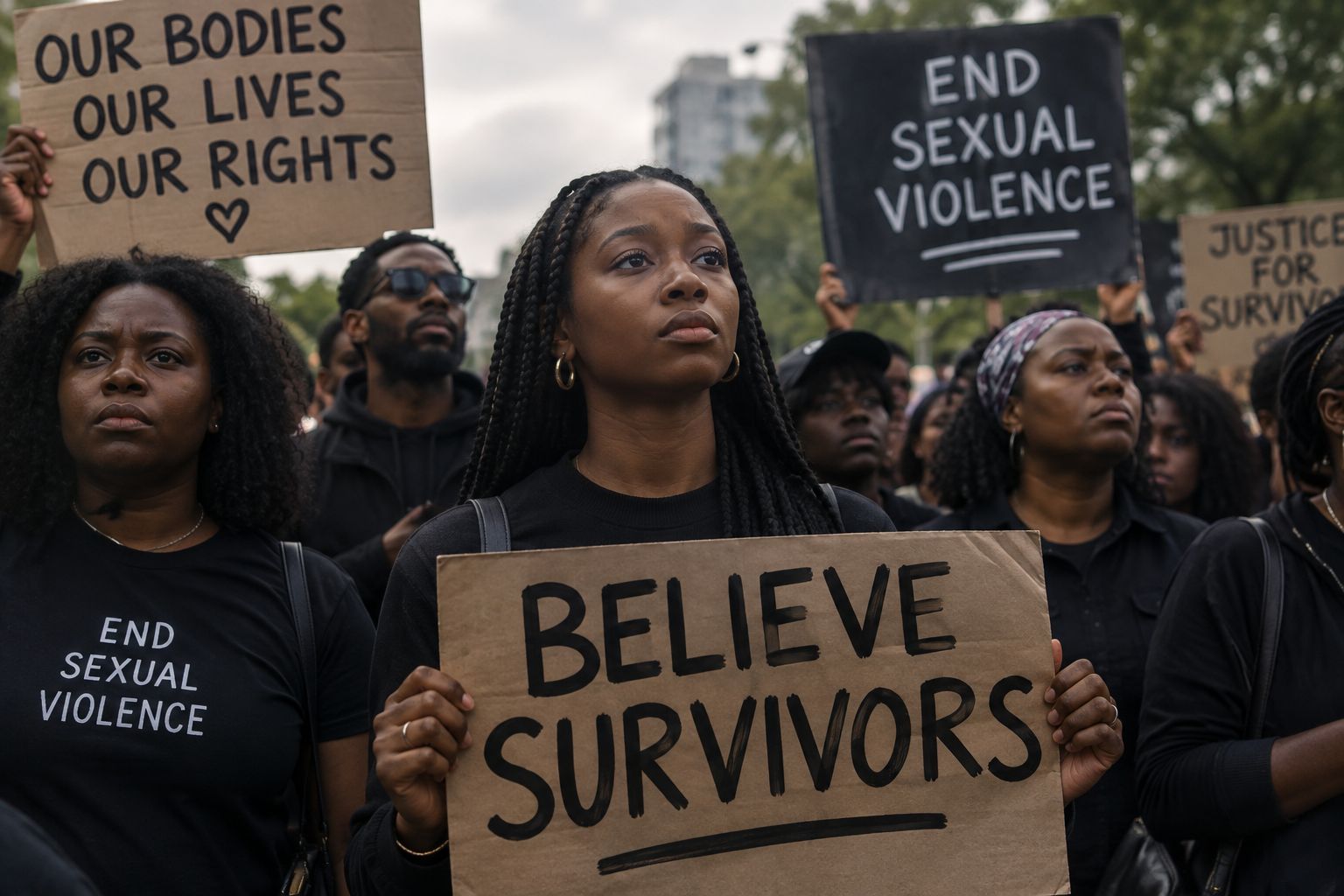
Those common expressions in the opening paragraph and their variations completely absolve the abuser and blame the victim directly. There is no justifiable reason for sexual violence, regardless of clothing, appearance, location, or relationship to the perpetrator. The only person or persons responsible for any case of sexual violence are the perpetrator or perpetrators. Hence, it is our collective duty as members of society to fight against sexual violence and stop victim blaming.
One of the most important ways we can fight against sexual violence is by acknowledging and accepting that it is a fight that should involve us all. We cannot afford to be bystanders. Most people only seem to get concerned when someone close to them becomes a part of the disheartening statistics. You should not have to wait until you or someone close to you is affected before you decide to join the fight against sexual violence. There should be no “it is not my business” when it comes to this matter. The aftereffects of sexual violence (some of which have been listed earlier) are too severe, and we must all ensure it is an epidemic that comes to an end.
Also, speaking up is an act we encourage, but it will do no good if victims who find the courage to speak up are treated like the architects of their misfortune and as outcasts. Unfair treatment leads to survivors internalising these prejudices, resulting in intense self-blame and possibly self-harm. It is important to create a safe space where victims can feel free to share their stories without fear of judgment. When a society shifts from scepticism and victim-blaming to active listening and accountability, we strip abusers of their shield of silence and pave the way for true healing.
In addition, strict legal measures should be taken against abusers. It is not enough for the act to be condemned; perpetrators need to face the full weight of the law. In many cases, they walk away without being punished. Closing loopholes in the judicial process, eliminating institutional corruption, and ensuring that reporting an assault leads to transparent, unbiased investigations are critical steps. Without uncompromising legal consequences, the cycle of impunity will only continue to protect offenders at the expense of survivors.
I’d like to encourage victims of sexual abuse to do all they can to seek help. When you are ready and safe to do so, sharing your burden with a trusted professional or support system can help strip the experience of its secrecy and power. There will be days when it might seem as if you have not healed at all, days when the memories seem so fresh, but even on those days, the following days are better. The nightmares will become way less frequent and may eventually stop completely. You will find many reasons to smile. Self-harm and suicide are never the answers. It gets better with time.
The post Praise Otito Obanya: Fighting Against Sexual Assault and Rape is a Collective Responsibility appeared first on BellaNaija – Showcasing Africa to the world. Read today!.