Donald Trump and Xi Jinping’s Washington summit has been billed as a discussion of major issues surrounding the development and possible regulation of artificial intelligence (AI), as well as trying to find common ground over Taiwan and trade. What everyone wants to know is whether – and how – the leaders of the two biggest world powers can get over their rivalry through face-to-face diplomacy to achieve a positive outcome in what is surely the most urgent question facing global leadership.
The importance Beijing attaches to such encounters was underlined on September 17 when, in a call with the US secretary of state, Marco Rubio, the Chinese Foreign Minister Wang Yi declared that “head-of-state diplomacy is the anchor of China-US relations”.
For this diplomacy to bear fruit, Trump and Xi have to develop what is known as “security dilemma sensibility”. This is the ability to recognise that an adversary may be acting out of fear and not predatory intent and to appreciate how one’s own state’s actions have contributed to that fear. If Trump and Xi can do this, it could create an opening for policies of reciprocal reassurance.
In our new book we argue that face-to-face diplomacy offers leaders an opportunity to examine these questions directly and explore what reassurance could involve.
Each of the two leaders need to acknowledge how their own country’s actions contribute to the other’s insecurity. Trust may develop out of such a shared understanding, but recognising an adversary’s fears does not require accepting their claims. What it does do is open the path to new policies of reassurance and restraint.
This summit is an important opportunity for the US and Chinese presidents to show each other that they are exercising security dilemma sensibility, especially in relation to those issues (Taiwan and AI) that could if left unmanaged plunge the two sides into deeper confrontation.
Reagan and Gorbachev’s nuclear rapport
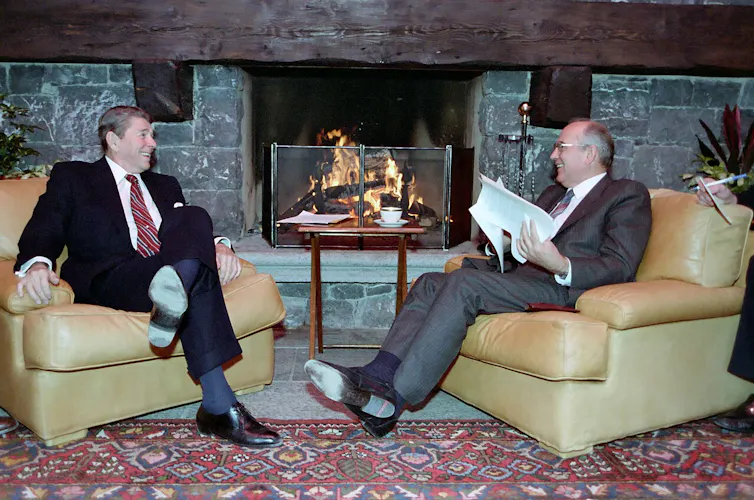
There are lessons to be taken from the relationship between Ronald Reagan and Mikhail Gorbachev in the late 1980s. When the two leaders met for their first summit in Geneva in November 1985, it was against the backdrop of a tense superpower relationship in the first part of the 1980s, especially Soviet fears that the United States was planning to launch a nuclear attack on the Soviet Union under the cover of Nato’s November 1983 Able Archer exercise.
Gorbachev came to power as general secretary of the Soviet Union in March 1985. He had a reputation as a pragmatist and reformer who wanted to reduce global tensions and curb the expensive nuclear arms race.
In their first private conversation, Reagan proposed examining the suspicions driving the arms race. Gorbachev argued that cooperation did not require either country to change its political system and that it was possible to advance one superpower’s interests without undermining that of the other.
On the all-important nuclear question, their joint statement declared that “a nuclear war cannot be won and must never be fought”. Crucially, and often overlooked, they also pledged that: “They will not seek to achieve military superiority.”
UN National Archives
These commitments publicly acknowledged a common interest in preventing nuclear war. Their statement agreed to “study the question at the expert level of centers to reduce nuclear risk” and “took satisfaction in such recent steps in this direction as the modernization of the Soviet-US hotline”.
This led to the development of the Nuclear Risk Reduction Centers (NRRCs) in 1987. These were described by the US Department of State as “specialized 24/7 government communications hubs … to lower the risk of accidental nuclear war”.
So while the Geneva summit did not eliminate superpower competition, it established a framework on which further cooperation could build.
Could AI provide a similar opening?
While nuclear fears were at the top of the agenda for Reagan and Gorbachev, AI is the burning issue for Trump and Xi. There have already been some positive steps. On September 21, US treasury secretary, Scott Bessent, said Washington and Beijing had agreed to establish a formal AI dialogue, including an incident line. Further talks are planned in Shenzhen later in the year.
It’s a start. But agreeing to establish a channel, or “AI hotline” as some have called it, is no guarantee as to how it will work. We know that the US fears that if it constrains its development of AI, China may cheat and surge ahead. Anthropic’s chief executive, Dario Amodei, said exactly this when he wrote: “If we greatly restrain our AI capabilities in the belief that China will do the same, and then China defects, AI could be so powerful that such a defection could lead to their geopolitical dominance.”
It’s reasonable to assume that China feels the same way. This is going to make cooperation very difficult.
The security dilemma arises when each side’s efforts to protect itself intensify the other side’s feelings of insecurity. When it comes to AI, our argument is that recognising the common danger is only part of the task. Each side also needs to consider whether its efforts to avoid falling behind will encourage the other to accelerate, potentially at the expense of safety.
The incident line will go some way to addressing this by establishing common tests for dangerous AI capabilities and procedures for warning one another about serious incidents.
The real test of the summit
A summit need not resolve fundamental disagreements or produce personal trust to make cooperation possible. Rather, the test of the summit is whether each can recognise the other’s security fears, especially in relation to AI, and acknowledge how their own actions have contributed to them.
The summit and new AI dialogue provides an opportunity to explore potential common ground on AI safety that can limit the dangers of US-China competition.
For outside observers, the evidence would lie less in declarations of personal rapport than in specific reciprocal commitments, responsibilities assigned to officials and arrangements for follow-through.
An operational incident-reporting channel would not prove that trust had developed, but it would provide a way to examine whether the leaders’ commitments were being put into practice.

Nicholas John Wheeler has received funding from the Economic and Social Research Council (ESRC) and the Open Society Foundations.
Marcus Holmes does not work for, consult, own shares in or receive funding from any company or organisation that would benefit from this article, and has disclosed no relevant affiliations beyond their academic appointment.