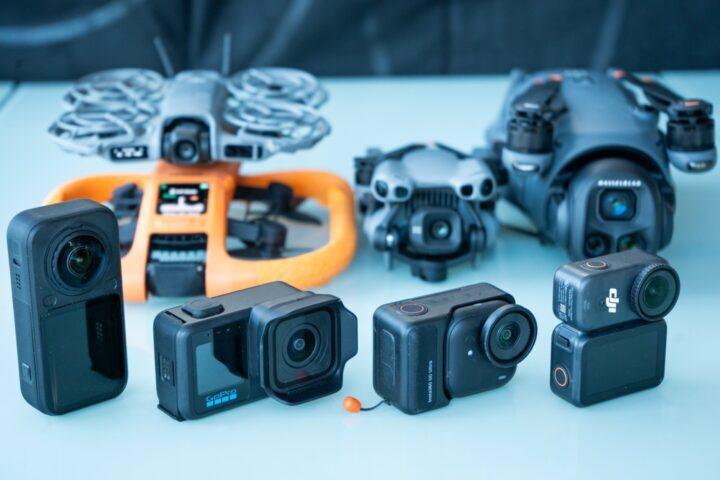


I use action cams and drones virtually every single day, and I’ve used virtually every mainstream consumer action camera and drone on the market today. Though, in reality, we’ve basically just got three main action camera companies: GoPro, DJI, and Insta360. And in many ways, they make relatively similar cameras. In fact, some of them are using the exact same image sensors and processors in certain models. That said, as you’ll see, it’s far more than just an image sensor that makes a good action camera. The app is just as important, especially for 360 cameras.
Meanwhile, on the drone front, we’ve got two and a half consumer drone companies. There’s DJI, of course, the giant that makes drones in almost every category. Then there’s HoverAir, which makes a ton of small follow-me drones. Beyond that, we’ve got a slate of pretend DJI shell companies trying to do business in the US, but mostly getting whack-a-mole banned on a weekly basis. Things like SkyRover, Specta, and Xtra. We’ll ignore these copycats for our purposes here. After all, nobody buys those outside the US because you might as well just buy the real thing (the DJI-branded one).
Then there’s the ‘half a drone’ company I mentioned, which is Insta360’s Antigravity spin-off. Currently, they have just one model, which is showing promise. But at its current price point, it’s pretty tough to recommend given the competition. That said, I’m super excited to see where the company goes, and think they could really stick the landing on a second model at some point (no pun intended).
With that, a quick note about my recommendations:
1) None of these are sponsored: I’ve bought all of these drones/action cameras myself. Yes, I spend too much on drones and action cameras. Inversely, the drone and action cam market is absolutely smothered with sponsored garbage/videos, almost everything, in fact.
2) My recommendations are based on real-world usage: And more importantly, not trying to sell you any specific model. I don’t really care what you buy, as long as you’re happy with it. Ultimately, these are also largely what I use daily as well, despite having every single model of every drone and action cam available to me.
3) DJI is challenging for US buyers: There’s no two ways about it. DJI got double-whacked over the past 18 months. First, there’s the FCC ban impacting *all wireless devices* that DJI wants to certify, which includes action cameras, drones, e-bikes, and anything else they make that has a Bluetooth or WiFi chipset in it (which is everything). Then, on top of that, there’s the overall no-foreign-drone ban that occurred last December 2025. Collectively, those two things mean that buying new DJI products in the US made after those certification/import bans doesn’t come with any support, and is basically bought in the grey market of random imported companies. Note that the drone portion of the ban affects all non-US companies going forward, not just DJI.
So let’s get right into it!
Action Cam Recommendations:

When it comes to action cams, I’d argue there are essentially just two main categories: full-featured, slightly bigger ones, and then tiny little action cams that sacrifice some features for the ability to stick it somewhere really small. That said, one thing to keep in mind is that the size difference between these two categories is actually really small if you’re using it within the case. Meaning, the size of an Insta360 Ultra Go in the case is basically the same as the main cameras. Except none of the small camera cases from DJI or Insta360 are waterproof (meaning you can’t take the larger case portion in the water, only the pod).
The reason I mention that first, is that if you’re trying to decide between the two sizes, I’d almost always go with the large size one, as it’s fully waterproof (and thus really hard to kill accidentally), and the features to price tend to be better. As does the quality. In all cases, the larger cameras have notably better quality/resolutions/frame rates.
Main Action Camera – GoPro Mission 1 Pro:

This is a beast of an action camera, easily the best on the market today. There’s not really any objective way you could say otherwise. It beats every other camera on specs, image quality, run times in most categories, and just about every other thing out there. Of course, that unfortunately extends to price too – it’s the most expensive action camera in the market today. Still, it’s pretty rock-solid, produces incredible shots, and syncs cleanly into the GoPro Cloud where I back up all my action camera footage. Insta360 has a similar cloud offering, though GoPro’s is unlimited GoPro footage at full/native resolution, while Insta360’s is capped at 2 TB, and you pay nearly double. You can blow through storage pretty quickly when shooting in 8K at high bitrates, which the GoPro Mission 1 Pro does. Ultimately, I’ve now bought a small fleet of Mission 1 Pro cameras that I use for most of my larger action cam needs.
My Backup Camera – Insta360 Ace Pro 2:

Prior to the GoPro Mission 1 Pro, I basically flipped a coin whether I was taking the GoPro Hero 13 Black or the Insta360 Ace Pro 2. Both gave good performance, though the Insta360 Ace Pro 2 beat the Hero 13 for low light/night footage, while the GoPro beat it for daytime footage. Insta360’s benefit though, was that it had/has better integration with the sports devices I use from Garmin, Apple, COROS, and more. Those metrics sync right into the Insta360 app, and I can instantly overlay them right onto the videos I make, showing stats like speed, distance, pace, power, and so on. DJI also has a similar feature, but I find Insta360’s a bit more flexible. The other reason I tend to prefer the GoPros is the dual-front/back screen, whereas the Ace Pro 2 has a back flip-up screen. That’s super cool for vlogging, but a little less practical for flipping up during quick selfie-style shots while holding a camera on a bike or other sport thing at high speed. Still, the Ace Pro 2 is a strong buy at the right price.
Honorable Mention – GoPro Mission 1 Pro ILS:

This is a quirky one to me, not because it’s not good – as it’s really good. But it’s also just not something that most people looking for an action cam on a regular basis would want. The Mission 1 Pro ILS has an interchangeable lens system, like a mirrorless/DSLR. That’s awesome, and crazy unique. You can put any micro-4/3rds lens on it you want. The only catch? No autofocus.
Now, for people who want to put tiny cameras in small places (like mounted in cars and such), that run for many hours without issue and have all the power of the new Mission 1 Pro series, this is a massive deal. But if you’re not used to manual focus, let alone manual focus on an action camera with a tiny screen…these can be hard to handle. I’ve got some amazing shots from this camera (and seen people do even crazier things), but equally, it’s definitely not going to be your primary action camera. This is a camera for someone who already has a fleet of them and wants some super creative angles/shots. It’s awesome of that.
| Product | Amazon | Note | |
|---|---|---|---|
 |
GoPro Mission 1 Pro | Amazon | Retail Price: $699, currently on sale for $599 |
 |
Insta360 Ace Pro 2 | Amazon | Retail Price: $389, currently on sale for $309 |
The Mini Action Cams:

I’ve done a stupid amount of testing of these three action cameras above, though only managed to get the Insta360 Go Ultra reviews across the line. Sigh. If only my hard drives full of terabytes of footage could edit themselves. Still, I tend to use these cameras sparingly, since both the DJI & Insta360 tiny cams aren’t fully waterproof. Only the small pod portion is waterproof, not the full-sized case. And because the small removable pod is…well…small, it means you’re almost certainly going to attach it to a larger stick when in the water (so you don’t lose it). And once you do that, you kinda defeat the purpose of a small action camera.
Instead, the core/main scenario I use tiny action cameras for it actually clipping it to the magnetic necklace pendant, through my cycling jersey. So it looks like the camera is just hovering there on my chest. I usually do this when I don’t want to deal with a full chest mount/strap setup of the bigger cameras. This works well if you get the angle right, but admittedly a chunk of the time if down in the drops (lower portion of handlebars), then this mount ends up mostly just filming the ground.
In any case, when it comes to these two, they’re honestly kinda a wash. There are very few differences between them. DJI includes internal storage, whereas Insta360 doesn’t (both take/allow MicroSD cards). Insta360 ties into their Insta360 cloud storage, whereas DJI doesn’t. These are very similar spec’d cameras. I personally tend to grab the Insta360 Go Ultra a bit more, merely because I find the Insta360 app better than the DJI Mimo one, but that’s really the only reason why.
Now, you may be wondering about the GoPro Hero 4K/Hero 4K Lit seen up there in the combo picture. Well, I don’t recommend that one. This camera was super promising. Incredibly promising. Unlike Insta360 & DJI, it’s actually fully waterproof, which I find super important in an action camera. But then I looked at the footage. Unfortunately, it’s just not awesome at all, and nowhere in the same league at the DJI OSMO Nano or Insta360 Go Ultra cameras. Of course, it’s a notably less expensive camera, especially in the US. So perhaps that justifies it. But equally, you can pickup a DJI OSMO Action 6 for basically the same price, and that’s got great image quality, albeit is a touch bit bigger.
I really hope GoPro takes another crack at the smaller form factor camera. Give me the same size as this little Hero 4K, but ditch the light, and then give me something with the new GoPro chipset in there. Please
| Product | Amazon | Note | |
|---|---|---|---|
 |
DJI OSMO Nano | Amazon | Retail Price: $389, currently on sale for $349 |
 |
Insta360 Go Ultra | Amazon | Retail Price: $449, currently on sale for $359 |
The 360° Action Cams:

Next, there are the 360° action cams. These ones capture video 360° at usually 8K, allowing you to play back either as a 360° video, or more commonly, as a ‘flat’ video at any angle you choose in 4K. This is the most common scenario where people (including myself) tend to use 360° action cameras. I never watch the footage back with VR headsets or such, I just rotate the view to the bit I want, and then export it as a normal video file in 4K. This includes panning/zooming/etc to follow action within the frame.
The thing to understand about 360° action cameras is that, in general, they take more effort. While capturing everything around you at once sounds like it’s less effort, in reality it means that every video requires at least some basic video editing to get the views/angles you want. Sometimes that’s just a few seconds’ worth, and sometimes it’s more complicated/messy.
My rule of thumb here is that if you’ve only got one action camera, just get a regular action camera first. It’ll make your life much easier. But if you’re looking to add a second camera to the mix, and enjoy video editing, then a 360° action camera can make sense.
My Main Pick: Insta360 X6:

The Insta360 X6 came out this past summer, bringing upgraded internals, better low-light processing, and much better footage. A number of the changes seemed small, but in total it was a ton of meaningful changes. I use 360 cameras mainly in three core scenarios: Footage of me running where the camera appears out front (and the selfie stick erased), footage of me and my wife cycling with that same perspective, and underwater footage. I also sometimes use it for boat and efoiling footage, again, to get that ‘off to the side’ perspective without a selfie stick.
However, it’s really the underwater footage where Insta360 and the X6 absolutely dominate. I’ve stopped bothering to take a regular action cam/GoPro down underwater for scuba or free diving. It’s purely the X6 now. The shots just come out so damn good, every time. And the ability to reframe when scuba diving is awesome in particular. But more than underwater footage, the main ‘winner’ for me on the X6 over the GoPro Max 2 is simply Insta360’s software app. It’s just got all these little useful features that make it faster and better than GoPro’s app. It’s not like GoPro’s app is bad, but it’s just not really in the same league as Insta360’s, which is constantly getting new features. So while it’s more expensive, I personally find it worth it.
The Honorable Mention: GoPro Max 2:

This is a classic example of why software is so darn important in the 360° action camera space. On paper, the GoPro Max 2 has slightly higher resolution and video-focused details than the Insta360 X6 does in daylight footage (for most people, though, it’s a wash). Heck, the GoPro Max 2 is even a fair bit shorter/smaller than the Insta360 X6 as well.
But that software gap I mentioned above is the singular reason I’d recommend the X6 over the Max 2 if the price is equal. But the thing is, these days the price isn’t actually equal. The GoPro Max 2 is $299, basically half the price of the Insta360 X6. And while the software isn’t as good as the Insta360 X6, it’s also not horrible either. It’s perfectly fine in most cases. It’s just that Insta360 has lots of small/little features that give it the edge when everything else is equal. Still, to be really clear – the GoPro Max 2 has phenomenal image quality and great color science. It’s why so many professional users use GoPro, and that carries into this camera. You certainly won’t be unhappy here.
| Product | Amazon | Note | |
|---|---|---|---|
 |
GoPro Max 2 | Amazon | Retail Price: $499, currently on sale for $274 |
 |
Insta360 X6 Base Bundle | Amazon | Retail Price: $659, currently on sale for $524 |
The Best Drones:

When it comes to drones, I heavily use two main drones constantly, and then two others on a lighter basis. From an athletic standpoint, I’m constantly using the DJI NEO 2 in follow-me mode. It follows you around and is nearly impossible to kill. I’ve crashed it probably hundreds of times by now. Meanwhile, for ‘pretty’ shots that require some big-boy lenses, I use the DJI Mavic 4 Pro.
After that, I have the DJI Mini 5 Pro, which is a great drone, but I only tend to use it on vacations (or hikes) where I’m taking just one drone. And even then, I’d almost always defer to the DJI NEO 2 first, simply due to the better follow-me options.
Which leaves us with the last drone, the HoverAir Aqua above. This is a fully waterproof drone that can take-off/land/flip-over in the water. The design here is to follow you doing aquatic things, from stand-up paddleboarding, to surfing, to foiling, to swimming, and even on a boat. I’ve done most of those things (just not the surfing; I lack those skills). So let’s get into the details a bit more.
Follow-me drone – DJI NEO 2:

I use the DJI NEO 2 as my main follow-me drone. It’s basically indestructible for running, cycling, hiking, etc… Sure, it’s not super great above about 30KPH (it’ll slowly fall behind), but it’s still pretty solid for everything else. It has obstacle avoidance that’ll let it miss the big/obvious things, but there’s plenty (most) times it’ll whack right into the smaller things if you’re going fast. Still, despite me crashing it more times than I could possibly count (likely 100-200 times) since I bought it last year, it’s still going strong. Absolutely recommend this unit. Also, you can pair it up to a DJI remote and use it like a normal drone as well (or, even just use your phone for the same, but the remote gets longer range).
As for why not a HoverAir drone here? Well, simply put, the DJI NEO 2 is both cheaper and more dependable. Sure, you can get marginally better footage out of a HoverAir Pro/Pro Max, but I find the HoverAir drones to be not reliable. Sure, they work like 9 out of 10 times, and then you get to the random 1 out of 10 times where you’re standing on the side of a mountain, and the unit gives you some unknown error message that can’t be troubleshot for whatever reason. And if you use your drone enough, that 1 out of 10 times happens a lot with HoverAir, whereas it never happens with the DJI NEO 2. Frankly, I’m just tired of it.
The all-arounder – DJI Mini 5 Pro:

I use this one sparingly, basically in cases where I want a drone that goes a bit higher/farther, but don’t want to take the DJI Mavic 4 Pro due to size/weight limitations. Yes, this drone also does follow-me, but it requires using the controller (whereas the DJI NEO 2 doesn’t). It’s got better quality than the DJI NEO 2, though not actually a massive step-up in most normal lighting conditions. Instead, it’s lower light conditions or tricky lighting that it does better. Also, it can rotate it’s gimbal 90*, for proper vertical filming. This is a great all-arounder drone, though if you’re into sports I highly recommend picking up a DJI NEO 2 first, and then this second.
Best Prosumer Drone – DJI Mavic 4 Pro:

I use this when I want stunning shots of something, and don’t mind lugging around the beefcake that is the Mavic 4 Pro. This drone has three cameras, essentially a wide-angle, a medium telephoto, and a full telephoto. It can fly upwards of 70KPH, and can track subjects across those lenses. All while putting forth incredible imagery. Of course, it’s not quiet, not cheap, and not lightweight. Living in the Mediterranean, I get a lot of use out of this with tons of stunning things to film in the ocean/mountains/beaches/boats, etc… Whereas if you’re living somewhere without a ton of scenic stuff, then…yeah, you might want to distribute your funds elsewhere.
The Waterproof Drone – HoverAir Aqua:

This is a fun drone if you spend time in the water. Or on the water. Either way, in places where you don’t normally want your drone to be in the water, this one is fully waterproof. You can throw it into the water upside-down, and it’ll flip itself over and then start following you. It’s super impressive. They’ve really done a lot of good work refining it over the past year since launch, but still, it’s a HoverAir product. Which means it’s still buggy. I went out last week for two separate swim days, and for reasons that are unclear to me, on both swims it tracked me just fine, but only recorded the last 75-90 seconds of some swims, while others recorded the full 5-8 minute track section. That’s just the way HoverAir drones have always been: They’re great when they work, but their software quality is just such a pain in the butt. Still, if you want a waterproof drone as I do, you’ve got no other real choice.
| Product | Amazon | Note | |
|---|---|---|---|
 |
DJI Mavic 4 Pro Combo | Amazon | Retail Price: $2,199, currently on sale for $1,999 |
 |
DJI Mini 5 Pro (with RC2 Remote) Fly More Combo | Amazon | Retail Price: $759 |
 |
DJI NEO 2 Fly More Combo (Extra Batteries) | Amazon | Retail Price: $259 |
 |
HoverAir Aqua | Amazon | Retail Price: 974EUR (not available in US) |
Wrap-Up:

There ya go – all my top pics for drones and action cameras as of today. As always, if you’ve got any questions or more specific scenario recommendations, feel free to drop them down below, and I’m happy to try and answer them.
Thanks for reading!