

If oil stopped flowing around the world tomorrow, different countries would find themselves in markedly different levels of a bind, and the figures don't paint an overly pretty picture for Australia – although the government says there's a good reason for it.
The war in the Middle East and ensuing effective closure of the Strait of Hormuz have brought national strategic oil reserves into sharp focus.
The federal government has repeatedly stressed Australia's fuel supply is secure in the short-term – while six shipments were cancelled or deferred, they have since been replaced, and three extras have been secured.
EXPLAINED: How much fuel does Australia have left?
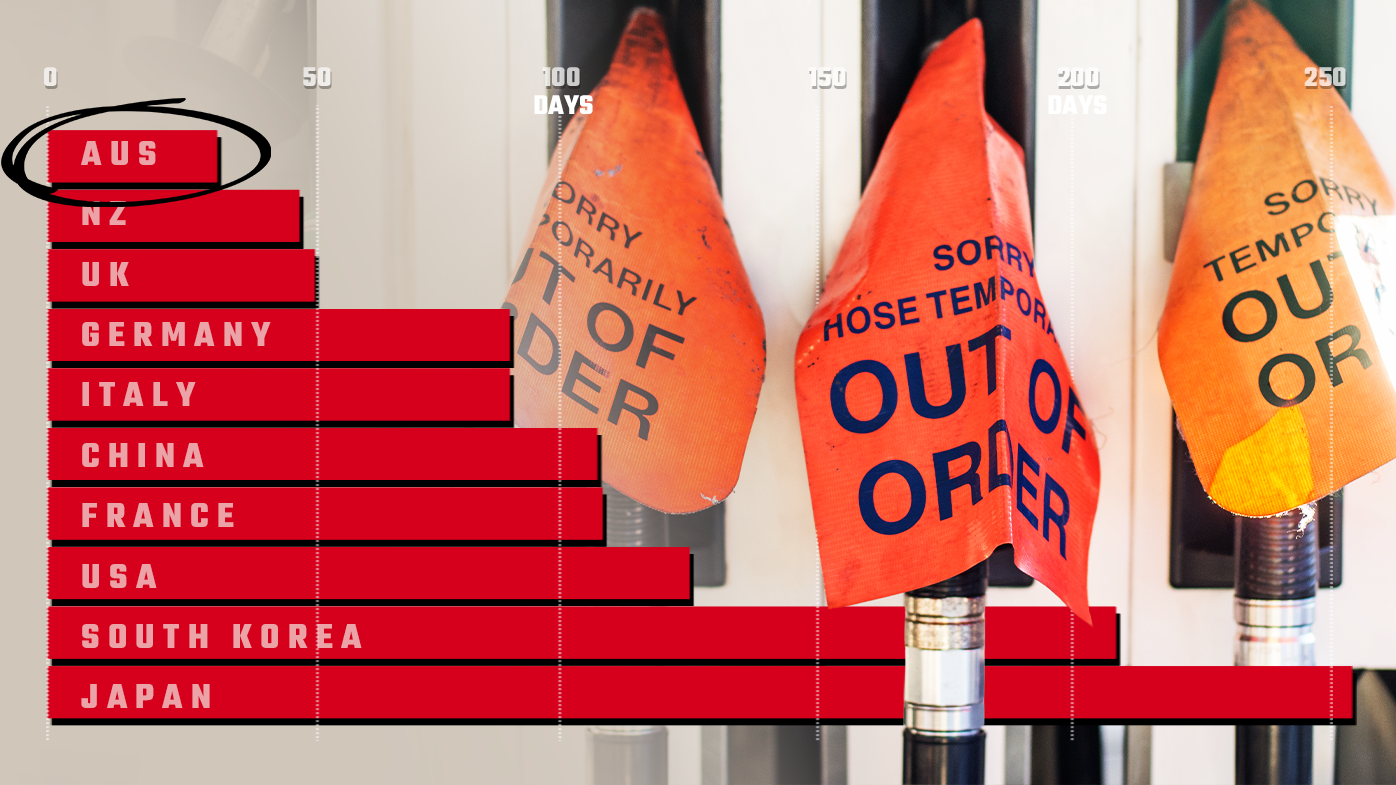
At the same time, it's clear the nation's domestic supplies are far more meagre than those of many other developed economies
As a member of the International Energy Agency (IEA), Australia is obliged to hold at least 90 days worth of fuel.
Canberra doesn't have a strategic stockpile as some other nations do, but instead requires oil companies to maintain a "minimum stock holding" of emergency reserves.
At the end of last year, Australia had 38 days' worth of gasoline, 32 of diesel and 29 of jet fuel in those holdings – all far short of the IEA's obligation.
Those figures have remained fairly steady since the start of the war.
READ MORE: Aussie households set for triple-whammy bill price hike next month
Japan, by comparison, had a whopping 254 days' worth of oil in combined government and private reserves, and South Korea around 200.
The United States has the Western world's largest strategic reserve: some 415 million barrels before the war started, good enough for 125 days, according to the White House.
That is much smaller than it was at the start of the decade, when it was sitting above 650 million barrels, before the Biden administration ordered the release of 180 million barrels in response to the energy shock caused by Russia's invasion of Ukraine.
On top of the 415 million barrels, the US has a further 439.3 million barrels of commercial reserves in private hands.
Even larger is China's estimated stockpile.
READ MORE: Top tip to save on fuel in Australia's fuel crisis
The Asian superpower doesn't publish official figures, but according to energy analytics firm Vortexa, its inventory would have hit 1.13 billion barrels at the end of 2025.
Using daily imports of 10.6 million barrels, that's enough for more than 100 days.
In Europe, nations such as Italy and Germany legally mandate holding at least 90 days' worth of oil in reserve, while French economy minister Roland Lescure said his country's stockpile was sitting at 108 days in early March.
The UK has about 68 million barrels of oil in its stockpile – enough for 52 days, taking the Energy Institute's daily usage estimate of 1.3 million barrels, although other estimates have put it closer to 90 days or more.
Australia is not the only nation that had less than 90 days' fuel at the start of the war.
New Zealand currently has less than 50, and Canada is the only G7 member which doesn't have a strategic reserve, although, as a net exporter of oil, it's not required to by the IEA.
FINANCE: Is Australia headed for a recession? The job data paints a grim picture
However, according to official IEA data for December 2025 – which differs slightly from official figures – Australia had the smallest oil holdings of any of the organisation's members, and was the only one with less than 80 days' worth of imports on hand.
The nation hasn't met the 90-day obligation for more than a decade, and Energy Minister Chris Bowen has argued it would be too expensive and not address domestic needs.
"Ninety days is not how much petrol is used," he told the 7am Podcast earlier this week.
"It's a 90-day import days, and they can be held anywhere and it's not for domestic supply. It's to be able to sell it if things get rough and the IEA asks us to.
"Now, we don't comply with that. But if we did try to keep 90 days' worth in Australia, that would cost $20 billion over four years… that's $20 billion we're not spending on schools, hospitals or anything like that. So that's a big, big call.
"There's a reason why consecutive governments haven't done the 90 days. I think every new energy minister has asked – I certainly did – 'why don't we do 90 days?'. And you get the advice it's going to cost $20 billion.
"And you think, well, that's pretty hard to find."
READ MORE: Millions of Aussies to get an extra hour of sleep as daylight saving set to end

He and the rest of the government has insisted Australia was better prepared before the start of this conflict than it was previously.
"It's a legitimate conversation, but we're actually more prepared… certainly than when we went into Ukraine," Bowen said.
"We've got those 38 days of petrol, 30 days of diesel, 30 days of jet fuel and, you know, sure, people can say we need more, but it's a lot more than we've had previously."
However, some experts have argued Australia should hold more oil on hand because of its place in the supply chain.
"Australia remains exposed to global disruptions because it imports a large share of its refined petroleum," Professor Sajid Anwar from the University of the Sunshine Coast said after the outbreak of the war.
"The country typically holds around 30 days of fuel stocks, well below the 90-day level recommended by the International Energy Agency.
"Although Australia draws on multiple suppliers, including Singapore, South Korea and Japan, these sources sit within the same Asia-Pacific supply chain, meaning major regional disruptions could still affect supply."
NEVER MISS A STORY: Get your breaking news and exclusive stories first by following us across all platforms.
- Download the 9NEWS App here via Apple and Google Play
- Make 9News your preferred source on Google by ticking this box here
- Sign up to our breaking newsletter here
