
Please note that SCOTUS Outside Opinions constitute the views of outside contributors and do not necessarily reflect the opinions of SCOTUSblog or its staff.
In a previous piece for SCOTUSblog, I suggested a somewhat unconventional way to gauge which are the most important Supreme Court cases: simply count the number of amicus curiae – “friend of the court” – briefs filed in each one. The logic, borrowed from economics, was that filing a brief costs time, money, and reputation, and a large number of filers in a case is therefore a credible signal that knowledgeable parties believe that case really matters. Because briefs are filed before a case is decided, this measure also sidesteps the circularity of calling a case important only after a close, ideologically contentious vote suggests that it was.
That measure worked reasonably well, but I was candid about one weakness: it leans heavily toward civil rights and “culture war” cases, when plenty of other types of cases may have a profound effect on people’s lives or the public discourse. Indeed, researchers have long noted that civil liberties disputes, in particular, attract a disproportionate share of amici, and a raw count inherits that bias. Here I want to propose a refinement that provides a different and arguably more revealing picture of what constitutes the most important Supreme Court cases.
Whose briefs count?
Not every amicus brief is filed simply to persuade the justices. Some are filed to be seen filing – to signal to donors, members, or the general public that an organization showed up for the fight. These expressive briefs are perfectly rational, but they tell us more about the politics surrounding a case than about whether the legal questions at its center are weighty. And they are precisely the kind of briefs most likely to pile up in civil rights cases.
So how do we separate the briefs filed to move the law from the briefs filed to signal to donors? Here economics offers a familiar answer: look at what the buyer is actually willing to pay. In my field, the value of an asset is revealed by what people will pay for it, not by what they say about it. The justices “pay” for an amicus brief not with money, but their attention, and ultimately a citation in the opinion. The court is unlikely to cite a brief it found unhelpful, and an expressive brief that breaks no new ground is unlikely to earn a mention. A filer the justices have cited before, by contrast, has a proven track record: the amicus has shown that it can tell the court something worth repeating, which may help decide a significant issue in the case.
That suggests weighting each case’s amici by the reputation of the filers. Although gauging one’s reputation may seem subjective, the way to determine this is actually fairly straightforward. For every organization that files in a case, I counted how often the court cited that filer in its opinions over the previous five terms – a rolling window, so that credibility earned long ago fades and recent reputation counts for more. I then added up those citation counts across all of a case’s filers. A case crowded with first-time or seldom-cited filers will score low. A case that draws the organizations the justices actually quote scores high. (I will go into the filers themselves in a separate article.)
One filer I set aside: the United States. The solicitor general is cited so much more often than anyone else that including the government would swamp every other signal – and because the United States is so frequently a party rather than a friend of the court, counting it would turn the measure into a test of whether the government was in the case rather than that case’s importance.
What rises, and what falls
The tables below show the top five cases per term by amicus reputation, the vote breakdown, and whether the case split along ideological lines (which I discuss later in this article). The final column reports how far each case moved relative to its rank under the raw count – that is, where that case stood in my previous article when I took only the total number of amicus filings into account.
Supreme Court cases 2024–25 term
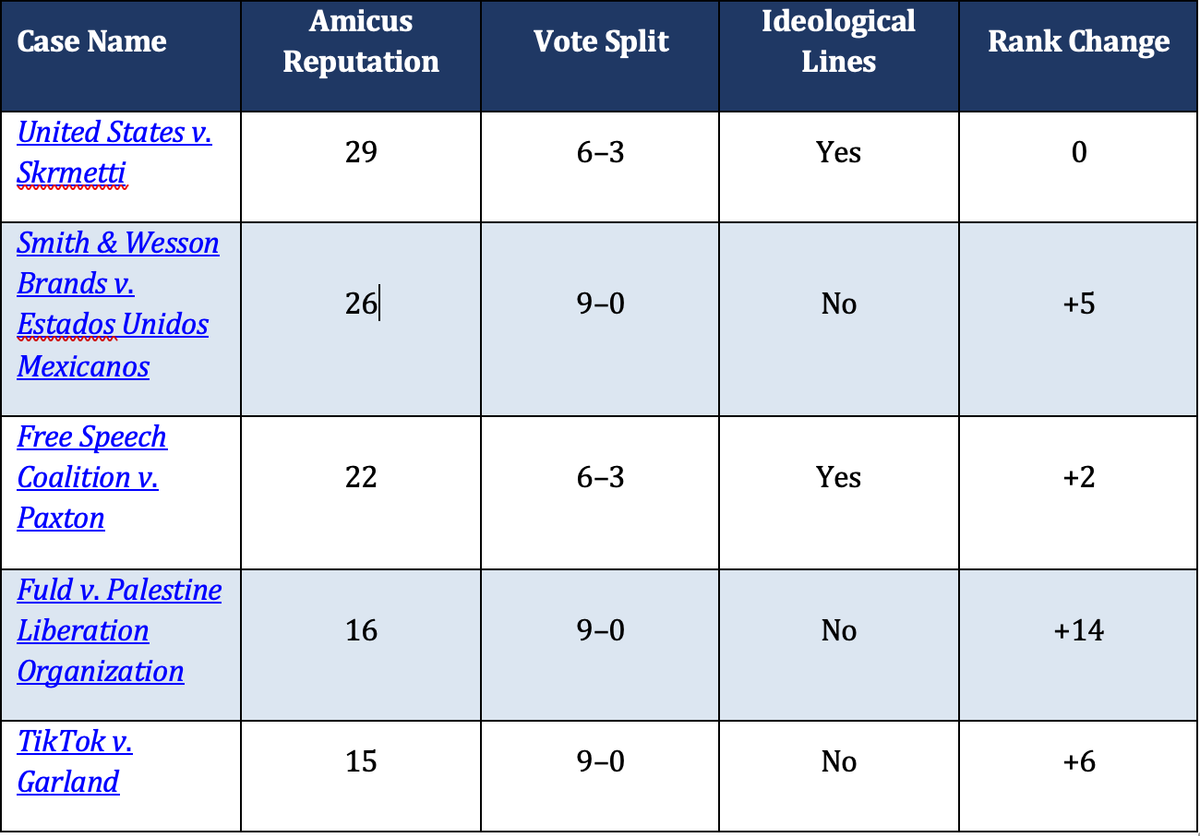
According to this metric, United States v. Skrmetti, in which the court considered state bans on certain medical treatments for transgender minors, was last term’s most salient case. Smith & Wesson, on whether Mexico was allowed to sue gun manufacturers, came in second. Next was Free Speech Coalition v. Paxton, asking if a Texas law requiring age verification for websites that published sexually explicit content violated theFirst Amendment. Fourth was Fuld v. PLO, concerning whether the Palestinian Liberation Organization could be sued under the Antiterrorism Act of 1990. And finally was Tiktok v. Garland, which considered if the First Amendment blocked a federal law requiring TikTok to divest from Chinese control to operate in the United States.
Supreme Court cases 2023–24 term
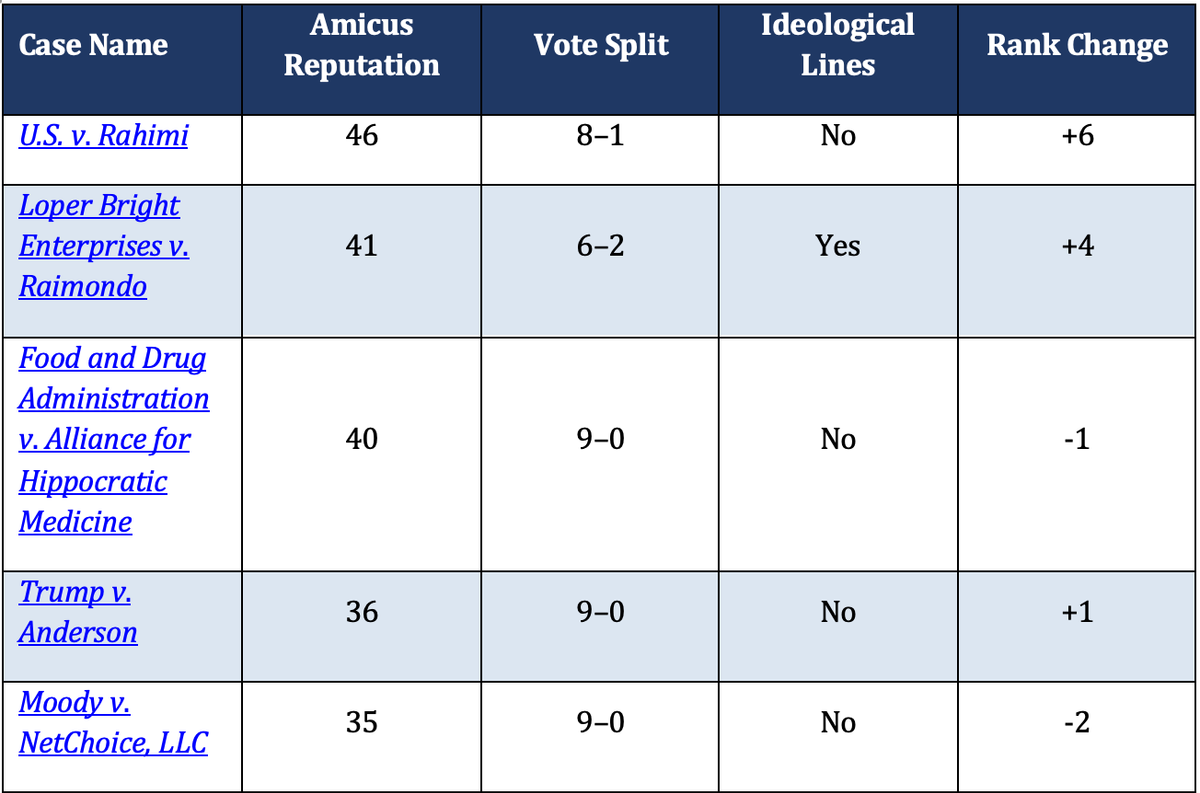
With regard to the 2023-24 term, United States v. Rahimi, which dealt with whether Second Amendment rights applied to someone with a domestic violence restraining order, topped the list. Loper Bright Enterprises v. Raimondo, on deference courts give to an executive agency’s interpretation of the law it administers, came next. This was followed by FDA v. Alliance for Hippocratic Medicine (on regulatory actions regarding the abortion drug mifepristone); Trump v. Anderson (on whether a state could remove Donald Trump from the ballet under the insurrection clause of the 14th Amendment); and Moody v. Netchoice, LLC (on state laws regulating social media).
Supreme Court cases 2022–23 term
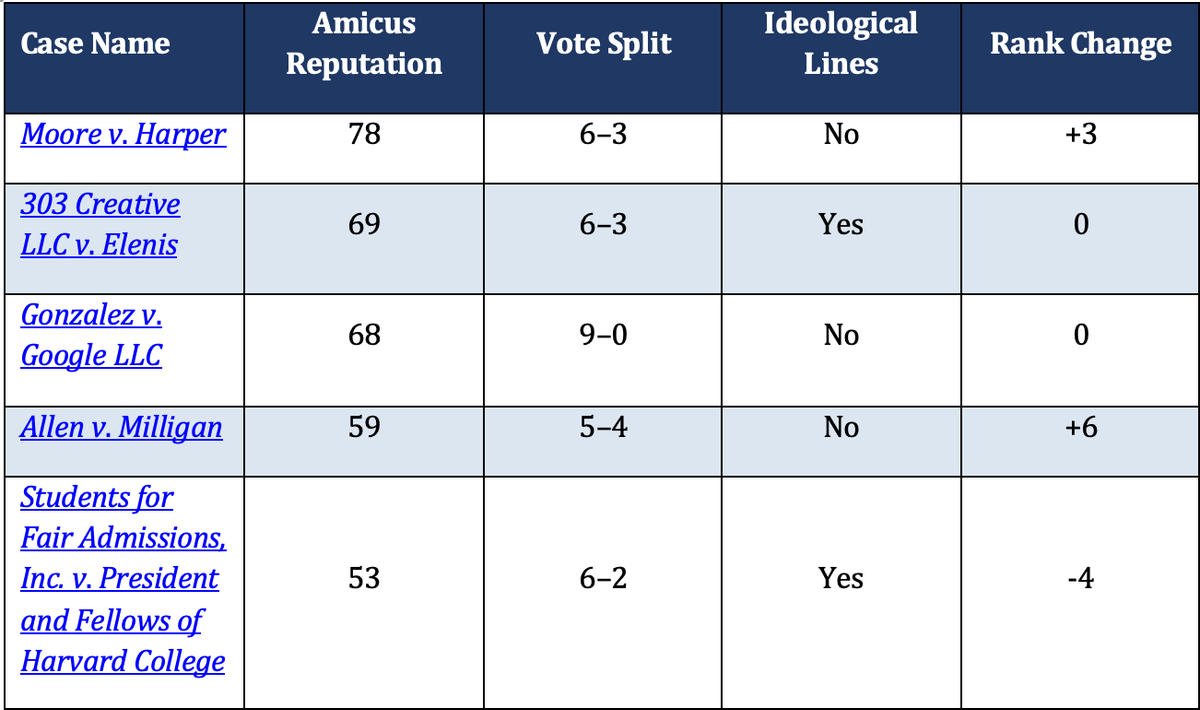
Lastly is the 2022-23 term. Here, the lead case was Moore v. Harper, which rejected the independent state legislature theory on how much control a state legislature possesses over elections, followed by 303 Creative LLC v. Elenis (on designing websites for same-sex weddings); Gonzalez v. Google LLC (on government regulation of speech on social media – a common theme among the most salient cases); Allen v. Milligan (on the Voting Rights Act); and Students for Fair Admissions v. President and Fellows of Harvard College (on affirmative action in college admissions).
What this tells us
Based on the above, two patterns stand out. First, the cases that climb to replace the previous top five are, somewhat strikingly, not civil rights cases. Instead, these were focused on institutional stakes, administrative power, and economic regulation. In the 2022-23 term, Moore v. Harper rises to first, Allen v. Milligan climbs from 10th to fourth, and Biden v. Nebraska – whether the Biden administration had the power to forgive approximately $430 billion in student loans under a particular statute – moves up to sixth. In the 2023-24 term, United States v. Rahimi and Loper Bright Enterprises v. Raimondo, both previously outside the top five by raw count, jump to first and second. And in the 2024-25 term, Smith & Wesson rises to second, Fuld v. Palestine Liberation Organization to fourth, and TikTok v. Garland to fifth. Many of these cases did not dominate the news, but they are the cases that draw the filers whose briefs the court takes seriously.
Perhaps the biggest omission in the top five is Trump v. United States, the presidential-immunity case I singled out last time as undersold by the raw count, which here climbs from 10th to eighth. But this may be explained by an expedited timeline of 19 days to file a brief compared to the more typical six weeks, which likely reduced the number of filers.
Second is the prevalence (or relative lack thereof) of decisions decided along purely ideological lines. In my original article, the raw count largely cut against the popular narrative that the most important cases all break down along the familiar 6-3 conservative-liberal split. Weighting amicus briefs by reputation barely changes that conclusion. Among the 15 top five cases across the three terms, the number decided along ideological lines edges down only slightly, from six under the raw count to five under the weighted one. According to this measure, 23 of 28 (82%), 17 of 25 (68%), and 23 of 28 (82%) of the most salient cases were not decided along ideological lines. Stripping out the expressive filings, in other words, does not make the court look any more or less partisan. The 6-3 narrative remains real in a handful of marquee cases, but a large majority do not support this.
The current term
As I did last time, I also took a close look at the most recent term, in which the final opinions were handed down in argued cases last week.
Supreme Court cases 2025–26 term
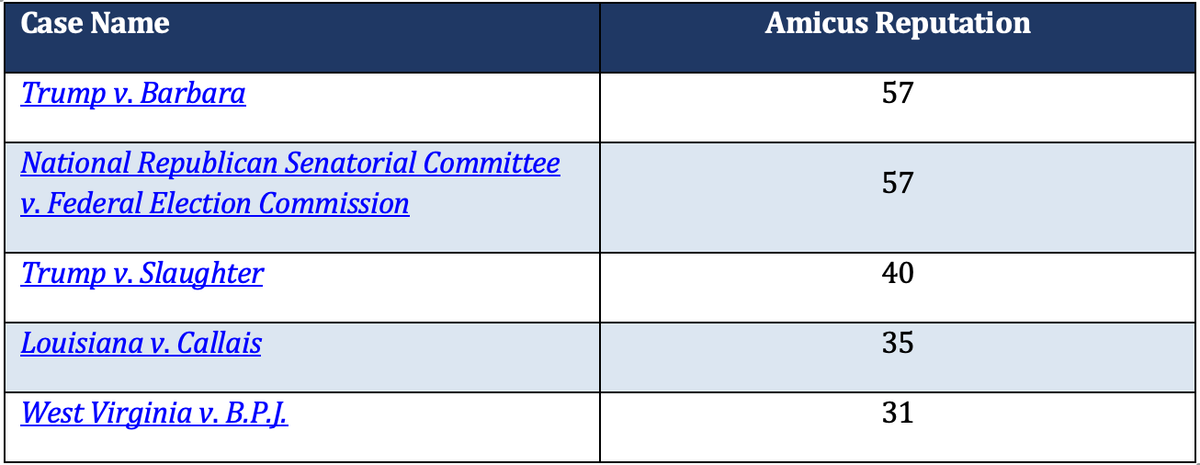
Trump v. Barbara, on the president’s order ending birthright citizenship, and the NRSC’s campaign-finance challenge tied for first. Trump v. Slaughter (on the independence of federal agencies), Louisiana v. Callais (on the Voting Rights Act), and West Virginia v. B.P.J. (on transgender athletes) rounded out the top five. These cases include two on elections, one on administrative power, and two on civil rights.
The measure is still imperfect. Learning Resources, Inc. v. Trump – the challenge to the president’s power to impose tariffs under the International Emergency Economic Powers Act, and by any account one of the most consequential cases of the term – sits just outside the top five under both the raw and the weighted measures. But, as was the case with Trump v. United States, there is good reason for this: Like several recent blockbusters, Learning Resources was expedited, giving potential amici far less time than usual to file, which likely led to fewer briefs.
We can also see how many of the cases with high amicus reputation were decided along ideological lines. Three of the top five cases fit the 6-3 narrative, with Trump v. Barbara and West Virginia v. B.P.J. being the exceptions. When looking at all the above median cases for amicus reputation, however, 29 of 38 of these (74%) were not decided along ideological lines, very similar to the previous three terms.
Conclusion
Counting amicus briefs is a useful way to spot important cases before they are decided, but not all briefs carry the same information. Weighting each case’s filers by how often the court has actually cited them helps reveal the cases that genuinely matter while shedding some of the noise from briefs filed primarily to make a statement rather than to persuade the justices. The result is a list that leans less on civil-rights flashpoints and more on the quieter questions of procedure, administrative power, and economic regulation that court watchers – if not the public – tend to recognize as of profound importance.
Based on this, we can also say that only a third of the very top cases – and only about a fifth of all above-median cases – were decided along ideological lines. The image of a court that splits 6-3 on everything that counts is, once again, real in a few high-profile cases and overstated across the docket as a whole. The conservative-liberal divide is certainly not an illusion. But it is far from the full story.