
I’ve become an unequivocal fanboy for Capital One’s incredible shopping offers over the last few years. I’ve written extensively about Capital One Shopping (the public shopping portal) and some of the absolutely bananas offers on hand. Many readers have been equally as excited about Capital One Offers (exclusively for Capital One cardholders).
The difference between the two is that Capital One Shopping offers rewards that can only be redeemed for third-party merchants, and the available selection changes over time. Capital One Offers are only for Capital One cardholders and are found within a Capital One login, so they offer the opportunity to earn either miles or cash back (depending on your card). There’s often some discrepancy in the payout rates between the two; lately, that has really made me consider when to choose which portal. Is 15X miles better than 20% back in gift cards? What about when the rate climbs to 30% or 35%? Which should you choose, and how do you decide?

Capital One Shopping doesn’t always track well (but I’ve had success)
Before getting too deeply into a discussion about Capital One Shopping versus Capital One Offers, one has to address the fact that tracking is far less reliable through Capital One’s shopping portals than it is through other portals. We hear more issues from users of Capital One Shopping than Capital One Offers, but we get failure reports about both more often than about other portals.
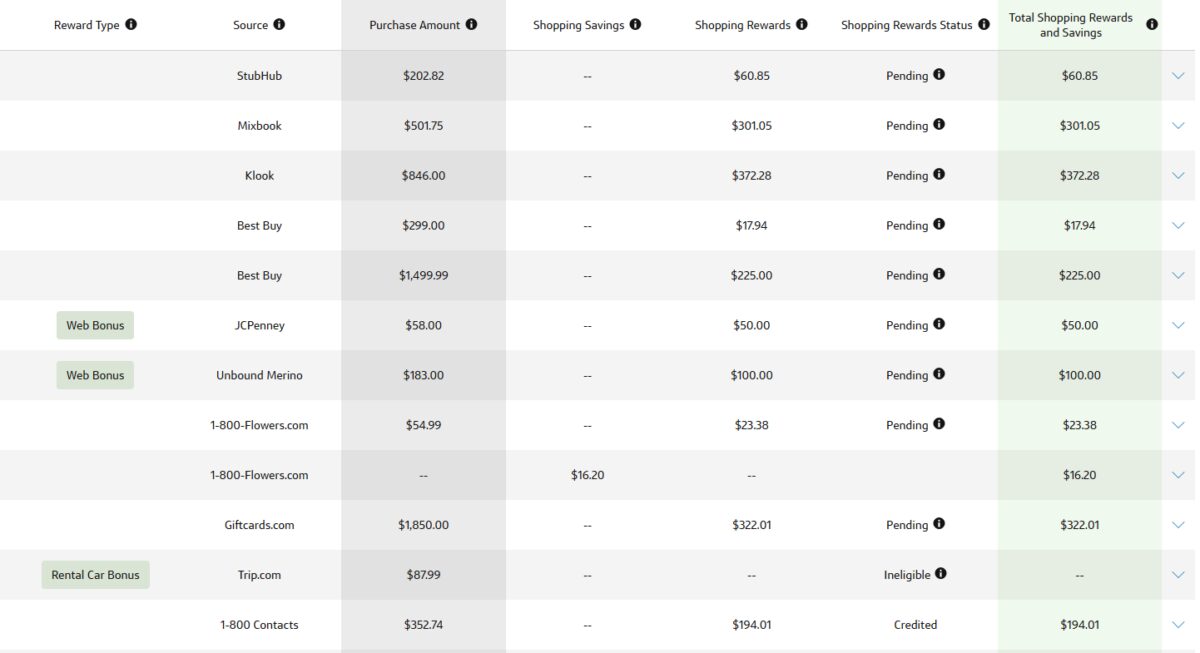
I have been largely successful having orders track correctly through Capital One Shopping. Here are just some of my recently tracked purchases:
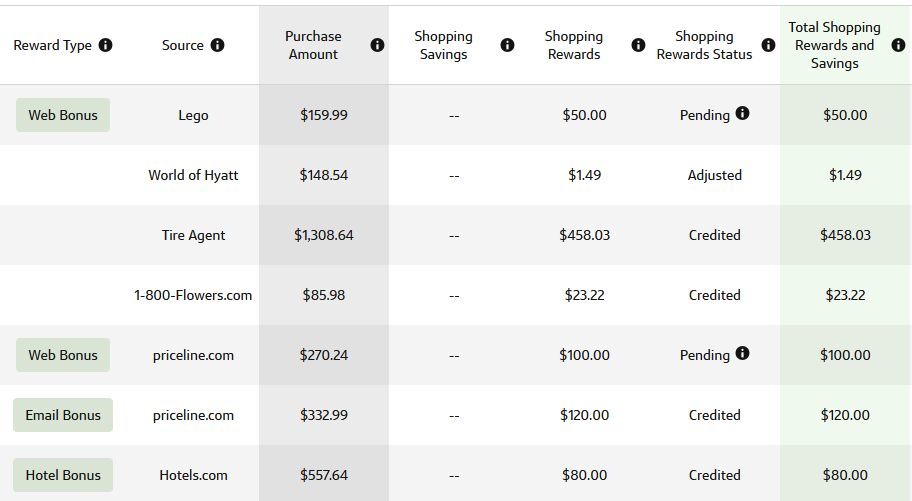
My wife has been similarly successful as of late:
While we mostly have great success with Capital One Shopping, we had a recent frustration. Just a few days ago, there was an offer for Klook that didn’t track at the right rate. In that case, I expected to get 56% back on tickets to Busch Gardens in Tampa, FL (which had tickets for sale on Klook for about the same price as the Busch Gardens website for our date). Instead, we got 44% back. That’s annoying. Thankfully, that rarely happens to me (for what it’s worth, at least one reader notes that it is a common problem on Klook purchases, across portals). I was still perfectly happy with 44% back in that case, but it’s definitely a harder portal to rely on than many other shopping portals.
That said, the crazy payouts often make it worth the risk for me. Notice examples above like $194 back on a $352 purchase from 1-800-Contacts, or $50 back on a $58 purchase at JCPenney. I’ve had so many of those successes that I took the Klook miss with a grain of salt.
Others have sworn the portal off because of difficulty tracking a big purchase. I can understand that.
In my case, when I’m making a purchase that’s highly reliant on the portal rewards, I’ll often wait until I see the rewards tracked properly before I make a final decision on keeping whatever item it is that I’m buying.
Obviously, there are some situations where you don’t have that option. Whether or not Capital One Shopping / Offers are worth the risk of their sometimes broken tracking is hard to say. I’ve had very good luck earning a lot of rewards between my account and a couple of family members. Your mileage may vary, for sure.
I should probably add that there are some merchants where I expect tracking to be less reliable. Omaha Steaks is an example that comes to mind. To be clear, I don’t know whether Omaha Steaks is prone to bad tracking, but I know that you’ll get different prices at Omaha Steaks depending on how you arrive at the site (from a Google search, an ad, etc). And if you have a “gift card” to use at Omaha Steaks, it gets entered like a promo code (or at least, that was the case in the past). Entering a unique promo code that wasn’t provided by the portal is very likely to interfere with your shopping portal rewards.
A site like that, where the price varies depending on where your click originates, and where gift cards are entered like promo codes, feels ripe for tracking issues (likely through many different portals). I tend to avoid making purchases at many of those types of stores. I also avoid signing up for a site’s email list in exchange for a 10% off coupon when I’m clicking through a high rewards offer like 40% back, because those email coupons are usually unique codes that could invalidate the rewards, and that’s not a trade I’m willing to make. I don’t tend to have problems purchasing from major retailers, department stores, electronics stores, etc.
My most consistent problem has been Avis car rentals. I no longer click through Capital One Shopping to Avis, as those rentals never track properly for me. But I’m not going to eschew $194 back on my wife’s contact lenses because Avis tracks poorly. To each their own on that.
Gift card rewards should be valued below face value
While I am bullish on Capital One Shopping, I don’t value the rewards earned through Capital One Shopping at full face value.
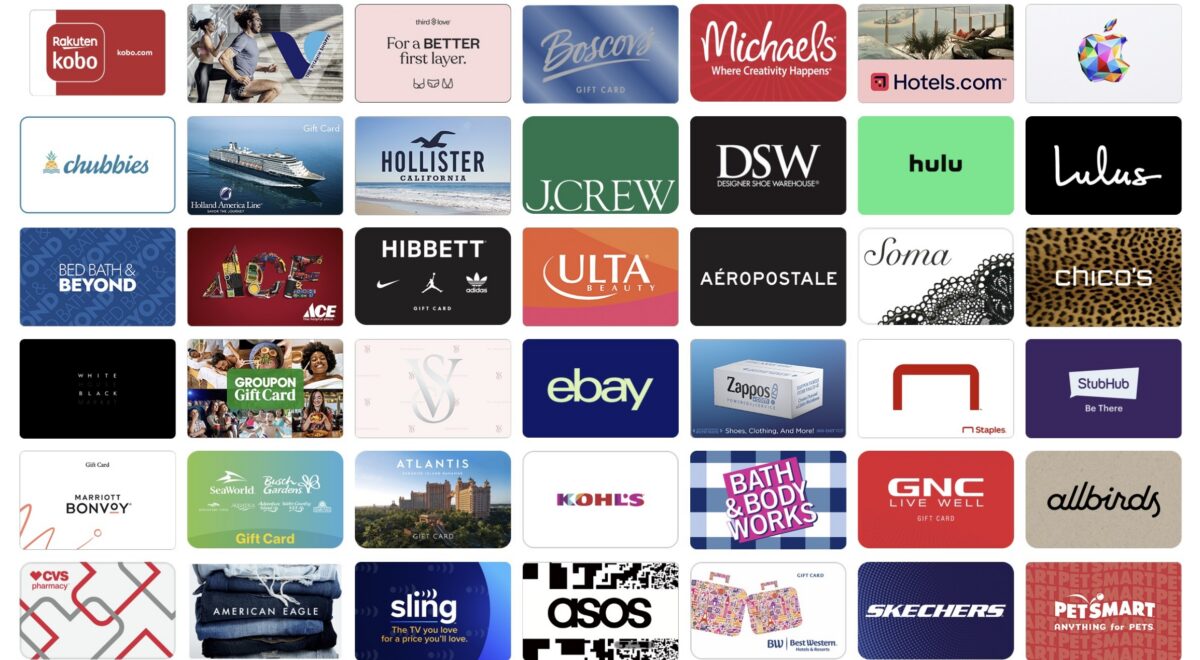
That’s because Capital One Shopping rewards can’t be redeemed directly for cash, but rather only for third-party gift cards. Furthermore, the third-party gift card merchant selection can vary, which can suddenly limit the utility of those rewards depending on your use case and needs.
Additionally, many of the third-party merchant gift cards available can regularly be purchased at a discount from face value. For instance, some of the restaurant-style gift cards available for Capital One Shopping redemptions can be purchased through warehouse clubs like Costco, Sam’s Club, or BJ’s Wholesale or sometimes from grocery stores or even Amazon.com at a discount from face value.
It is correct to discount the value of the Capital One Shopping rewards, depending on your redemption patterns and needs. Personally, I have redeemed the vast majority of my Capital One Shopping rewards for either Marriott gift cards or Hotels.com gift cards. I’ve used Marriott gift cards at times when using points doesn’t yield enough value or to cover food and drinks in expensive locations, like when we went to Bora Bora last year. I’ve used Hotels.com gift cards to book properties that aren’t available via rewards programs, like stays at a couple of indoor waterpark properties, or at an independent hotel in Italy earlier this year (and as you can see above, my wife earned $80 back on that Hotels.com reservation, which was paid for with gift cards redeemed from Capital One Shopping).
But I have also redeemed gift cards with the intention to convert them to cold, hard cash.
My solution: I value based on the selling price
My imperfect solution has been to value Capital One Shopping rewards based on the price at which I can sell gift cards that I redeem.
Giftr cards for some brands can routinely be sold for 85-90% of face value, depending on your gift card resale relationships. Rather than expect the best, and for the sake of quick math, I typically value Capital One Shopping rewards at 80% of face value, knowing that I can get that much or more on the resale market.
That means that a return of “30% back” on Capital One Shopping is like 24% back (or better) in actual cash value.
In other words, if I make a $1000 purchase and get 30% back from Capital One Shopping, I earn $300 in rewards that can be redeemed for gift cards. I value that at $240, since I know I can redeem for a gift card that sells for that much or more.
This effectively means that I value 1 cent of Capital One Shopping rewards at 0.8c ($0.008). I am intentionally being a little conservative; it is quite often possible to sell some third-party brands for more.
That gives me a “cash” value of Capital One Shopping’s funny money, which is helpful for comparison.
Capital One Shopping or Capital One Offers: Which is better?
Both Capital One Shopping and Capital One Offers are known for big targeted offers that easily eclipse what you can expect from other shopping portals. However, Capital One Shopping rates frequently feature a higher numerical rate.
For instance, yesterday, Capital One Offers showed me 25X miles at TireAgent.com. That’s a terrific multiplier for Tire Agent (the next best option was 9X Virgin Atlantic miles, but most programs were offering 4-6X).
At the same time, Capital One Shopping showed a headline rate of 30% back. Which is better, 25X or 30% back?
At first blush, you might point to our Reasonable Redemption Value of Capital One miles and say that, since Capital One miles are worth about 1.45c per mile, then 25X Capital One miles is like an effective return of 36.25% in value (since you can reasonably expect to get 1.45c in value or better for each mile redeemed when transferring to Capital One’s airline partners).
In the previous section, I noted that I value Capital One Shopping “cash back” rewards (which can only be redeemed for gift cards) at 0.8c per “penny”. That makes the 30% cash back worth an equivalent of 24% back in cash value.
Based on that calculation, shopping through Capital One Offers seems like the much better decision, but is that true?
Using Capital One Offers to earn miles has real opportunity cost (and feels to me like buying miles)
As I contemplated some big purchases over the past week, I realized that there’s another way of looking at it: using Capital One Offers to earn miles feels to me like “buying” miles.
Consider my $1000 purchase example. At 25X miles, I would trade $1,000 of my real dollars today to buy both my item and 25,000 miles. If I could alternatively get 30% cash back through Capital One Shopping, I could get my purchased item and a $300 gift card. Assuming I could sell that gift card for 80% of face value, that’s $240 in actual cash.
While the miles could potentially be redeemed for more value, choosing to earn miles costs me the opportunity to earn $240. Imagine two bags on a table in front of me: one has $240 in it, and the other has 25,000 miles. Would I choose to pick up the 25,000 miles and leave the $240 behind on the table?
Taking those miles instead of the $240 would feel to me like buying miles at a cost of 0.96c per mile, since I’d be giving up that kind of cash in exchange for the chance to earn miles.
For some folks, buying miles at just under 1c per mile would be an easy trade. For those flush with points, it might feel like a high price. For me, it felt like a high price.
The economists among us would also point to the “time cost of money”. By earning miles, I tie up all $1000 until a “someday” redemption comes along. By choosing gift card rewards, I have the chance for $240 back in my pocket “now” (or pretty soon, depending on how long rewards from my desired merchant take to become available). I would ultimately pay out a net $760 in real money after selling the gift card (I assuming I did so in short order).
If I had a near-term redemption in mind for the miles, choosing miles could clearly be far better. Even if I just used the Capital One miles to erase a travel purchase, I could erase a $250 purchase with the miles. That probably makes more sense than taking $240.
But if I didn’t have a near-term use, I have to consider whether it is worth tying up that extra $240 now and until that redemption day arrives. If I don’t use those miles for a year or two or three or five, and if I make that type of decision regularly, I could tie up a lot of capital waiting for “the one” (yes, I am proud of that pun).
And while you may be convinced that Capital One Offers was the better choice in the described scenario, consider that, in reality, I got a far better targeted offer that might change your perspective.
Targeted offers make choosing miles feel expensive

While you might think Capital One Offers was the better choice for a Tire Agent purchase based on the headline rates, the discussion becomes more interesting when we consider Capital One Shopping’s targeted offers.
In reality, I got a targeted offer for 60% back at Tire Agent on my wife’s Capital One Shopping account. That changed the math considerably.

At first glance, some would still shrug off Capital One Shopping, considering that the rewards can only be used for gift cards, not for outsized value, while the miles could be used for a premium cabin redemption worth far more than 1.45c per mile.
While it is true that the miles can be redeemed for very high value, at what acquisition cost does it become too expensive?
Consider my 60% back offer: Using Capital One Shopping for my $1,000 purchase would mean earning a $600 gift card versus earning 25,000 miles through Capital One Offers.
If I sold that gift card at just 80% of face value, that’s $480 in cash. If you could choose a bag full of $480 in cash or 25,000 miles, does that change the equation for you?
It certainly did for me. Giving up the chance for $480 in cash value would feel a lot like paying 1.92c per Capital One mile. I could either pay $1,000 in cash out of pocket in exchange for the tires and 25,000 miles, or I could spend $1,000 for the tires and then sell the gift card money for $480 (and put that $480 back in the bank to save/invest/whatever else).
That just feels like too high an opportunity cost to take miles.
(Not relevant to the points above: There was also both a Citi Merchant Offer and an Amex Offer for 15% back at Tire Agent, which stacked really nicely on top of that 60% back when helping a family member buy tires yesterday!).
To be clear, I don’t mean that everyone should come to the same conclusion. If I had 0 miles, or if I were 25,000 miles short of a valuable redemption for my family, I might value the miles enough to accept the opportunity cost.
However, sitting on enough miles to cover my family’s travels for at least the next year or two, I couldn’t see tying up the money.
More importantly, I couldn’t see making that decision again and again. If you 10x my situation up to $10,000 in purchases that could earn 250,000 miles or $6,000 in gift cards that I could resell for $4,800, I’d have a hard time taking the miles unless forgoing them would mean that I’d be buying flights and hotels out of pocket that would cost me more than $4,800.
The question you need to answer is what opportunity cost you’re willing to forgo for the miles
The examples above are real-world illustrations that represent the actual dilemma I’ve faced lately: when do I choose Capital One Shopping for the gift card rewards, and when do I eschew what could be a very good cash back return in order to earn more “someday” miles?
I think it really comes down to deciding your opportunity cost threshold. How much opportunity are you willing to turn down per mile?
Everyone has their tipping point. Would you choose to earn 1 mile per dollar spent over earning 1.5c? What about 2c? If you could earn 10c or 1 mile, would you choose one mile? You have to figure out where to draw the line.
I find that the targeted Capital One Shopping offers have been pushing me toward that line.
The tire purchase was a great example, since I was trying to help someone else save money on their tires. They wanted to spend as little as possible out of pocket, but they were letting me make the purchase to earn credit card rewards.
Because their goal was to spend as little as possible, the following stack made sense:
- Click through Capital One Shopping for 60% back
- Pay $1,000 for the tires with a card synced with a card-linked offer for 15% back, earning $150 back
- Sell the $600 in gift cards for at least $480
- Spend a net $370 on the tires
Since I was handling everything and using my card, I would just collect $370 from my friend, expecting that I would keep the $150 from the card-linked offer and the $480 from selling the gift cards to bring me back to an even $0 out of my pocket, picking up the credit card spend and the associated credit card rewards. I told my friend that they owed me $370.
In reality, I had a choice: execute the plan just like that, or:
- Click through from Capital One Shopping for 25X, earning 25,000 miles
- Pay $1,000 for the tires with a card synced with a card-linked offer for 15% back, earning $150 back
- Collect $370 from my friend
In that case, I would spend $1,000 and collect $370 from my friend and $150 from the card-linked offer, putting $520 back in my pocket. In that scenario, I would have traded $480 of my real dollars to end up with 25,000 miles. That would certainly feel a lot like buying miles.
In the past couple of weeks, I have run into exactly that sort of situation quite a few times. The miles could have been really good someday, but earning those miles would cost real cash out of my bank account. I have opted to go through Capital One Shopping more often than not.
I love miles, but I love acquiring them at a reduced opportunity cost.
This calculation extends beyond Capital One Shopping/Offers
In reality, the same opportunity cost scenario exists each time we choose to earn miles or a transferable currency over earning cash back. The difference is just that, whereas the tire purchase took money out of my bank account proactively, the miles-versus-cash-back trade often happens on the front end.
In other words, let’s say I had the Robinhood Gold card, which earns 3% cash back. If I choose to use a card that earns 2 transferable points instead of using the Robinhood Gold card, I would be forgoing 3 pennies for every 2 miles. That’s giving up 1.5c for every mile earned.
The truth is that I do make that sort of trade regularly. I don’t feel it, since those rewards aren’t pennies in my bank account but rather potential of pennies. That often puts the choice out of sight, out of mind. Capital One Shopping vs Capital One Offers brings the choice front-and-center.
The bottom line is that, while I do love transferable rewards (and the associated premium cabin flights and luxury hotels), those things do come at a cost. When you’re deciding whether to earn those transferable currencies, don’t focus so much on the potential value that you lose sight of the real cash value that you could have instead.
Of course, if you have a cash back Capital One credit card, you can sort of have the best of both words, choosing to earn cash back through Capital One Offers, which could then be converted to miles at a rate of $0.01 to 1 mile if you also have a miles-earning Capital One card.
The post Capital One Shopping vs Capital One Offers: Choose your own opportunity cost appeared first on Frequent Miler. Frequent Miler may receive compensation from CHASE. American Express, Capital One, or other partners.